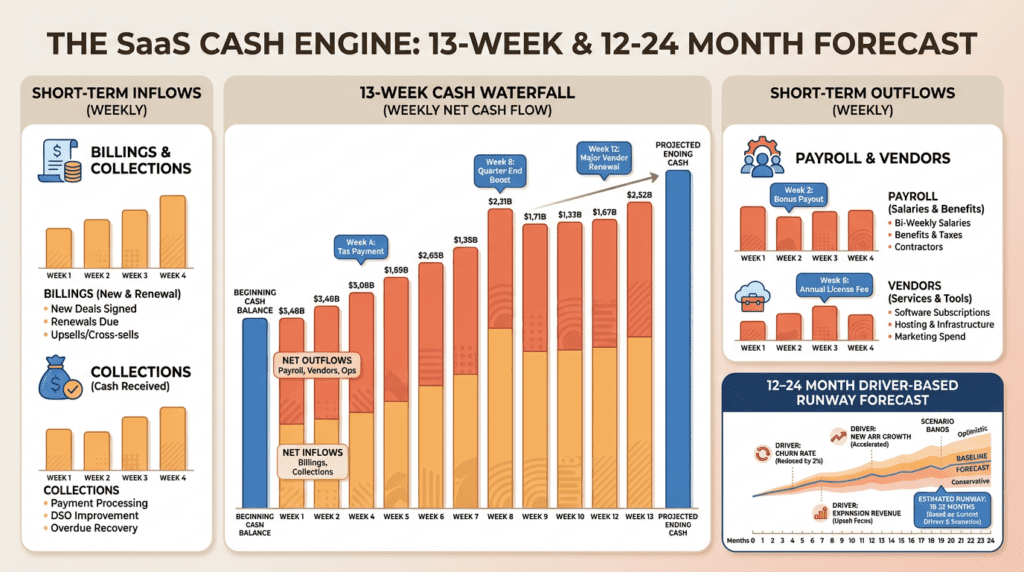
A 13-week cash flow model provides essential weekly visibility into your business’s liquidity, enabling proactive management of cash during periods of growth, seasonality, or operational complexity.
This forecasting approach aligns with natural business cycles and creates a disciplined, rolling process that helps prevent cash surprises and supports confident, data-driven decisions.
Implementing a 13-week cash flow model is especially valuable for companies facing rapid growth, unpredictable collections, or lender requirements, and can be effectively managed by a CFO or Fractional CFO.
Your profit-and-loss statement might show healthy margins, but your bank account tells a different story. Cash gets tight long before financial statements reveal trouble, leaving even profitable companies struggling to maintain consistent payroll timing. This timing gap between earning revenue and collecting cash has blindsided countless growing businesses.
Most companies discover this reality during their first cash squeeze, which is precisely when the question “Do we need a 13‑week cash flow model?” becomes urgent. A 13-week cash flow model transforms this reactive scramble into proactive leadership control. It gives you weekly visibility into liquidity, timing, and trade-offs that keep growth sustainable and help companies stay strategic during challenging periods.
Ready to turn cash surprises into strategic decisions? Ascent CFO Solutions helps growing companies implement comprehensive forecasting models that scale with their ambitions.
The Strategic Case: Why 13 Weeks Is the Right Horizon for Growing Businesses
Most growing companies have enough revenue but struggle with when cash actually arrives versus when bills are due. The benefits of a 13-week cash flow model for startups and scale-ups become clear when you realize this horizon perfectly matches how your business actually operates.
Operating Cycles Drive the 13-Week Sweet Spot
Your business runs on predictable cycles that repeat within a 13-week period. Customer collections typically span 30-90 days, payroll hits every two weeks, and inventory turns happen monthly or quarterly. As Yale School of Management research demonstrates, these working capital cycles create scheduling mismatches between when you book revenue and when cash actually arrives. A 13-week window captures these full cycles, giving you enough visibility to see problems coming and enough time to act.
This Operational Alignment Becomes Actionable Through Weekly Decision Cadence
The weekly structure of a 13-week model forces decisions that monthly forecasts often miss. EisnerAmper’s analysis shows how weekly granularity surfaces mid-month cash crunches that could derail payroll or vendor payments. When you can see that Week 7 will be tight, you make different choices about hiring in Week 3, inventory purchases in Week 5, or vendor payment coordination. This granular view transforms vague cash concerns into specific, actionable decisions.
Rolling Updates Transform Reactive Management Into Strategic Rhythm
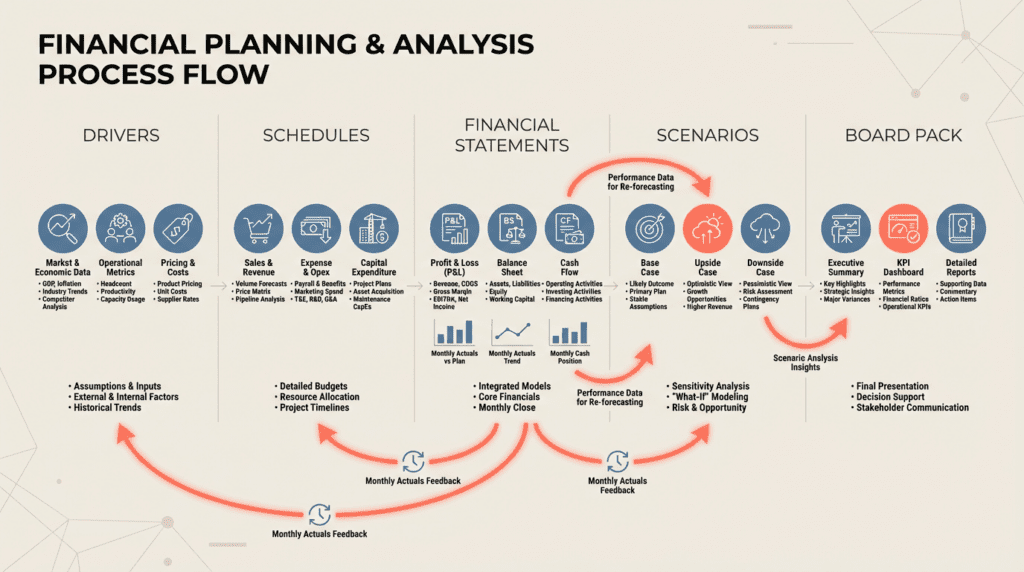
The strategic advantage becomes clear when your 13-week model becomes a rolling process. Each week, you compare forecasts with actuals to identify gaps, update assumptions, and add Week 14 to maintain constant forward visibility. This weekly rhythm shifts your leadership team from fighting cash fires to making proactive decisions about growth investments, vendor negotiations, and financing sequencing. Comprehensive forecasting models help finance, operations, and sales start speaking the same language about cash impact and coordination.
What Is a 13-Week Cash Flow Model? Definition, Structure, and Cadence
A 13-week cash flow model is a weekly forecast that tracks actual cash coming in and going out of your business over the next three months. Unlike traditional financial statements that include non-cash items like depreciation, this model focuses purely on cash receipts and disbursements. The 13-week timeframe covers one fiscal quarter, giving you enough visibility to make informed decisions while staying accurate enough for weekly planning.
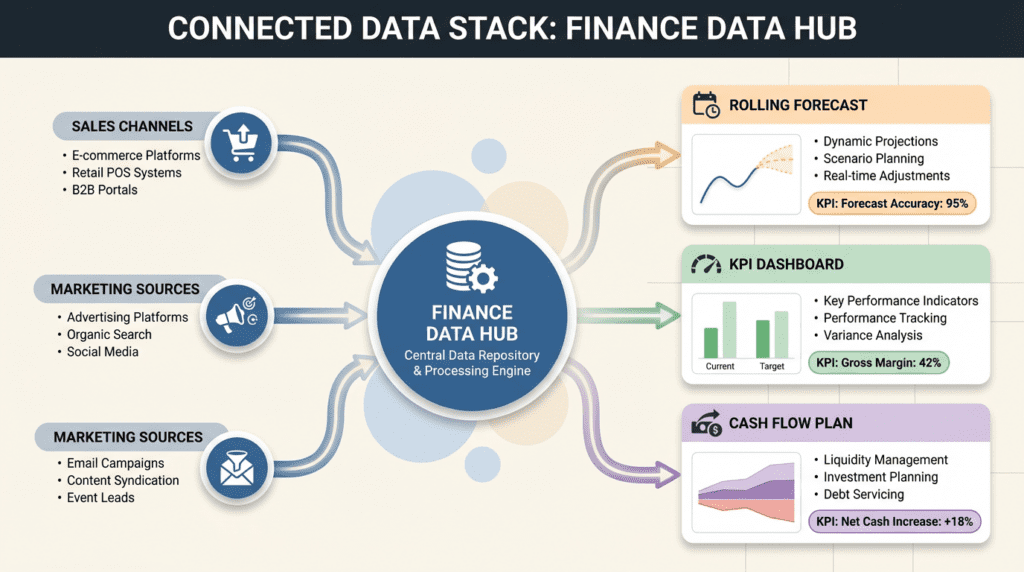
To build this visibility, the model pulls data from multiple sources across your business: accounts receivable aging reports show when customers will pay, accounts payable schedules reveal vendor payment timing, and payroll calendars show payroll timing. Sales pipeline data reveals when deals will close and payments arrive, while inventory purchase plans and debt service schedules complete the cash picture. What makes these models powerful is their rolling nature – each week, you replace forecasted numbers with actual results, update your assumptions, and add week 14 to maintain continuous 13-week visibility. This weekly rhythm transforms cash management from reactive scrambling into proactive cash flow forecasting, giving leaders the financial visibility needed to protect payroll and growth investments.
Who Needs a 13-Week Cash Flow Model? Triggers and Fit by Stage
Every company can benefit from weekly cash visibility, but certain growth patterns and operational realities make a 13-week model invaluable. The question isn’t whether you can afford to implement one, but whether you can afford the surprises that come without it.
Growth-stage companies experiencing working capital stress should adopt the model before cash gets tight. When your business faces longer supplier lead times, larger purchase orders, or lumpy enterprise deals that create unpredictable collections, weekly visibility prevents growth from outpacing your ability to fund operations.
Companies with seasonal revenue swings or irregular cash patterns benefit from weekly forecasting to protect payroll and maintain vendor relationships. Whether you’re managing seasonal fluctuations in construction or dealing with subscription churn, the 13-week model gives you advance warning to secure financing or adjust spending.
Founder-led teams transitioning from hands-on to systematic operations use the model to align finance decisions with sales, operations, and procurement. As your company scales beyond what you can manage intuitively, the weekly forecast becomes the strategic planning tool that keeps all departments working from the same cash reality.
Companies approaching $2-$10 million in revenue typically hit the growth stage where monthly financial statements aren’t enough. At this stage, cash flow management becomes more sophisticated than tracking your bank balance, and weekly visibility prevents small timing issues from becoming payroll challenges.
Businesses preparing for fundraising, acquisition, or debt financing need the model to demonstrate financial discipline to investors and lenders. The 13-week forecast shows you can manage liquidity proactively rather than reactively, which builds confidence in your ability to scale responsibly with comprehensive forecasting models.
Growing companies often wonder whether they need the discipline of weekly cash forecasting or if monthly snapshots are sufficient. These questions address the practical decisions around timing, implementation, and ownership that business leaders face when considering more structured liquidity management.
How do you know if your business needs a 13-week cash flow model?
Your business needs a 13-week model when growth stresses working capital, collections become unpredictable, or you experience cash timing issues despite strong revenue. According to the AICPA, cash flow forecasts are essential for monitoring liquidity when risks are heightened. If you’re making reactive decisions about vendor payments or hiring timing, you need weekly visibility.
When should a company implement a 13-week cash flow forecast?
Implement before cash gets tight, not after. CBIZ research shows companies often wait until lenders require forecasts during financial stress. The optimal time to implement is when you hit $2-10M revenue, add complexity like multiple entities or debt, or shift from founder-led to systematic processes. The model prevents surprises rather than reacting to them.
Who is responsible for managing a 13-week cash flow model in a growing business?
The CFO-level financial leadership owns the process, with input from operations, sales, and procurement teams. GTreasury notes that CFOs and finance heads typically drive forecast processes because controllers often lack strategic forecasting skills. For growing companies without full-time CFOs, a Fractional CFO can establish and maintain the model or train internal teams.
What happens if you skip implementing a structured cash forecast?
You risk payroll timing issues, missed vendor payments, and reactive decision-making that constrains growth. Companies often discover cash problems too late when relying on bank balances or monthly reports. Professional cash flow forecasting prevents operational disruption and maintains stakeholder confidence during growth phases.
How often should you update a 13-week cash flow forecast?
Update weekly, rolling forward one week each cycle. The Controllers Council emphasizes that 13 weeks is long enough to spot trends but short enough to correct course quickly. Weekly updates and comparisons to actual results keep assumptions fresh, integrate actual results, and maintain the discipline needed for accurate liquidity planning.
Next Steps: Implement, Operationalize, and Scale With Confidence
A 13-week cash flow model transforms liquidity from reactive fire drills into proactive leadership decisions. Companies that stand up rolling forecasts gain weekly visibility into cash timing, enabling smarter choices about hiring, vendor payments, and growth investments before cash gets tight.
The path forward is clear: build a rolling weekly model, establish a weekly cash meeting rhythm, and integrate your AR, AP, payroll, and pipeline data into a single, integrated forecasting platform. This operational discipline separates growing companies that scale confidently from those that struggle when cash flow blind spots create unexpected shortfalls.
Ready to strengthen your liquidity planning? Ascent CFO Solutions delivers comprehensive cash flow forecasting for scaling businesses, helping you build the rolling models and weekly governance that turn cash visibility into competitive advantage.
Focusing on a select set of actionable KPIs—such as conversion rate, customer acquisition cost, and contribution margin—is essential for scalable and profitable ecommerce growth.
Integrating data sources and establishing a single source of truth enables real-time insights, more accurate forecasting, and confident decision-making across all business functions.
Disciplined, regular review of KPIs at operational and strategic levels empowers ecommerce companies to proactively adjust strategies, optimize spend, and avoid costly mistakes from fragmented or delayed reporting.
Most ecommerce companies drown in data but starve for insights. Growth stalls not from lacking metrics, but from tracking vanity metrics that disconnect from profit and cash flow. The difference between scaling sustainably and burning through runway lies in choosing the right performance indicators.
The solution requires strategic focus. What KPIs should an ecommerce company track?, The answer demands linking traffic quality, conversion efficiency, contribution margin, and retention into a single source of actionable insights. This guide delivers a CFO-grade framework for the fifteen metrics that directly influence budgeting, forecasting, and scalable growth decisions while avoiding the costly mistakes of delayed reporting.
Partner with Ascent CFO Solutions to build the KPI dashboard that transforms your data into profitable growth strategies.
Defining Ecommerce KPIs That Drive Scalable Growth
Building an effective ecommerce KPI framework starts with mapping metrics to your growth engine: acquire, convert, fulfill, and retain customers. Each KPI must directly impact contribution margin and cash flow, not vanity metrics that look impressive but don’t drive decisions. As Fast Slow Motion recommends, choose a single North Star metric like revenue per visit, then select 3-6 driver KPIs that explain performance across your entire customer journey from first click to repeat purchase.
Successful ecommerce companies adopt a review schedule that matches decision-making needs. Weekly reviews focus on granular operational KPIs like traffic and conversion rates, while monthly sessions examine strategic metrics such as customer acquisition cost and lifetime value trends. Quarterly assessments present board-level performance against growth targets and cash projections. Before scaling any marketing spend, integrate systems across ads, web analytics, ERP/OMS, and accounting to create a single source of truth that eliminates conflicting data and enables confident investment decisions.
(1/15) Conversion Rate Optimization: Turn Visitors Into Customers
Blended conversion rates mask performance gaps that drain marketing budgets. Desktop converts at roughly 1.7x the rate of mobile, while returning customers convert 2-5x higher than first-time visitors. Track these segments separately to identify where your funnel breaks down. Industry benchmarks range from 1.4% for home and furniture to 4.9% for food and beverage, but your traffic mix determines what’s realistic for your business.
Focus improvement initiatives on fixes that move the needle fastest. Checkout speed tops the list since increasing page load from one to five seconds raises bounce probability by 90%. Add clear trust signals, transparent shipping costs, and simple return policies to reduce hesitation at purchase. Set a threshold to close your gap-to-benchmark by 10-20% before scaling ad spend, ensuring each dollar works harder as traffic increases.
(2/15) Customer Acquisition Cost: Spend With Discipline
Customer acquisition cost determines your growth sustainability. Calculate it wrong, and profitable channels look unprofitable while unprofitable channels seem viable.
Most companies track only direct ad spend, missing the true cost of acquisition. Growth-focused companies include every dollar spent to win customers and use that data to make disciplined budget decisions.
Focus on these fundamentals:
Include agency fees, creative costs, and marketing overhead in your fully-loaded CAC calculation
Track CAC by channel to identify which sources deliver sustainable customer economics
Throttle spend when your LTV:CAC ratio drops below 3:1 or payback exceeds targets
Reallocate budget weekly toward channels with superior retention and contribution margins
Disciplined CAC management prevents the common trap of scaling unprofitable growth. When acquisition costs exceed your acceptable thresholds, proper forecasting helps you pivot spend before burning cash.
(3/15) Average Order Value: Increase Basket Size Strategically
Average order value represents one of your most controllable levers for revenue growth without increasing customer acquisition costs. Tiered free shipping thresholds set approximately 30% above your current AOV encourage larger baskets while protecting margins. Product bundles and complementary upsells work best when they add genuine value rather than simply pushing higher prices. Test these margin-aware tactics methodically before scaling to avoid training customers to wait for promotions.
Smart segmentation reveals where to focus your AOV optimization efforts most effectively. Direct traffic consistently produces the highest average order values at $114.78, followed closely by email and search channels, while social traffic converts at significantly lower order values. Target your highest-intent channels with premium bundles and cross-sells, then model these improvements directly into your ROAS targets and inventory planning to maintain cash flow alignment.
(4/15) Customer Lifetime Value: Monetize Over the Long Run
Customer lifetime value becomes your north star for sustainable growth when calculated correctly. Most companies get this wrong by using revenue instead of actual profit margins.
Accurate CLV calculation drives better budget decisions and prevents the costly mistake of scaling unprofitable customer acquisition. Focus on these three areas to maximize long-term customer value:
Calculate CLV using contribution margin multiplied by customer lifetime, not gross revenue totals
Track cohort retention rates monthly to spot early warning signs of declining customer lifetime value
Deploy welcome sequences and 30-day repurchase campaigns to shorten payback periods
Set acquisition spend limits when CLV:CAC ratios drop below 3:1 thresholds
Prioritize product lines and channels that generate customers with proven repeat behavior
Companies like Klaviyo report 14-month payback periods by measuring contribution margin recovery against marketing spend. Follow this same discipline in your LTV tracking to guide budget allocation and product decisions, and avoid the red flags that undermine growth stories.
(5/15) Cart Abandonment Rate: Rescue Intent at Checkout
Cart abandonment rate reveals where purchase intent meets friction in your checkout flow. The global average sits at 70.22%, but mobile abandonment runs significantly higher at 79.61% compared to desktop’s 67.29%. This device gap signals specific optimization opportunities: mobile-first checkout design, faster load times, and simplified forms. Track abandonment by traffic source and device using tools like Ascent CFO Solutions’ KPI tool for ecommerce companies to identify your largest revenue gaps and prioritize fixes.
Deploy triggered recovery emails within 30-60 minutes of abandonment when purchase intent remains strongest. Academic research confirms these campaigns increase online revenues, with roughly one-third of email clicks converting to purchases. Test incentive offers carefully to avoid training customers to abandon for discounts. Focus first on removing friction: 39% abandon due to unexpected costs and 19% due to forced account creation. Enable guest checkout, wallet payments, and display total costs upfront. Consider implementing custom dashboards to track abandonment patterns and recovery performance across channels.
(6/15) Gross Profit Margin: Protect Unit Economics
Your gross profit margin reveals whether each sale actually contributes to growth or quietly erodes profitability. Most ecommerce companies track blended margins that hide SKU-level losses and channel inefficiencies.
Calculate true COGS by SKU including landed costs, packaging, and handling fees to surface hidden losers
Track margins by traffic source and device to identify which channels deliver profitable customers versus price-sensitive customers
Set minimum contribution margin thresholds before scaling paid acquisition or launching promotions
Review SKU profitability monthly to discontinue or reprice products that fail to meet targets
Tie promotional calendars to inventory turns rather than arbitrary discount schedules that erode pricing power
Protecting margins at the SKU and channel level prevents profitable growth from becoming unprofitable scale. When you present margins by product line, you can make data-driven decisions about where to invest and where to pull back.
(7/15) Return on Ad Spend: Align Revenue and Efficiency
Return on ad spend becomes misleading when you rely solely on platform-reported numbers. Research shows that different attribution methods can shift ROAS by up to 63% across campaigns. Track both your platform ROAS and Marketing Efficiency Ratio (MER) to capture the full picture. MER calculates total revenue divided by total marketing spend, giving you a blended view that accounts for cross-channel effects and attribution gaps.
Beyond attribution challenges, revenue-only ROAS can hide unprofitable campaigns by ignoring your actual costs per order. Calculate contribution-margin return on ad spend using gross profit after variable costs instead of raw revenue. This approach reveals whether campaigns generate real profit, not just top-line growth. Set different ROAS targets by funnel stage since prospecting campaigns naturally show lower immediate returns than retargeting. Case studies demonstrate that accepting negative first-order margins for new customers can drive 140% revenue growth when lifetime value supports the strategy. Just like fully-loaded CAC calculations, contribution-margin ROAS prevents you from scaling unprofitable channels.
(8/15) Inventory Turnover Ratio: Balance Stock and Cash
Your inventory turnover ratio reveals how efficiently you convert stock into sales and working capital. Poor turns signal capital trapped in slow-moving products that drain liquidity and increase markdown risk.
Smart inventory management requires category-level visibility and proactive reorder policies. Focus on these tactical approaches:
Track turnover by SKU and category to identify slow movers that tie up cash and increase markdown risk
Build rolling forecasts with lead-time buffers to set reorder points without overstocking safety inventory
Schedule promotions around aging inventory to accelerate turns before markdowns become necessary
Integrate demand forecasts with procurement timing to optimize working capital without compromising service levels
Set minimum turn thresholds by category and pause reorders when inventory exceeds target levels
Companies using advanced data analysis for inventory optimization report turnover improvements from 2.5 to 3.0 times annually. As experienced fractional CFOs emphasize, inventory turn is a core metric that directly impacts cash conversion cycles and reduces the risk of obsolete inventory write-offs that can swing purchase price by 10-20% during company sales.
Effective inventory turnover management requires integrating rolling forecasts with procurement policies and promotional calendars. This coordination prevents capital from getting trapped in slow-moving stock while maintaining the service levels your customers expect.
(9/15) Repeat Purchase Rate: Build Habit, Not One-Offs
Repeat purchase rate reveals whether you’re building a sustainable business or just handling one-time sales. Track repurchase behavior in 30, 60, and 90-day windows by customer cohort to identify onboarding gaps and retention issues early. Research shows that customer satisfaction has strong relationships with repeat purchases, but satisfaction varies significantly across customer segments. Your KPI dashboard should segment repeat rates by acquisition channel, product category, and customer type to pinpoint which cohorts convert from one-time buyers to loyal customers.
Building on these measurement insights, deploy replenishment reminders and subscription options to create predictable cash flows from repeat business. Subscription models show that CAC recovery often takes multiple months, making retention the key to profitability. Focus CRM investments on tactics that lift repeat purchase margin, not vanity metrics like email opens. CRM integration that emphasizes personalization and service responsiveness significantly increases both loyalty and retention, creating measurable improvements in repeat purchase behavior.
(10/15) Net Promoter Score: Predict Retention With Experience
Most ecommerce companies collect Net Promoter Score too early, missing the complete customer experience that drives actual retention behavior. Research shows that individual promoter scores reliably predict actual online word-of-mouth behavior, but only when collected after customers experience your full service delivery. Here’s how to make NPS predictive of customer retention:
Collect NPS post-delivery to capture shipping speed, packaging quality, and product satisfaction in one retention-predictive score
Route detractors immediately to service recovery teams while memories are fresh and retention is still recoverable
Engage promoters systematically for user-generated content, reviews, and referral program participation
Segment NPS by SKU to identify which products drive loyalty versus one-time purchases
Track NPS by carrier and delivery metrics including delivery time, damage rates, and packaging quality scores
The most actionable NPS programs, combine the score with operational data to pinpoint exactly what drives customer retention versus churn. This correlation reveals whether retention issues stem from product quality, fulfillment speed, or packaging experience, enabling targeted improvements that directly impact repeat purchase rates.
(11/15) Website Traffic Sources: Allocate Budget to What Works
Not all website traffic sources deliver equal value to your bottom line. Research shows that customers cluster into distinct segments based on channel usage and purchase behavior, making it crucial to segment your traffic by channel and campaign. Track conversion rates, average order value, and contribution margins for each source rather than treating all visitors the same. Social media traffic might convert at 1.2% while email converts at 4.8%, but if social delivers higher AOV and repeat purchase rates, the unit economics tell a different story. As we discuss in our guide on building scalability, website traffic becomes a vanity metric unless tied to meaningful financial outcomes.
Attribution models reveal that last-click attribution systematically under-credits upper-funnel channels that assist conversions. A customer might discover your brand through a Facebook ad, research on Google, and purchase via email—but last-click gives email all the credit. Use data-driven insights to track assisted conversions and shift budget weekly toward channels that deliver superior post-purchase retention and lifetime value.
(12/15) Order Fulfillment Rate: Deliver on the Promise
Your order fulfillment rate directly impacts customer retention and cash flow. Perfect orders depend on four components working together.
Track perfect order rate including on-time delivery, complete shipment, damage-free product, and accurate documentation
Target 90%+ perfect orders as your baseline, with best-in-class operations achieving 97-99% across components
Measure delivery consistency not just speed—customers notice when delivery windows are unpredictable and unreliable
Audit pick-pack-ship bottlenecks weekly using throughput metrics like picks per hour and line-item fill rates
Implement proper product identification with scannable barcodes and consistent packaging standards to reduce mis-picks and damage
Churn rate means different things depending on your business model. Subscription businesses track customers who cancel recurring orders, while one-time purchase stores measure customers who stop buying within typical buying cycles. Track churn by cohort rather than overall averages to spot patterns early. Cohort-based tracking reveals which customer groups churn faster and helps you model the cash impact on revenue forecasts. This makes churn rate one of the core KPIs for scaling e-commerce companies.
Deploy win-back flows with time-bound offers to re-engage lapsed customers without training them to expect discounts. Cap incentives at 10-15% and set clear expiration dates to protect margins. Use cancellation surveys to understand why customers leave, then feed those insights back into product improvements and messaging. These insights create a cycle that reduces future churn at the source.
(14/15) Mobile Commerce Performance: Optimize the Primary Channel
Mobile commerce performance represents your largest revenue channel but often your biggest conversion leak. With mobile accounting for over 72% of ecommerce traffic yet converting at just 2.1% versus desktop’s 3.5%, optimizing this channel directly impacts your cash conversion and growth forecasts.
Implement thumb-friendly design with 44px minimum touch targets and simplified product pages for easier navigation
Establish device-specific KPIs including mobile conversion rate, mobile AOV, and payment method completion rates
Mobile optimization directly affects your unit economics and cash flow projections because mobile represents your primary customer acquisition channel. Close the mobile-desktop conversion gap by even one percentage point, and you can significantly improve your contribution margin without increasing acquisition spend.
(15/15) Cost of Goods Sold: Know Your True Costs
Your cost of goods sold calculation must capture the complete picture, not just purchase price. Include landed costs like freight, customs duties, packaging materials, and variable fulfillment expenses. Many ecommerce companies miss smaller items like shipping labels, handling fees, and payment processing costs that quietly erode margins. These hidden components can reduce gross profit by 2-5% without proper tracking.
Standard costs become outdated quickly as supplier prices, shipping rates, and duty structures change. Review and update your cost assumptions quarterly to prevent margin drift from stale data. Connect COGS accuracy directly to your pricing strategy and promotional calendar—detailed cost tracking helps you avoid running promotions that push products below profitability thresholds. When costs shift but prices stay fixed, every sale chips away at your contribution margin.
Ecommerce KPI FAQs
Fast-growing ecommerce companies face critical decisions about KPI governance, benchmarking, and system integration. These answers address the most pressing questions CEOs ask when scaling their data-driven decision making.
How often should we review KPIs at different organizational levels?
Operations teams should review conversion rates, traffic sources, and fulfillment metrics daily or weekly for tactical adjustments. Executive teams need monthly KPI reviews focusing on unit economics, cash flow, and growth trends. Board presentations should feature quarterly KPI summaries with year-over-year comparisons and strategic insights.
What are realistic benchmarks for key ecommerce metrics?
Industry data shows average conversion rates around 2.9% overall, with mobile at 2.8% and desktop at 3.2%. CAC payback should occur within 1-3 orders depending on your model. ROAS targets vary by channel, with prospecting campaigns typically requiring lower thresholds than retargeting efforts.
How do we create a single source of truth across all systems?
Connect your advertising platforms, web analytics, order management system, ERP, and accounting software through integrated dashboards. This eliminates data silos and ensures consistent metric definitions across teams. Prioritize your highest-impact KPIs first, then expand systematically to maintain data quality and team adoption.
Which KPIs belong on board decks versus daily dashboards?
Daily dashboards should track operational metrics like conversion rates, traffic sources, inventory levels, and order fulfillment rates. Board decks require strategic KPIs including customer lifetime value, contribution margins, cash conversion cycles, and rolling forecasts. Focus board presentations on trends and variance explanations rather than raw numbers.
When should we adjust KPI targets and thresholds?
Adjust targets quarterly for seasonality patterns, immediately for supply chain disruptions, and within 30 days of new product launches. Seasonal forecasting helps predict demand shifts, while rolling forecasts accommodate unexpected changes. Building strong foundations for scalability ensures your KPI framework adapts effectively to business changes.
Turn KPIs Into Scalable Growth
The difference between growing companies and scaling companies lies in their approach to measurement. Growing companies track everything and react to yesterday’s data. Scaling companies choose a focused set of KPIs, integrate their systems for real-time visibility, and establish a weekly cadence that turns insights into immediate action. Your ecommerce KPI strategy transforms conversion rates into budget allocation decisions and CLV data into acquisition spending thresholds.
Success requires discipline in both selection and execution. Scale only when your contribution margins and payback thresholds justify the investment. Build integrated systems and dashboards that surface unit economics alongside traffic metrics. Most importantly, avoid the costly delays that come from manual reporting and fragmented systems. The companies that scale successfully move from hindsight to foresight by treating their KPI framework as a competitive advantage.
Ready to transform your metrics into a growth engine? Ascent CFO Solutions can design your KPI dashboard and forecasting model to align with your unit economics and cash flow needs.
Most growing companies have a finance department. Far fewer have a finance culture. The difference between the two could determine whether your next big initiative pays off — or quietly bleeds cash for 18 months before anyone notices.
What Is a Finance Culture, and Why Does It Matter?
If you’re a founder or CEO scaling a company past the $2M–$5M mark, you’ve probably asked yourself at least once: “Why does every initiative cost more than projected and deliver less than promised?” You’re not alone in that frustration. The issue usually isn’t the initiative itself. It’s the absence of a finance culture: a company-wide habit of thinking financially before, during, and after every major decision.
A finance department processes transactions, closes the books, and produces reports. A finance culture goes further. It makes financial thinking part of how every team lead, department head, and project manager operates. Sales asks whether a new market segment is worth the CAC. Marketing asks what content ROI looks like over 90 days. Operations asks whether that new hire pays for themselves within two quarters.
That shift doesn’t happen on its own. Someone has to architect it.
The CFO’s Real Job: Changing How the Company Thinks
Modern CFOs are no longer confined to traditional duties of financial oversight and compliance. They are now pivotal players in driving profitability and strategic growth. But the most valuable thing a great CFO does (especially in founder-led companies) isn’t a forecast model or a board deck. It’s teaching the rest of the leadership team to think in terms of return.
Think of it this way: A CFO who only operates inside the finance department is like a coach who only watches the scoreboard. The real work happens on the field, in every conversation, every budget request, and every go/no-go decision across the organization.
Leading CFOs understand that an organization’s ability to create and sustain a high-performing culture relies on value-added financial and non-financial data. That means the CFO’s influence has to reach beyond the spreadsheet and into the daily operating rhythm of the business.
For companies in tech, SaaS, healthcare, and professional services firms are growing fast and competing hard. This kind of embedded finance culture is often the difference between scaling smartly and scaling painfully. Fractional CFO services make this kind of cultural influence accessible without the full-time executive price tag.
Why Most ROI Conversations Fail Before They Start
Here’s a scenario that plays out constantly in growing companies. A VP of Marketing wants to launch a new campaign. She builds a pitch deck, gets buy-in from the CEO, and the project moves forward. Six months later, the campaign underperformed and cost 40% more than budgeted. A post-mortem is held. Lessons are “noted.” Then it happens again.
The problem is almost never execution. It’s that the ROI conversation never happened at the right depth before the decision was made. Nobody asked: What does success look like in measurable terms? What assumptions are we making about customer acquisition? What’s the cost of delay if this doesn’t work?
Companies are looking toward the CFO’s organization to help prepare for unforeseen events, increase efficiency, lower costs, and determine the right growth investments. But that only works if the CFO is in the room before the decision — not called in afterward to explain why the numbers don’t add up.
This is where cash flow forecasting and data analytics capabilities become genuinely strategic tools, not just reporting functions. They give teams the language and framework to pressure-test ideas before committing capital.
How a CFO Builds a Finance Culture Across the Organization
Building a finance culture is less about enforcing rules and more about installing habits. Here’s how effective CFOs make it stick:
Translating financial concepts for non-finance teams. A CFO who can explain gross margin, burn rate, or payback period in plain language turns every department head into a smarter decision-maker. CFOs who master data storytelling can convey complex financial information in a clear, engaging, and actionable manner, leading to better decision-making across the organization.
Building ROI frameworks into initiative planning. Before any significant project launches, a finance-culture-driven company asks the same structured questions: What’s the projected return? Over what timeframe? What assumptions are we making? What triggers a go/no-go reassessment?
Making financial performance visible to everyone. When teams can see how their work connects to company financials, accountability shifts. Shared dashboards, monthly all-hands reviews, and transparent KPIs all contribute to this.
Connecting department goals to financial outcomes. A sales target isn’t just a revenue number. It’s a cash flow impact, a hiring trigger, a resource allocation signal. CFOs help other leaders see those second-order connections.
Creating a shared vocabulary. When the whole company speaks the same financial language, cross-functional planning gets faster and more accurate. Fewer surprises. Fewer costly misalignments.
A finance-first culture cannot exist in isolation. It requires a collaborative approach from the C-suite to take full effect. CFOs must act as the bridge between finance and other functions to align organizational goals.
For growing companies that need this kind of cross-functional financial leadership without the overhead of a full-time executive, fractional accounting support combined with strategic CFO oversight is often the most efficient model available.
The ROI Problem: Why Initiative Budgets Keep Missing
Let’s be blunt. Most initiative budgets miss because the ROI model was built after the decision to proceed was already made. The numbers were reverse-engineered to justify the ask, not to test it.
A CFO building a finance culture flips that sequence. ROI analysis happens before alignment, not after. That means asking uncomfortable questions early: Is this the highest-return use of this capital? Are we comparing this initiative against what else we could do with the same dollars? What does the financial model say about timing?
The most effective finance leaders go beyond cost control to architect value creation across the enterprise; linking finance with strategy, technology, and talent while aligning capital allocation with enterprise goals.
That’s the shift. Finance stops being the department that says yes or no to budget requests. It becomes the function that helps every leader make better requests to begin with.
For founder-led companies in particular, especially those with revenues between $2M and $50M, this requires the kind of strategic CFO leadership that goes far beyond bookkeeping or monthly reporting. It requires someone who sees the whole board.
What Happens When Finance Culture Is Missing
The warning signs are familiar to most founders and operators:
Initiatives consistently miss their projected ROI without clear accountability for why
Teams seek budget approval without financial modeling to support the ask
“Finance” is viewed as a gatekeeper or compliance function rather than a planning partner
Post-mortems identify the same problems repeatedly with no structural fix
Growth decisions are made on instinct or competitive pressure rather than financial analysis
According to the 2024 Gartner report on CFOs, their top priority is spearheading their company’s digital transformation. Yet 70% of finance transformations are either less impactful or moving slower than expected. Much of that drag comes from cultural resistance — teams that weren’t built to think financially, operating inside a structure that never asked them to.
The answer isn’t training alone. It’s leadership. A CFO who operates as a strategic partner, not just a financial steward, changes the operating norms of an entire company over time. That kind of leadership is available through interim CFO services for companies in transition, or through ongoing fractional CFO engagement for companies that need consistent executive-level financial guidance.
Frequently Asked Questions
1. What is a finance culture in a company?
A finance culture means financial thinking is embedded across all departments — not just in the finance team. Every leader understands how their decisions affect cash flow, margins, and ROI. It’s the result of intentional CFO leadership that builds financial literacy and accountability across the organization.
2. How does a CFO improve ROI on company initiatives?
A CFO builds frameworks that require financial modeling before initiatives are approved. This includes defining clear ROI benchmarks, identifying assumptions, setting financial triggers for reassessment, and connecting initiative goals to broader business performance metrics — all before capital is committed.
3. What’s the difference between a finance department and a finance culture?
A finance department handles transactions, reporting, and compliance. A finance culture means the entire company has internalized financial discipline into its daily decision-making. The first is a structure; the second is a behavior.
4. Can a small or mid-sized company build a strong finance culture without a full-time CFO?
Yes. Fractional and virtual CFO models are specifically designed for companies that need executive-level financial leadership without a full-time hire. These models allow growing companies to get the strategic guidance necessary to build a finance culture at a fraction of the cost of a full-time CFO salary.
5. What are the signs that a company lacks a finance culture?
Common signs include initiatives that consistently exceed budget, ROI projections that are rarely revisited after launch, finance being treated as a back-office function, and leadership teams that make growth decisions without structured financial analysis. If any of those sound familiar, it’s worth evaluating the financial leadership structure.
How Ascent CFO Helps Companies Build a Finance Culture That Drives Real ROI
We work with high-growth startups, scale-ups, and established small and mid-sized companies across Boulder, Denver, and beyond: helping leadership teams build the finance culture their next stage of growth demands.
Our Fractional CFOs don’t just close the books. We embed ourselves in how your company plans, decides, and executes. We bring financial frameworks into your leadership conversations, your initiative planning, and your capital allocation decisions. So that the next time your team brings a big idea to the table, the ROI conversation happens at the right depth — before the first dollar is spent.
If your company is growing and your financial decision-making needs to grow with it, speak with one of our CFOs today and see what building a real finance culture looks like in practice.
Effective CFO interviews should go beyond technical skills to assess candidates’ strategic judgment in cash management, forecasting, systems integration, and leadership.
Interview questions must be tailored to the unique demands of full-time versus fractional CFO roles, with a focus on immediate impact for fractional hires and long-term vision for full-time candidates.
Structured, scenario-based interviews and scoring frameworks significantly improve the chances of hiring a CFO who can drive sustainable growth and support rapid scaling.
The wrong CFO hire can burn through six months of runway before you realize the mismatch. While most founders focus on technical accounting skills, the best interview questions reveal strategic judgment across cash management, forecasting, systems integration, and leadership capabilities that actually drive growth.
What are the best interview questions for a CFO candidate when you’re scaling rapidly? The answer depends on whether you need full-time organizational building or fractional strategic impact. Research shows that effective CFO interviews probe beyond technical competence to assess commercial judgment and strategic thinking that distinguishes technical expertise from transformational leadership capability.
Ready to find the right financial leader for your scaling business? Ascent CFO Solutions provides expert fractional CFO services and recruitment guidance tailored to growth-stage companies.
Strategic CFO Interview Questions That Reveal Growth Readiness
Growth-stage companies face unique financial challenges that require strategic interview questions CFO candidates can navigate with confidence. The right questions uncover how finance leaders approach cash management, systems integration, and cross-functional collaboration. These three areas often determine whether your CFO hire accelerates growth or becomes a bottleneck.
Focus on Cash Runway Scenarios and Forecasting Discipline
Consider asking candidates to walk through extending cash runway by 6-12 months without stalling growth. Effective responses demonstrate clear trade-off frameworks. They might discuss adjusting payment terms, modifying hiring timelines, or refining subscription pricing models. Deloitte’s cash flow forecasting research shows that successful CFOs establish rolling forecast governance balancing accuracy with decision speed.
Explore how they build weekly forecast updates and identify their top three monitoring metrics. Candidates with growth-stage experience can explain unit economics modeling and adjust customer acquisition assumptions based on market conditions. Ascent CFO’s essential interview questions resource provides additional prompts for evaluating financial planning capabilities.
Evaluate Systems Integration Thinking
Modern finance leaders must connect ERP, CRM, and BI systems to support rapid decision-making. Try asking how they would achieve integration within 90 days and what governance structures they would implement. Harvard Business Review research demonstrates that midsize companies gain significant accuracy and speed advantages through consolidated finance data.
Look for specific examples of connecting billing systems to financial reporting or creating automated dashboards. Candidates should describe training non-finance teams to interpret key metrics. The best responses include building data analytics and insights capabilities that transform raw numbers into actionable business intelligence.
Assess Cross-Functional Influence and Team Building
CFO success depends heavily on influencing leaders across departments. Request specific examples of changing a CEO’s perspective on resource allocation or helping sales teams understand unit economics. McKinsey’s research on CFO capability building emphasizes cross-functional influence as a core competency for modern finance leadership.
Discuss how they would establish weekly operating rhythms with department heads and create accountability structures. Effective candidates describe building finance teams that become trusted business partners throughout the organization. They should demonstrate familiarity with cash flow forecasting that drives operational decisions and team development approaches that scale with company growth.
Fractional CFO vs. Full-Time CFO: Tailor Your Interview Questions
The scope and timeline of these two roles demand different evaluation approaches. Fractional CFOs need to demonstrate immediate impact and integration speed, while full-time hires must show long-term organizational vision.
Fractional CFOs: Ask for a detailed 30-60-90 day plan showing rapid value delivery and how they’ll establish weekly governance rhythms
Full-time CFOs: Focus on hiring roadmaps, internal control frameworks, and succession planning for finance team growth over 12-24 months
Integration speed: Fractional candidates should explain how they’ll embed with your existing accounting team without disrupting current workflows
Experience scope: Fractional CFOs must show pattern recognition across multiple clients; full-time candidates need, long-term transformation expertise within similar industries
Understanding these differences helps you align candidate strengths with role requirements. Whether you need immediate strategic support or long-term organizational development, the right questions reveal execution readiness.
13 High-Impact CFO Interview Questions (And What Strong Answers Include)
The best CFO interview questions reveal strategic judgment under pressure. These targeted prompts test how candidates manage cash runway, build forecasting systems, and drive growth decisions.
Cash Runway Management: Ask how they’d extend runway 6-12 months without stalling growth and what trade-offs they evaluate first
Forecasting Rigor: Test their approach to rolling forecasts and the 3 weekly metrics they monitor for early problem detection
Systems Integration: Probe how they’d connect ERP, CRM, and billing to create unified data within 90 days
Strategic Decision-Making: Evaluate their frameworks for capital allocation, scenario planning, and unit economics under pressure
Leadership and Execution: Assess team building, board reporting, and compliance readiness for scaling companies
Quality responses include specific examples from similar growth stages, clear implementation timelines, and measurable outcomes. Look for candidates who understand cash flow forecasting methodologies and can build value-building frameworks that support rapid scaling. Strong candidates also demonstrate familiarity with structured interview methods by providing specific situations, actions taken, and results achieved.
Use these question categories as your foundation, adapting complexity based on your company’s stage and specific challenges. The right CFO interview approach distinguishes strategic thinkers from traditional accountants.
CFO Interview FAQs for Founders and CEOs
Tech founders scaling rapidly often find standard CFO interview FAQ guidance too generic for their unique challenges. These questions address the specific concerns growth-stage CEOs face when evaluating financial leaders who can navigate hypergrowth, fundraising cycles, and complex unit economics.
What should founders ask when interviewing a Fractional CFO candidate?
Focus on time-to-impact and integration capabilities. Ask about their 30-60-90 day plan, how they establish governance cadence with your existing team, and examples of pattern recognition across similar clients. Assess their ability to deliver immediate value while building sustainable financial processes.
How do interview questions differ for a Fractional CFO versus a Full-Time CFO?
Fractional CFO questions emphasize rapid deployment and cross-client expertise, while Full-Time CFO questions focus on organizational building and long-term vision. For fractional roles, ask about client management and knowledge transfer. For full-time roles, explore team-building strategies and long-term organizational development.
Which interview questions assess a CFO’s background with startup and scale-up challenges?
Ask scenario-based questions about cash runway extension, rolling forecasts during rapid growth, and fundraising strategy. According to The CFO Hiring Playbook, strong questions probe their track record with unit economics, burn rate optimization, and building financial infrastructure that scales with revenue growth.
What qualities indicate a strong CFO candidate during interviews?
Look for candidates who balance strategic vision with operational execution, ask thoughtful questions about your business model, and provide specific examples of past wins and failures. Strong candidates explain complex financial concepts simply and demonstrate how they’ve influenced non-finance leaders to drive growth.
How can founders validate a CFO candidate’s strategic thinking abilities?
Present real scenarios from your business and ask for their approach. Strong candidates will ask clarifying questions, identify key assumptions, and propose measurable solutions. Review additional interview strategies to structure your evaluation process efficiently.
Make the Right CFO Hire with a Structured, Data-Driven Interview
Building your hire a CFO interview process around the five pillars creates a framework that reveals true strategic capability. Research shows that structured interviews with job-relevant scoring significantly improve hiring decisions compared to unstructured conversations. Score each candidate’s responses against growth impact and consider running a paid case study or working session to see their thinking in action.
\Beyond structure, the right financial leader transforms your cash runway into sustainable growth while accelerating decision-making. Interviewer notes focused on job-relevant competencies predict long-term performance better than intuition.
For additional interview question examples or immediate strategic support while building your permanent team, Ascent CFO Solutions delivers execution-ready financial leadership that scales with your growth.
A well-organized, audit-ready fundraising data room is essential for building investor trust and accelerating the due diligence process—consistency and clarity across all materials are critical.
Startups should include 15 core document categories, from financial statements and cap tables to legal agreements and KPI workbooks, ensuring each item is reconciled, version-controlled, and easily navigable.
Professional support, such as Fractional CFO services, can transform scattered information into investor-grade, board-ready materials, improving fundraising outcomes and securing better investment terms.
Investors decide whether to lean in or opt out within minutes of accessing your data room. A high-quality data room tells a consistent, audit-ready story across your finance, legal, and go-to-market materials. This CFO-built checklist is the difference between a fast, confident close and a derailed diligence process.
Define the Goal: What a Fundraising Data Room Is—and Isn’t
A fundraising data room serves as a secure, organized repository that enables fast, confident due diligence—not a catch-all file dump. As Andreessen Horowitz explains, the goal is to give investors the information they need to make their investment decision, not to store every document your company has ever created. Think of your data room as a curated collection that tells a coherent story about your business, demonstrating operational maturity and readiness to scale.
To meet this goal, the standard for a professional fundraising data room includes version-controlled documents, clear folder logic, and read-only permissions with watermarking. Modern virtual data rooms provide security features like role-based access controls, encryption, and activity monitoring to protect sensitive information. Most importantly, aim for a single source of truth where numbers, metrics, and narratives reconcile across all documents. When your pitch deck metrics align with your financial statements and your KPI dashboard, investors can move through due diligence with confidence rather than spending time reconciling conflicting data.
(1/15) Investor Pitch Deck: Your Narrative in 15 Slides
Your investor pitch deck serves as the cornerstone of your data room, but only if the numbers tell a consistent story. Every metric you present—ARR, runway, CAC/LTV, and growth projections—must reconcile perfectly with your financial statements and KPI workbook. Investors will compare your pitch deck claims against supporting documents. Inconsistent numbers are an immediate red flag that derails the raise. Investors are buying confidence, and conflicting data sells uncertainty.
Beyond accuracy, maintain two versions of your deck to balance transparency with confidentiality. Create a “clean” version without sensitive customer names or proprietary details for initial investor outreach, plus a detailed appendix with deeper financial models and case studies for investors conducting due diligence. Lock your final PDF version and implement strict version control—nothing kills momentum faster than investors receiving conflicting copies during diligence. Sequoia recommends keeping presentations to 20 minutes, so your core narrative should be concise while your appendix provides the depth experienced investors expect.
Investors expect GAAP-compliant financial statements they can analyze, benchmark, and trust during due diligence. Timely, accurate reporting builds credibility and speeds up the investment process.
Provide GAAP income statements, balance sheets, and cash flows for the past 24 months plus year-to-date results
Include monthly financials with variance analysis that explains deviations from budget and forecast by 10% or $25k+
Document accounting policies and tie financials to bank statements for complete audit trail
Add 12–24 month forecasts with detailed assumptions linking revenue projections to your hiring and go-to-market plans
Prepare stock-based compensation schedules following ASC 718 requirements for equity expense recognition
Clean, reconciled financials demonstrate institutional rigor. They prove you have the consistent reporting infrastructure required to responsibly manage investor capital and sustain a professional monthly close process.
(3/15) Cap Table: Clean Ownership, No Surprises
Your cap table serves as the definitive ownership record that investors scrutinize immediately. Present a fully diluted view that includes your option pool, outstanding SAFEs, convertible notes, and warrants alongside a pro forma scenario showing post-raise ownership percentages. This transparency prevents last-minute surprises that derail negotiations and demonstrates your financial sophistication to potential investors.
Every equity grant, option exercise, and transfer must reconcile perfectly with signed agreements and board approvals in your records. Flag any transfer restrictions, vesting acceleration clauses, or pending exercises that could affect ownership calculations. Include a clear summary of existing investor rights like pro rata participation and most favored nation clauses that may influence new round terms. Professional cap table management through Virtual CFO services, Fractional CFO services or Interim CFO services ensures these details align seamlessly across all your fundraising materials.
(4/15) Legal Documents: Incorporation, Board, and Key Agreements
Your legal documents tell the story of your company’s foundation, governance, and compliance posture. Investors use these materials to assess corporate structure, ownership clarity, and potential legal risks that could impact their investment.
A well-organized legal folder demonstrates professionalism and reduces the time investors spend searching for basic corporate information.
Certificate of incorporation and bylaws – Include all amendments, current versions, and certificates of good standing that define your company structure and governance rules
Board meeting minutes and written consents – Provide records of major decisions, equity grants, and corporate actions over the past 24 months
Shareholder agreements and voting arrangements – Share documents outlining ownership rights, transfer restrictions, and investor protective provisions
Material contracts with customers, vendors, and partners – Include agreements representing significant revenue, expenses, or strategic relationships
Outstanding litigation, regulatory notices, or compliance obligations – Disclose any legal matters upfront with status summaries and potential impact
Create a master index that maps each document type to its file location, organized by date, counterparty, and document type. Weak corporate organization can create significant risks for growing companies, while the NVCA model documents provide industry-standard templates that many investors recognize. Proper due diligence preparation streamlines the entire process and builds investor confidence.
(5/15) Customer Contracts: Revenue Quality and Risks
Your top 10–20 customer contracts tell the story of revenue predictability and growth potential. Include redacted versions that protect sensitive information while showcasing payment terms, renewal cycles, and termination clauses. Summarize key commercial terms in a separate document—annual vs. monthly billing, auto-renewal periods, and early termination rights. This summary helps investors quickly assess cash flow timing and customer stickiness without reviewing each contract in detail.
Beyond basic contract inclusion, flag any unusual clauses that could limit your ability to scale or pivot. Most favored nation pricing (guaranteeing customers your best available rates) and broad indemnification terms (extensive liability protection for customers) can create operational constraints as you scale. Include a clean logo list of your top customers and cohort retention summaries that demonstrate expansion dynamics. These materials provide concrete evidence of customer satisfaction and revenue growth patterns that support your financial projections.
(6/15) Intellectual Property: Protect the Core
Your intellectual property demonstrates what makes your technology defensible and valuable. Investors expect comprehensive documentation that proves ownership and mitigates legal risks.
Include executed IP assignment agreements from all employees, contractors, and founders covering inventions and derivative works
Maintain an IP inventory listing patents (filed and granted), trademarks, copyrights, and trade secrets with filing dates and registration numbers status
Document all third-party licenses including open-source software usage, Software Bill of Materials (SBOM), and license compliance requirements
Provide HIPAA de-identification processes or similar regulatory regimes if handling sensitive data, including Expert Determination reports or Safe Harbor documentation
Include freedom-to-operate analyses and any IP litigation history with outcomes and current status
Strong intellectual property documentation demonstrates that your competitive advantages are legally protected and ready for investor scrutiny. This foundation supports both valuation discussions and partnership negotiations.
(7/15) Team Bios: Management Depth and Governance
Effective team bios should highlight relevant domain experience and proven scaling capabilities rather than generic career summaries. Include an organizational chart showing current headcount by function and reporting lines, plus your next 2–3 critical hires tied directly to your financial plan. Investors want to see how leadership experience translates to execution—whether that’s a founder’s previous exit, a Fractional CFO’s fundraising track record, or a VP of Sales who scaled similar go-to-market motions.
Address key-person risk head-on by documenting succession plans like cross-training protocols, interim leadership assignments, and retention strategies such as option refresh programs. Strong governance demonstrates institutional readiness—include board meeting cadences, advisory relationships, and how critical knowledge transfers between team members. Investors understand that scaling requires moving from founder-dependent operations to systems-driven execution, so show how your leadership structure supports that transition.
(8/15) Market Analysis: Why This Opportunity Wins
Your market analysis demonstrates to investors that your opportunity can generate returns large enough to justify their investment timeline and risk. This section transforms market research into a compelling investment thesis by showing both market size and your credible path to capturing meaningful share.
Document TAM/SAM/SOM using bottom-up methodology with customer counts, pricing, and penetration assumptions that tie to your pipeline
Map competitive landscape including direct/indirect competitors, market share, and differentiation validated through customer interviews and win/loss analysis
Highlight barriers to entry such as regulatory requirements, network effects, or proprietary data that protect your market position
Connect market tailwinds like regulatory changes, technology adoption, or demographic shifts that accelerate your addressable market growth
Strong market analysis combines credible market research with customer-validated positioning. Investors want to see that you understand both the market opportunity and your realistic path to winning it.
(9/15) Funding History: Rounds, Use of Proceeds, and Milestones
Your funding history tells the story of how investment dollars became business progress. Create a comprehensive summary for each round that includes the date, amount raised, instrument type (equity, SAFE, convertible note), lead investor, post-money valuation, and major terms like liquidation preferences or board seats. This funding documentation should reconcile with your cap table and provide investors with a clear timeline of your financial journey. Include term sheets, stock purchase agreements, and investor rights agreements to support each round’s details.
Articulate the ROI of every dollar raised. Show how investment capital translated into product certifications, accelerated customer acquisition, or platform build-out. Include outstanding SAFEs or convertible notes with their caps, discounts, and maturity dates, plus conversion scenarios that model dilution at different valuation levels. This transparency builds investor confidence in your team’s ability to translate capital into measurable progress.
Your go-to-market strategy documentation demonstrates your ability to acquire customers predictably and profitably. Investors need to see the math behind your growth engine, not just the vision.
Document your ideal customer profile with specific firmographics, pain points, and buying behaviors that drive your segmentation approach
Provide customer acquisition costs breakdown by channel with payback periods, showing which channels scale and which need optimization
Map your sales process with defined stages, average deal sizes, win rates, and cycle lengths tied to your CRM data
Align hiring plans to quota capacity demonstrating how new sales hires connect to revenue targets and territory coverage
Show retention and expansion metrics including net revenue retention, upsell rates, and leading indicators that predict customer growth
This documentation elevates your GTM strategy from a story into a data-driven playbook. Track these essential GTM metrics to build investor confidence in your repeatable motion.
(11/15) Product Roadmap: From Now to Next
A well-structured product roadmap tells investors how their capital translates into customer value and revenue growth over the next 12–18 months. Y Combinator recommends including a summary roadmap covering up to six quarters that clearly shows what an investment buys. Focus on strategic themes tied to customer outcomes, compliance milestones, and scalability priorities rather than granular feature lists. Include how each roadmap item supports your revenue targets and connects to your go-to-market strategy.
Document dependencies explicitly to demonstrate execution readiness and risk awareness. Call out data infrastructure needs, vendor integrations, and security requirements like HIPAA certifications or SOC 2 compliance that could impact delivery timelines. Show how your technology stack and operational processes will scale alongside product development. Include delivery history from the past 12 months with forecast-versus-actual comparisons to evidence your team’s estimate accuracy and execution reliability. Present this information in a clean, visual format with clear timelines and milestone markers that investors can quickly scan and understand.
(12/15) Key Performance Indicators: One Source of Truth
Your key performance indicators tell the story of your business health in numbers investors can trust. A well-structured KPI workbook prevents misalignment and demonstrates you understand what drives your company’s growth.
Define core metrics clearly — Include formulas and calculations for ARR, churn, NRR, CAC, LTV, gross margin, and payback period
Reconcile GL and CRM data — Document timing differences, revenue recognition variances, and customer classification discrepancies with explanations and resolution dates
Maintain consistent definitions — Use the same calculation methods across all investor materials and internal reporting
Update metrics regularly — Refresh your KPI workbook monthly and note any methodology changes or data corrections
This workbook becomes your financial scorecard that instills investor confidence throughout due diligence. Next, we’ll cover how to organize these materials so investors can navigate your data room efficiently.
(13/15) Data Room Organization: Structure, Access, and Version Control
Start with a standardized folder tree that investors recognize: 01_Financials, 02_Legal, 03_GTM, 04_Product, 05_HR, and so on. Lock your naming conventions using descriptive filenames with dates in YYYYMMDD format and version numbers—like “2024_Q4_Financial_Statement_v1.2.pdf” instead of generic names. This approach creates predictable file paths that speed investor navigation and demonstrates the operational discipline investors expect from audit-ready companies.
Beyond organization, configure read-only permissions with watermarking and document expiry dates to protect sensitive information while tracking investor engagement. Track which documents investors review—this data helps you prioritize follow-up conversations and gauge genuine interest. Maintain a changelog that tags each update as v1.0, v1.1, and beyond, preventing the confusion that kills deal momentum when investors reference outdated projections during due diligence discussions.
(14/15) Due Diligence Checklist: The Master Index
A master index transforms dozens of investor document requests into a streamlined response system. This numbered roadmap maps every potential ask to your exact file location and current status.
Create numbered entries linking each diligence request to specific data room file paths and folder locations
Add status columns (Ready, In Progress, Not Applicable) with assigned owners to accelerate responses by up to 50%
Include security documentation proactively: SOC2 reports, HIPAA compliance, privacy policies, and vendor risk assessments
Map common requests using proven templates from established checklists covering corporate records through IP filings
Export as spreadsheet with clickable links and version timestamps so investors can navigate directly from request to document
Your master index becomes the single source of truth that eliminates back-and-forth emails. When investors can find what they need instantly, due diligence can move from weeks to days.
(15/15) Executive Summary and Company Overview: Set Context Fast
Your executive summary serves as the gateway document that investors review first. Keep it to 1-2 pages maximum, covering your mission, the problem you solve, your solution approach, and current traction metrics that matter most. Include your business model, pricing structure, and compelling proof points like marquee customer logos or regulatory validations specific to health tech, such as FDA clearances, clinical trial results, or HIPAA compliance certifications. This document should tell your complete story at a glance while linking to deeper materials in your data room.
Beyond content quality, make your company overview investor-ready by including contact information, key fundraising dates, and a short link to your latest pitch deck. Investors often share these materials internally, so clear contact details and current raise specifics accelerates their decision-making. Your overview should position the executive summary alongside management bios and current fundraising documents, creating a complete first impression that reduces back-and-forth requests for basic information.
Fundraising Data Room FAQs
Founders often have practical questions about setting up and managing their data rooms effectively. These answers address the most common concerns around organization, timing, and security to help you move through diligence smoothly.
How should a startup organize a fundraising data room for VC due diligence?
Use a clear folder structure with numbered sections: 01_Financials, 02_Legal, 03_GTM, 04_Team, 05_Product. Y Combinator recommends preparing your complete data room before signing a term sheet to save up to a week during closing. Lock file naming conventions and maintain a master index that maps every document to its exact location. Allow 2-3 weeks for proper setup.
What documents are essential at Seed vs. Series A vs. Series B?
Seed rounds focus on pitch deck, basic financials, cap table, and incorporation docs. Series A adds GAAP-compliant statements, customer contracts, IP documentation, and detailed projections. Series B requires audit-ready financials with monthly variance analysis, comprehensive customer metrics including cohort retention, and detailed operational reports covering all business functions. Document complexity increases significantly at each stage.
How often should we update the data room and notify investors of changes?
Update monthly for active fundraising and quarterly for ongoing investor relations. Forbes research shows monthly updates to existing investors and 4-8 week updates to potential investors maintain strong investor engagement. Version-control all changes and send brief email notifications highlighting what’s new to keep investors engaged without overwhelming them.
What security settings and permissions are best practice for data rooms?
Set read-only access with watermarking and expiration dates for each user. Enable multi-factor authentication and track document views to prioritize follow-ups. Professional CFO services typically implement role-based permissions, encrypted communications, and formal NDAs. Never allow downloads of sensitive materials without explicit approval and documented access logs.
How do we handle sensitive items like customer PII or pending patents?
Redact customer names and personal information while preserving contract terms and revenue data. For pending patents, provide invention disclosures and filing receipts rather than full applications. Create summary sheets for sensitive contracts highlighting key terms without exposing proprietary details. Fractional CFO expertise and legal counsel review are often required for confidential materials to ensure proper handling.
Ready Your Data Room—Accelerate Your Raise
Your fundraising readiness depends on executing these 15 checklist items with clear ownership and deadlines. Start by assigning a team member to each document category and establish your folder structure this week. Investors can move fast when they see organized, consistent materials that tell a compelling financial story.
Ascent CFO Solutions’ Fractional CFO support doesn’t just organize documents; it embeds the financial rigor that secures investment. We transform scattered spreadsheets into audit-ready models and board-ready reporting, ensuring your metrics align across every document and your forecasts are grounded in realistic, defensible assumptions. That difference closes rounds faster and on better terms.
Ready to strengthen your financial foundation and accelerate your next raise? Schedule a CFO call to discuss how we can help you build the investor-ready data room that secures investment.
A collaborative, team-based fractional CFO model provides SaaS companies with deep industry expertise, seamless integration, and consistent service—far surpassing what solo practitioners can offer.
Top fractional CFO firms deliver scalable financial leadership tailored to each growth stage, ensuring SaaS businesses have the right systems, metrics, and reporting to drive informed decisions and investor confidence.
Partnering with an experienced fractional CFO team transforms financial operations from reactive reporting to proactive, data-driven growth enablement, positioning SaaS companies for sustained success.
Growth is the ultimate cash crunch for a SaaS company. If you’re tired of the monthly scramble to reconcile numbers, you’re not alone. Successful companies consistently track cash flow cycles and key metrics to inform their decision-making and growth plans. They often partner with a Fractional CFO firm for strategic guidance and execution, and they expect more than just technical skill.
The difference between good and exceptional Fractional CFO support for SaaS comes down to collaboration, integration, and true SaaS industry expertise. This article explores 11 specific differentiators that set top-tier firms like Ascent CFO Solutions apart from the rest—from our team-based delivery model to SaaS-specific financial strategies that anticipate critical growth stages. You’ll discover how the right partnership transforms finance from reactive reporting to proactive growth enablement.
Ready to explore how our approach could accelerate your company’s trajectory? Schedule a call to get started.
What Sets a Top Fractional CFO Firm Apart for SaaS?
The best Fractional CFO for SaaS criteria extend beyond individual expertise to include collaborative teams that integrate seamlessly with your existing leadership. While solo practitioners might offer technical skills, top firms provide an integrated team of experienced CFOs and financial specialists who work together to deliver comprehensive solutions. This team approach means you gain access to diverse specialties—from revenue recognition to investor relations—while maintaining consistent service delivery and cultural alignment with your organization.
Beyond team dynamics, industry-specific knowledge is essential. Leading firms understand the nuances of subscription metrics like ARR bridges, cohort analysis, and net revenue retention (NRR) that drive valuation and growth decisions. We bring scalable processes for revenue recognition and integrated data systems that connect your CRM to financial reporting. This enables us to translate complex SaaS economics into actionable insights for boards and investors from day one.
1 — More Than Individual Experts: The Collaborative Team Approach
A collaborative CFO team for SaaS companies delivers something individual practitioners simply cannot: collective expertise spanning SaaS revenue recognition, growth-stage metrics, and subscription billing complexities. When you partner with Ascent CFO Solutions, you gain access to Controllers, Financial Analysts, and specialized CFOs who work together seamlessly.
The most effective partnerships happen when your Fractional CFO team becomes a true extension of your leadership, fully integrated into your culture and strategic decision-making. This means collaborative work both within the finance team and with your internal departments—from RevOps to product development. Cross-functional collaboration breaks down organizational silos and creates the single source of truth that SaaS companies need for accurate forecasting and investor reporting.
We are genuinely invested in your long-term success, not just monthly deliverables.
2 — Senior Financial Leadership with Immediate Impact
SaaS companies can’t afford to wait months for financial leadership during critical growth phases. The right senior financial leadership delivers both strategic vision and hands-on execution without the typical hiring delays.
Successful executives must demonstrate customer obsession, product fluency, and data discipline—traits that our experienced finance leaders bring from day one. Spencer Stuart research on SaaS leadership requirements emphasizes these qualities. Here’s what sets proven Fractional CFO firms apart:
Access experienced CFOs and Controllers through flexible engagements starting rapidly.
Receive strategic cash flow modeling and scenario planning from your first week of engagement.
Benefit from leaders who understand SaaS metrics, customer retention, and recurring revenue models.
Implement board-ready reporting and investor communications without learning curves or training delays.
Scale financial operations seamlessly as your ARR grows from $1M to $50M+.
Unlike 3-6 month hiring processes, Fractional and Interim CFO services eliminate search delays and onboarding friction. You gain experienced leadership that integrates with your team culture and delivers measurable results from day one.
3 — Cohesive, Reliable Service Delivery
When you partner with an established firm like Ascent CFO Solutions, you gain access to a unified team that delivers consistent communication and dependable execution. Rather than relying on the bandwidth of individual practitioners, our team-based approaches ensure your finance function benefits from the collective knowledge and expertise of an entire bench of financial professionals.
Documented processes and playbooks form the foundation of service continuity during and after a Fractional CFO engagement. We emphasize that standardized playbooks transform finance from reactive monthly reporting into proactive strategic input, creating predictable outcomes regardless of personnel changes. We establish clear communication channels and defined handoff procedures through our Fractional CFO services, providing you with a single point of accountability for all finance functions.
4 — Industry-Specific and Growth Stage Expertise
SaaS companies operate with unique financial complexities that not all CFOs can confidently navigate. From recurring revenue models to complex CAC, these businesses need financial leaders who understand the unique math of scaling.
That’s why our Fractional CFO team brings deep industry-specific specialized knowledge that goes beyond generic financial advice. We understand that a $2M ARR company faces different challenges than a $20M ARR business, and we adjust our strategic approach accordingly by:
Tracking SaaS-specific metrics like CAC payback periods, net revenue retention, and ARR cohorts with precision.
Benchmarking performance against industry standards segmented by revenue size, contract value, and go-to-market motion.
Designing pricing strategies that optimize for expansion revenue while protecting gross margin and customer lifetime value.
Guiding companies through growth inflection points from product-market fit through scale-up challenges using proven SaaS playbooks.
Preparing investor-ready models that highlight key valuation metrics investors expect at each funding stage.
When your Fractional CFO team brings specialized knowledge of SaaS benchmarks and growth patterns, you gain a strategic partner who anticipates challenges before they impact your runway. This expertise is the foundation for making informed decisions where financial precision drives valuation.
5 — Fresh, Independent Perspective on Financial Operations
Internal teams often miss critical inefficiencies because they’re too close to daily operations. An external Fractional CFO brings objective financial insights for SaaS companies by conducting thorough assessments of your financial systems, processes, and growth opportunities. This outside-in view quickly identifies blind spots that internal teams overlook.
You get an objective, unbiased perspective. Our recommendations focus solely on what’s best for your business—not internal politics or existing relationships. This unbiased analysis of pricing strategies, operational efficiency, and investor readiness is critical when preparing for fundraising or strategic transactions, where financial remediation and investor-grade reporting can directly impact your valuation.
6 — Deep SaaS Financial Expertise That Anticipates Growth
True SaaS financial expertise goes beyond tracking metrics—it means using data to shape strategic decisions that protect and accelerate growth. A skilled Fractional CFO helps you design pricing models that balance acquisition with retention, establish discounting guardrails that preserve NRR, and structure renewal processes that maximize expansion opportunities.
Some of the most impactful SaaS financial guidance comes from cohort analysis that separates healthy expansion from masked churn. This analysis directly informs product-led growth investments.
By aligning financial insights with product roadmaps and go-to-market strategies, our Fractional CFOs ensure your metrics drive quota design, feature prioritization, and capital allocation decisions—transforming complex data into clear strategic direction.
7 — Scalable Fractional CFO Solutions Aligned to Your Stage
Growing SaaS companies often face a painful mismatch: outgrowing basic bookkeeping but not ready for enterprise-level finance systems. We build your finance function like your product—starting with core features and adding advanced tools as complexity demands.
This staged methodology prevents the expensive system overhauls that happen when companies invest in sophisticated platforms too early.
Start with fundamentals: Implement clean monthly close, cash flow forecasting, and basic reporting before adding advanced analytics.
Layer FP&A tools: Add scenario planning, cohort analysis, and investor reporting as ARR reaches growth inflection points.
Establish growth-ready rhythms: Build monthly operating reviews and quarterly planning that scale seamlessly from $1M to $74M+ ARR.
Design cross-team handoffs: Create clear processes between finance and RevOps to reduce friction as headcount doubles.
Implement continuous planning: Move from annual budgets to rolling forecasts that adapt to changing growth scenarios.
The right fractional CFO partner understands that SaaS companies need different financial infrastructure at $2M ARR versus $20M ARR. We build systems that evolve with you.
8 — Revenue Recognition for SaaS, Done Right
Proper revenue recognition for SaaS requires implementing ASC 606 policies that address the complexity of subscription models, usage-based pricing, and multi-element arrangements. Top Fractional CFOs establish clear contract review workflows. According to KPMG’s comprehensive handbook, SaaS arrangements require careful evaluation to distinguish between licenses and services, with most SaaS subscriptions recognized ratably over the contract term rather than upfront. We ensure you are compliant and audit-ready.
9 — Data-Driven Financial Insights and Single Source of Truth
SaaS companies often struggle with disconnected systems that create conflicting metrics and manual reconciliation work. This fragmentation turns strategic decision-making into reactive guesswork.
Top Fractional CFO firms for SaaS companies offer data-driven financial insights with seamless integration across your entire tech stack to eliminate costly disconnects. Ascent CFO Solutions:
Connects CRM, billing, and GL systems to automatically reconcile ARR, cash collections, and GAAP revenue streams.
Builds unified dashboards where founders, sales leaders, and board members see identical MRR, CAC, and LTV metrics.
Establishes clear data governance with standardized ARR and churn definitions to eliminate metric drift.
Implements real-time monitoring that identifies discrepancies between systems before they impact financial reporting.
Creates automated workflows that eliminate manual spreadsheet reconciliations and reduce the month-end close time.
Research shows that integrating multiple data sources into unified business metrics significantly improves decision-making accuracy for SaaS companies. When leadership teams operate from unified financial data, strategic discussions focus on growth rather than data validation.
Leading Fractional CFO firms help SaaS companies implement scenario planning with best-case, base-case, and worst-case growth scenarios, allowing them to model how changes in churn, expansion revenue, or market conditions impact runway and capital needs.
Building on this forecasting foundation, Ascent CFO Solutions is known for proactive planning, which for SaaS companies involves structuring billing terms and spend controls that extend runway without compromising ARR quality. This includes negotiating annual prepayments to improve working capital, implementing proper revenue recognition for subscription models, and preparing investor-ready models that demonstrate financial discipline to boards and potential funders.
This comprehensive approach ensures companies maintain efficient cash flow timing while building the transparent, data-driven reporting that accelerates fundraising and strategic decision-making.
11 — Customized Financial Reporting for SaaS Boards and Investors
Board meetings and investor updates demand more than standard financial statements. Customized financial reporting for SaaS requires ARR bridges, cohort analysis, and strategic narratives that connect metrics to growth decisions.
We transform complex SaaS data into clear, actionable board materials. Ascent CFO Solutions delivers:
ARR bridges showing new bookings, expansion, contraction, and churn with clear variance explanations.
Cohort views tracking customer retention and revenue expansion by acquisition period and segment.
Executive narratives that connect metric movements to strategic initiatives and next steps.
Audit trails with clear metric definitions to accelerate due diligence and investor Q&A.
Variance analysis linking budget deviations to specific business drivers and corrective actions.
Integrated data analytics capabilities ensure your board packs arrive on time with consistent formatting and defensible assumptions. This reliability builds investor confidence and positions your company for successful fundraising and strategic decisions.
FAQs: Choosing a Fractional CFO Team for SaaS Companies
SaaS leaders often have specific concerns about bringing external financial expertise into their organizations. These answers address the most common questions about team integration, delivery timelines, and cultural fit to help you make an informed decision.
How does a collaborative CFO team integrate with our in-house finance and RevOps teams?
A collaborative team works as an extension of your leadership, integrating into executive meetings and establishing clear communication cadences. They clarify responsibilities between Fractional and Internal roles, implement shared systems for data consistency, and mentor existing staff. The best Fractional CFOs become fully integrated into your organization’s culture and decision-making processes.
What are the advantages of a team-based approach versus a solo practitioner?
Team-based models provide broader expertise across strategy and execution and offer true scalability as your needs evolve. A Fractional CFO with a team-based Fractional CFO firm like Ascent CFO Solutions benefits from the collaboration and collective expertise of their financial colleagues, delivering comprehensive solutions that solo practitioners cannot match. You gain access to cost-effective expertise spanning industries and growth stages.
How quickly can Ascent CFO Solutions deliver actionable insights and reliable reporting?
Ascent CFO Solutions engagements deliver value within the first 30 days through rapid assessment and implementation. The first 90 days framework ensures strategic discovery, financial visibility, and operational excellence with measurable progress at each milestone.
What industry benchmarks and metrics should our board track monthly?
SaaS boards should monitor the Five Pillar Framework: Growth (ARR, bookings), Retention (NRR, GRR), Gross Margins, Financial Profile (Rule of 40), and Sales Efficiency (CAC, LTV). Companies exceeding $10M ARR should track metrics across all categories. Your fractional team implements dashboards connecting these SaaS-specific metrics to operational decisions and investor communications.
How does the onboarding process ensure alignment with our culture and goals?
Structured onboarding includes discovery calls, CFO matching based on experience and cultural fit, and comprehensive business discovery sessions. The best Fractional CFO firms prepare internal teams, establish clear roles, and create regular communication rhythms.
Ready to Elevate Your SaaS Finance Function?
The difference between struggling with ARR forecasts, revenue recognition complexity, and investor reporting demands versus scaling confidently comes down to having the right collaborative team. Fractional CFO services for SaaS companies deliver senior expertise that integrates seamlessly with your leadership team. You gain access to CFOs who understand subscription economics and board reporting requirements without the full-time cost.
This collaborative approach is exactly how Ascent CFO Solutions works with growing SaaS companies through our proven 90-day integration process. Your first 90 days focus on financial visibility, operational excellence, and strategic planning that scales with your growth trajectory.
Ready to map your path from financial complexity to confident scaling? Schedule a call to discuss how our collaborative CFO team can become the game-changing financial engine for your leadership team in the next 30 days.
The primary difference between virtual CFOs and fractional CFOs lies in their engagement model—virtual CFOs work 100% remotely, while fractional CFOs offer flexible, hybrid support including on-site presence for key business moments.
Both virtual and fractional CFOs deliver the same strategic finance services, but the right choice depends on your team’s collaboration style, growth milestones, and need for in-person alignment.
Fractional CFOs typically cost more due to their deeper strategic integration and flexible delivery, making them ideal for businesses navigating complex transitions, while virtual CFOs suit distributed teams seeking cost-effective, remote support.
Many growth leaders discover that when asking “what’s the difference between a virtual CFO and a fractional CFO,” the answer isn’t about expertise or services. Both deliver the same strategic financial leadership—rolling forecasts, board-ready reporting, and capital planning. The difference lies entirely in how they engage with your team.
The distinction becomes clear when you examine how each model operates. A virtual CFO operates 100% remotely. A Fractional CFO adapts between remote work, on-site presence, and hybrid arrangements based on your specific needs. Whether you’re preparing for a board meeting, navigating a funding round, or scaling operations, the engagement model you choose impacts collaboration speed and decision-making effectiveness. Growing businesses benefit most when the CFO’s working style matches their team dynamics and growth milestones.
Virtual vs. Fractional: Engagement Model, Not Expertise
The difference between virtual CFO and fractional CFO isn’t about what they can do for your business—both deliver the same strategic finance expertise. The real distinction lies in how they engage with your team and deliver results.
Virtual CFO: Remote-First, Standardized Delivery
Virtual CFOs operate entirely through digital channels, using cloud-based tools and standardized workflows to deliver consistent results. They excel at asynchronous collaboration through shared dashboards, automated reporting, and scheduled video calls. This approach delivers cost efficiency and fast turnaround times—perfect for distributed teams that already operate remotely and need quick access to financial insights without the overhead of in-person meetings.
Fractional CFO: Flexible Presence for Strategic Moments
In contrast to this remote-only approach, Fractional CFOs adapt their delivery style to match your specific needs. They might work remotely most weeks, then join your office for board preparation or attend investor meetings in person. This flexibility proves valuable during complex transitions like fundraising, acquisitions, or major strategic pivots where face-to-face collaboration improves stakeholder alignment and accelerates decision-making. Industry analysis shows that fractional CFOs typically engage 10-15 hours weekly.
Same Strategic Impact, Different Collaboration Style
Both models deliver identical strategic finance outcomes: rolling forecasts, KPI dashboards, capital planning, and investor readiness through comprehensive CFO services. Your choice should depend on how your team makes decisions and collaborates best. Companies with mature remote workflows often thrive with virtual CFO support, while businesses requiring frequent stakeholder alignment or navigating complex changes benefit from fractional flexibility.
How Delivery Affects Execution: Remote and In-Person Support
The way your CFO engages with your team directly impacts decision speed and strategic alignment. Understanding these execution differences helps you choose the right support model for your growth stage.
Remote delivery is achieved through weekly KPI reviews of shared dashboards and Slack integration for distributed teams
Video calls enable fast iteration cycles on forecasts and budget adjustments without scheduling conflicts
On-site presence delivers greater impact during investor meetings where face-to-face leadership and real-time alignment matter most
Planning sessions benefit from in-person collaboration to align leadership on strategic priorities and resource allocation
Hybrid approaches combine the best of both—Fractional CFOs attend board, investor, and leadership meetings on-site, then manage other meetings remotely
This flexibility in delivery creates different rhythms for strategic work. The services themselves remain consistent regardless of how they’re delivered.
Services That Matter for Scale: Same Playbook, Different Rhythm
When business leaders ask “is there a difference in services offered by virtual CFOs and fractional CFOs?”, the answer centers on where they work, not what they deliver. Both models provide identical strategic capabilities: rolling forecasts, 24-month cash runway modeling, KPI design, and investor readiness support. According to Omniga’s analysis, “both virtual CFOs and fractional CFOs provide financial health reporting and advice akin to an in-house Chief Financial Officer.” The strategic playbook remains consistent across engagement models.
Where the models diverge is in their location. Virtual CFOs will always be remote whereas Fractional CFOs can adjust their physical presence during key transitions—increasing on-site time for debt raises, pricing restructures, or post-merger integration when in-person alignment matters most. This cadence tuning allows fractional engagements to scale intensity around your most complex transitions.
FAQ: Choosing Between Virtual and Fractional CFO Support
CEOs of fast-growing tech companies often need quick clarity on which CFO model fits their growth stage and collaboration style. The answers below clarify the practical differences that impact your decision timeline and budget planning.
Can a Fractional CFO provide both remote and on-site financial leadership?
Yes, Fractional CFOs adapt their presence to your needs. Some engagements remain completely remote, while others include on-site meetings for board prep, annual planning, or investor presentations. This flexibility enables you to adjust face-to-face interaction based on milestones and stakeholder requirements.
What are the benefits of choosing a Fractional CFO versus a virtual CFO for growing businesses?
Both Fractional CFOs and virtual CFOs embed with your leadership team, attend board meetings, and provide customized financial strategies across growth stages. The main benefit of choosing a Fractional CFO is the option for an in-person or hybrid engagement.
When does a 100% remote virtual CFO model make the most sense?
Virtual CFOs excel when your team is fully distributed and your decision-making happens asynchronously. Early-stage startups with mature digital workflows often find virtual models sufficient for financial clarity and compliance without strategic integration requirements.
How quickly can a fractional CFO deliver measurable impact?
Most fractional CFOs begin contributing within the first week, with measurable value delivered in 30 days or less. This rapid deployment matters when board meetings or investor presentations create tight deadlines.
Match the Engagement to Your Growth Milestones
The choice between virtual and Fractional CFO models comes down to how your team collaborates and makes decisions. If you need flexible presence for board meetings, change management, or complex stakeholder alignment, choose a Fractional CFO. If your team operates fully distributed with mature systems providing reliable data access, a purely virtual model delivers strong results.
Once you’ve selected your model, focus on implementation fundamentals. Implement rolling forecasts that extend 12-24 months ahead, define 10-15 KPIs that drive your growth strategy, and schedule monthly strategy sessions with quarterly reviews as needed. Fractional CFO services for growing businesses work best when engagement matches your operational rhythm and stakeholder complexity.
Ready to align the right CFO model to your growth roadmap? Book a call with Ascent CFO Solutions to discuss which approach fits your team’s collaboration style and strategic milestones.
A Founder’s Guide to Scalable Finance Series Part 1
A part of you expected things to get easier after $5M. Instead, decisions started taking longer, financial questions became harder to answer, and confidence in the numbers quietly slipped. Growth didn’t remove friction. It revealed it.
Why Financial Complexity Accelerates After $5M
Revenue growth increases transaction volume, operating leverage, and organizational complexity. Systems designed for early-stage execution often focus on accuracy and compliance rather than forward-looking insight.
As a result, leadership teams begin to experience gaps between what they need to know and what their financial reporting can support. This gap typically appears in several areas:
Limited visibility into cash timing despite strong top-line growth
Reporting that is historically accurate but strategically insufficient
Difficulty analyzing profitability by product, customer, or channel
Increased effort required to answer investor and board questions
These challenges tend to surface gradually, which makes them easy to deprioritize. Over time, however, they begin to influence decision quality and execution speed.
Common Financial Pressure Points at This Stage
While every business is different, companies scaling past $5M often encounter similar financial constraints.
Cash Flow Forecasting Becomes Less Reliable
Growth introduces timing mismatches between revenue collection, payroll, vendor payments, and reinvestment needs. Without structured forecasting, leadership may struggle to anticipate short-term liquidity needs or evaluate tradeoffs confidently.
Reporting Cycles Slow Down
As data volume increases, month-end close can take longer while still producing limited insight. Leaders may find themselves reviewing financials that explain what happened, but not why it happened or what to do next.
Stakeholder Expectations Rise
Investors and advisors increasingly expect scenario modeling, unit economics, and clear assumptions behind growth projections. Producing these analyses manually becomes inefficient and difficult to maintain.
Headcount additions represent long-term commitments. Evaluating their impact on runway, margin, and future fundraising requires more than intuition.
Tax and Compliance Considerations Expand
Multi-state activity, evolving entity structures, and incentive programs introduce complexity that benefits from deliberate planning rather than reactive fixes.
The Questions Leaders Start Asking
At this stage, leadership conversations often shift from execution to evaluation:
Do our financial systems support where we are going, not just where we have been?
Are we allocating capital efficiently across growth initiatives?
How confident are we in our forecasts under different scenarios?
Do we need executive-level financial leadership full-time or strategically deployed?
These are governance and strategy questions, not bookkeeping issues. Answering them requires a different level of financial structure and perspective.
Why Waiting Increases Friction
As companies grow, it is common for leadership attention to focus on immediate priorities — revenue, product, hiring, and customer acquisition — while financial infrastructure upgrades are postponed. Early systems may still “work well enough,” so the sense of urgency around better reporting, forecasting, and analytics often lags behind other growth investments.
Waiting to improve financial systems seldom makes the challenges disappear. Limitations in reporting quality and forecasting typically compound over time because they reduce the organization’s ability to make quick, well-informed decisions. When insight arrives late or requires manual reconciliation, leaders default to slower decision cycles. Delayed decisions can create operational bottlenecks, slower execution, and more time spent reconciling information rather than acting on it.
Organizations with higher-performing planning and analysis capabilities tend to operate differently. According to industry research, companies are increasingly using structured financial planning and analysis (FP&A) processes to improve decision-making, and this shift is correlated with measurable performance benefits. For example, a 2024 FP&A Trends Survey reported that 64% of business decisions are now data-driven, reflecting a growing expectation that financial insight should inform strategy rather than lag behind it; a significant increase from prior years.
However, even with this shift, many organizations struggle with data quality and speed: 9% of finance professionals cite poor data quality as a barrier to decision-making, and forecasting beyond six months remains challenging for 63% of teams, with nearly 30% requiring more than 10 business days to finalize forecasts. These gaps are often a result of outdated systems, fragmented data, and manual processes — exactly the kinds of limitations that become more apparent as a business grows.
These trends highlight a broader point: financial insight isn’t just “nice to have.” When financial data is timely and accurate, it allows leadership to respond faster to changes in cash flow patterns, identify risks before they crystallize, and allocate capital with greater confidence. Conversely, when reporting is slow or unclear, teams spend more time gathering data and less time using it to guide strategy.
Importantly, improving financial infrastructure is not about implementing every possible system at once. The goal should be to identify the highest-impact enhancements; such as clearer cash flow visibility, shorter reporting cycles, and better forecasting models, that directly support decision quality today while establishing a scalable foundation for future growth.
By enhancing these capabilities earlier rather than later, companies can reduce friction, improve planning discipline, and make decisions with greater confidence as complexity increases. The objective isn’t perfection, it’s clarity at the points where leaders are already being asked to decide, pivot, and outperform expectations.
Options Beyond a Full-Time CFO Hire
For some companies, hiring a full-time CFO is the right move. As complexity increases and financial leadership becomes a daily operational requirement, a dedicated executive can make sense. For many growth-stage businesses between approximately $5M and $20M and in some cases even $50M in revenue, however, a full-time hire often exceeds current needs or creates unnecessary fixed costs before the role is fully utilized.
At this stage, most companies do not need 40 hours per week of CFO involvement. What they need is experienced financial leadership focused on the decisions that matter most: forecasting, capital allocation, reporting credibility, and system design. This is where Fractional CFO support becomes a practical alternative.
Fractional CFO engagement provides access to senior-level financial expertise on a scoped, part-time basis, aligned to the company’s current priorities rather than a predefined job description. Instead of paying for constant availability, companies engage leadership where it creates the most leverage.
At Ascent CFO Solutions, this typically includes:
Financial modeling and scenario planning – Building forward-looking models that reflect real operating drivers, not static assumptions. Scenario planning helps leadership understand how changes in growth rates, hiring plans, or capital availability affect outcomes before decisions are made.
Forecasting and cash flow visibility – Improving short- and medium-term cash visibility so leaders can anticipate inflection points rather than react to them. This often includes rolling forecasts and structured cash flow analysis that supports confident decision-making.
Board and investor reporting support – Translating financial data into clear, consistent narratives for boards, investors, and advisors. The focus is on credibility, clarity, and alignment between performance, projections, and strategic priorities.
Systems design and process optimization – Evaluating and improving accounting, reporting, and planning systems so they scale with the business. This reduces manual effort, shortens reporting cycles, and creates a more reliable financial foundation over time.
This model allows companies to strengthen financial leadership without committing to full-time executive capacity prematurely. It also provides flexibility. As needs evolve, the scope can expand, contract, or shift focus without the disruption of hiring, onboarding, or restructuring.
Most importantly, fractional support helps ensure that financial leadership grows in step with the business. Instead of waiting for complexity to force a reactive hire, companies can introduce experienced guidance earlier, focus it where it adds the most value, and build toward a future full-time role from a position of clarity rather than urgency.
Operating in a Competitive Growth Market
In markets like Boulder and the broader Front Range and beyond, growth-stage companies often operate under heightened investor and talent expectations. Financial clarity plays a role in fundraising readiness, strategic hiring, and long-term planning.
Many companies navigate this environment by treating financial infrastructure as a strategic asset. They invest deliberately, align systems with growth objectives, and bring in experienced leadership when complexity begins to constrain execution.
Frequently Asked Questions
1. When does Fractional CFO support typically make sense?
It often becomes valuable when leadership needs forward-looking insight, scenario analysis, or investor-ready reporting beyond standard accounting outputs.
2. How is this different from a Controller or bookkeeper?
Controllers and bookkeepers focus on accuracy and compliance. CFO-level work focuses on planning, analysis, capital allocation, and strategic decision support.
3. What does a fractional engagement usually involve?
Engagements are typically defined by scope and hours per month, with flexibility to adjust as company needs evolve.
4. Can an external CFO add value without deep company context?
Experienced professionals bring perspective from similar growth stages while developing a working understanding of each company’s specific model and priorities.
5. How do we decide between fractional and full-time leadership?
The decision depends on workload, budget, and how much ongoing strategic finance involvement the business requires on a weekly basis.
Building Confidence as You Scale
Financial growing pains are a normal part of scaling. They become more manageable when addressed deliberately rather than reactively.
At Ascent CFO Solutions, we help growth-stage companies build financial clarity, improve forecasting discipline, and design systems that support confident decision-making at scale. If your numbers feel increasingly hard to trust or harder to explain, it may be time to reassess how your financial infrastructure supports your growth.
Book a Discovery Call With Us to evaluate where friction is forming and identify the highest-impact steps to strengthen your financial foundation for the next stage.
Your bookkeeper just told you they’re overwhelmed. Your CPA only talks to you during tax season. And you’re pretty sure you need someone financially literate but have no idea what title to put on the job posting.
At some point, every growing company reaches the same crossroads. The books are getting more complicated. Tax conversations feel disconnected from day-to-day decisions. And you know you need stronger financial leadership, but the titles all blur together.
CFO, CPA, Controller. They all work with numbers, but they serve very different purposes. Understanding those differences is less about titles and more about matching financial capability to the decisions your business is making right now.
Understanding the Roles
As companies grow, financial needs evolve from basic recordkeeping to structured reporting and, eventually, to strategic decision support. Confusion often arises because these roles overlap in terminology but not in function.
Hiring the wrong role too early can add cost without solving real problems. Hiring the wrong role too late can slow decisions and introduce risk. The goal is not to fill an org chart, but to cover the right financial functions at the right time.
What Each Role Is Designed to Do
CPAs Specialize in Tax and Compliance
Certified Public Accountants primarily support businesses through tax preparation, tax planning, issuing audits and reviews, and regulatory compliance. Their work is typically periodic and retrospective, ensuring accuracy and adherence to regulations. CPAs play a critical role, but they are not designed to manage daily accounting operations or guide ongoing business strategy.
Controllers Manage Accounting Operations and Financial Accuracy
Controllers oversee the accounting function. They manage month-end close, financial statements, payroll coordination, accounts payable and receivable, and internal controls. Their focus is operational: producing accurate, timely financial data that reflects what has already happened.
CFOs Provide Strategic Financial Leadership
Chief Financial Officers operate at the forward-looking level and oversee Controllers and the accounting function. They focus on forecasting, financial modeling, capital allocation, investor and board communication, and designing financial systems that support growth. CFOs use financial data to guide decisions rather than simply report results.
These roles are complementary. They are not interchangeable.
How Financial Needs Typically Evolve as Companies Grow
Financial needs change as decision-making complexity increases. Early on, most companies are focused on execution: closing sales, shipping products or delivering services or software products, and keeping the books accurate enough to stay compliant. At this stage, basic bookkeeping services and a CPA relationship are usually sufficient because decisions are relatively straightforward and stakes are lower.
As revenue gains traction, transaction volume increases, teams expand, and operating decisions become more interdependent. Leaders need reliable monthly financials, clearer visibility into cash flow, and confidence that numbers reflect reality. This is often where Controller-level capability becomes necessary. The focus is still operational, but accuracy and timeliness start to matter more.
Eventually, the nature of decisions shifts again. Leadership is no longer just asking “What happened?” but “What happens if we do this?” Questions about hiring plans, pricing changes, capital allocation, and fundraising scenarios require forward-looking analysis. This is when CFO-level work becomes relevant, even if the workload does not yet justify a full-time executive.
The key point is that financial evolution is driven less by revenue alone and more by decision complexity. As soon as decisions depend on forecasts, tradeoffs, and scenarios rather than historical results, the financial function needs to evolve with them.
Where Mismatches Commonly Occur
Mismatches usually happen when roles are stretched beyond their intended purpose. These situations rarely break immediately. Instead, they create subtle friction that compounds over time.
One common mismatch occurs when accounting leaders are expected to provide strategic insight without the experience, time, or training to do so. Controllers excel at accuracy, controls, and consistency. Asking them to also build long-range forecasts or guide capital strategy often pulls them away from the operational work that keeps the foundation stable.
Another mismatch appears when tax advisors are relied on for ongoing financial management. CPAs provide essential expertise, but their work is typically episodic and compliance-driven. When they are pulled into day-to-day decision support, the engagement model often becomes inefficient and disconnected from operational reality.
Mismatches can also occur in the opposite direction. Hiring executive-level talent primarily to manage operational accounting can lead to frustration, misaligned expectations, and unnecessary cost. The role may be too senior for the work required, or the work may be too detailed for the role.
In most cases, the issue is not talent quality. It is role clarity.When responsibilities are not aligned with the purpose of each role, even strong professionals struggle to add value consistently.
How the Roles Work Best Together
When financial roles are clearly defined, they reinforce each other rather than overlap. Each function contributes a distinct layer of insight that builds toward better decision-making.
The accounting function provides accurate, timely financial data. This establishes trust in the numbers and creates a stable foundation. Without this layer, everything else becomes unreliable.
CFO-level leadership builds on that foundation by interpreting the data, connecting it to business drivers, and translating it into forward-looking insight. Forecasts, scenario analysis, and strategic recommendations all depend on clean underlying financials.
Tax and compliance advisors add another perspective, ensuring decisions are informed by regulatory and tax considerations without dominating operational priorities. Their input shapes structure and planning rather than day-to-day execution.
When these roles are coordinated, leadership benefits from both precision and perspective. Financial data moves from being a reporting obligation to a decision-making tool. Importantly, no single role replaces the others. Each contributes differently to the same objective: better-informed decisions at scale.
A Flexible Approach to CFO-Level Leadership
For many growth-stage companies, the need for CFO-level insight emerges before the need for a full-time CFO. Strategic planning, forecasting, fundraising support, and systems design may be required, but not on a 40-hour-per-week basis.
A flexible approach utilizing a Fractional CFO allows companies to introduce CFO-level leadership in proportion to actual needs. Rather than committing to a permanent executive role too early, companies can engage strategic finance support where it creates the most leverage.
This model allows leadership teams to strengthen forecasting discipline, improve cash visibility, and elevate board or investor communication without restructuring the entire finance function. It also creates room to reassess as the business evolves. As complexity increases, the scope of CFO involvement can expand. If needs stabilize, it can remain targeted.
Most importantly, flexibility reduces the risk of reactive hiring. Instead of waiting until financial complexity becomes urgent, companies can address strategic gaps earlier, with less disruption and more control over timing, scope, and cost.
This approach aligns financial leadership with growth, ensuring that strategic insight scales alongside the business rather than lagging behind it.
Frequently Asked Questions
1. Can one person serve as both Controller and CFO?
In some cases, yes, particularly at earlier stages. As complexity grows, however, the demands of each role often exceed what one person can manage effectively.
2. When does Fractional CFO support make sense?
It is often most valuable when leadership needs forward-looking insight, fundraising support, or strategic financial planning, but not full-time CFO capacity.
3. How do we decide between fractional and full-time CFO leadership?
The decision depends on workload, budget, and how consistently CFO-level input is required week to week.
Making the Right Choice for Your Stage
The CFO vs. CPA vs. Controller question is not about titles. It is about ensuring your business has the financial capabilities required to support the decisions you are making today and the growth you are planning next.
At Ascent CFO Solutions, we help growth-stage companies clarify those needs, integrate with existing finance teams, and add strategic financial leadership where it creates the most leverage.
If you are unsure which financial role will actually move your business forward, book a discovery call with a CFO. A focused conversation often brings far more clarity than another job description ever will.