


Your books are accurate. Your controller delivers on time every month. So why does it feel like every big decision you make is still a gut call?
Key Takeaways
- Controller-level reporting is built for compliance and accuracy, not for the forward-looking decisions a CEO must make at a growth inflection point. Recognize the gap before your next raise or strategic pivot.
- Strategic financial reporting requires a second layer above the controller: scenario modeling, cohort analysis (grouping customers by acquisition period to track behavior over time), and narrative that connects the numbers to where the business is going.
- CEOs approaching a Series A or Series B raise typically need 6–12 months of upgraded reporting infrastructure before their data room is investor-ready. Start earlier than feels necessary.
- A fractional CFO can bridge the gap between what your controller produces and what your board, investors, and leadership team actually need to make confident decisions.
The Scenario Most Founders Know But Won’t Name
You’re scaling. Revenue is growing. The team is expanding. Your controller delivers a clean P&L, a balance sheet, and a cash flow statement every month, right on schedule.
Then an investor asks for a 24-month cash flow projection broken out by business unit, with scenario sensitivity around two different growth assumptions. Or your board wants to understand unit economics (the revenue and cost attributable to a single customer) across three customer cohorts. Or your CFO search turns up empty because candidates keep asking what financial infrastructure currently exists, and the honest answer is: controller-level reporting, nothing more.
This is the inflection point problem. The financial system that got you to $5M in revenue was designed for a different set of questions than the ones waiting for you at $10M, $20M, or during a raise.
What Controller-Level Reporting Was Built to Do
To be clear, a strong controller is not a liability. Controllers are tactical finance operations leaders whose job is to implement the CFO’s strategy and vision for company growth while ensuring internal operations run seamlessly and to budget. That is genuinely valuable, and no strategic finance function works without it.
The controller’s primary outputs are historical and compliance-oriented:
- Accurate financial statements (P&L, balance sheet, cash flow) prepared in accordance with GAAP (Generally Accepted Accounting Principles)
- Timely monthly close processes with clean reconciliations
- Budget variance tracking against the plan
- Tax compliance and audit readiness
- Internal controls over financial transactions
Controllers are focused on historical data to maintain compliance and operational stability, with their detailed approach supporting leadership with reliable insights and creating a robust foundation for sustainable growth. That foundation is necessary. However, a foundation is not a building.
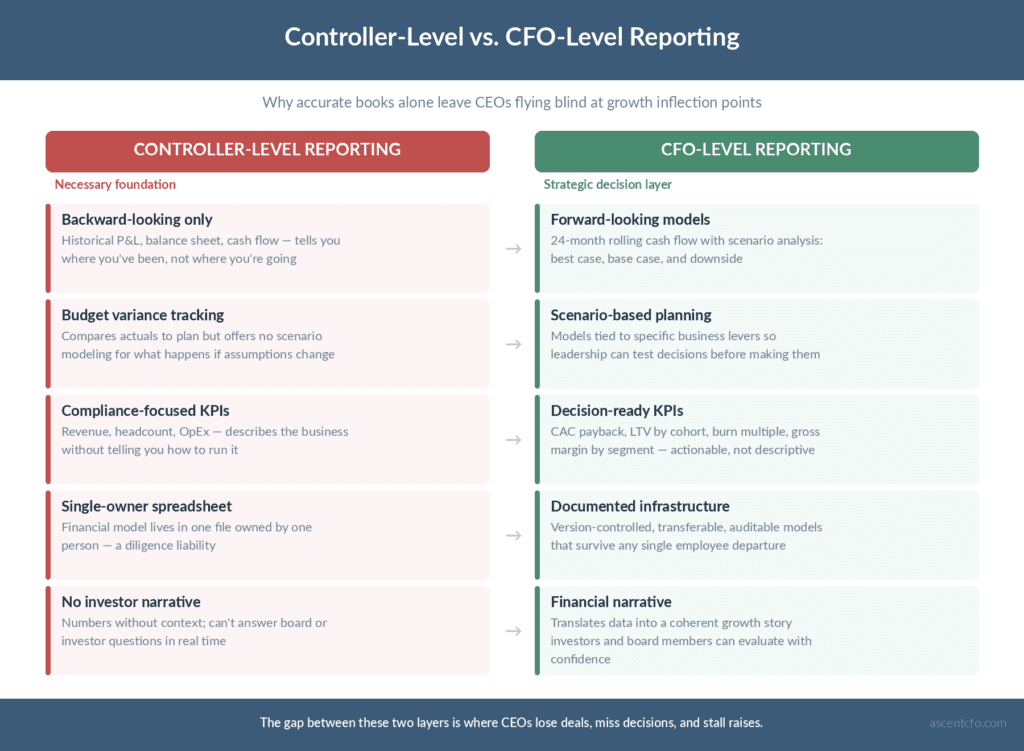
What controller-level reporting was never designed to produce is the forward-looking, scenario-based, investor-grade financial narrative a CEO needs at a growth inflection point.
The Three Layers Investors Actually Evaluate
When a sophisticated investor sits down with your data room, they are not primarily asking whether your books are accurate. They assume some level of accuracy. What they are actually evaluating is whether your financial reporting signals operational maturity, and whether the team running this business thinks about money the way a scalable company needs to.
There are three distinct layers to that evaluation, and most companies at the $5M–$20M revenue range only have the first one built.
Layer 1: Historical Accuracy (Controller Domain)
Clean GAAP financials, 18–24 months of monthly P&Ls, reconciled balance sheets, and documented close processes. This is the floor. Getting here is the controller’s job, and a good controller does it well.
Layer 2: Forward-Looking Infrastructure (CFO Domain)
This is where the gap opens. FP&A teams need to drive faster, deeper insights into reporting data, enabling comparative analysis at the right level of detail and the ability to explore profit variances, which requires a well-thought-out architectural design of planning data and actuals to compare past, present, and forward-looking information at the same level of granularity.
Layer 2 includes: a 24-month rolling cash flow model, departmental budget ownership tied to KPIs, scenario analysis for best case/base case/downside, and cohort-level unit economics for CAC (customer acquisition cost) and LTV (lifetime value).
Layer 3: Financial Narrative and Investor Translation (Strategic CFO Domain)
Numbers without narrative do not raise capital. The third layer is the ability to translate financial data into a coherent growth story, communicate it to your board, and answer investor questions in real time with confidence rather than a request for a follow-up.
CFOs act as a bridge between the company and its stakeholders, presenting financial strategies, performance metrics, and growth plans to investors and boards with clarity and precision. This is not the controller’s skill set. Asking your controller to build your investor narrative is like asking your head of accounting to run your Series A roadshow.
Five Financial Signals That Tell Investors You’re Relying Only on Controller-Level Reporting
Most founders do not recognize this gap until a diligence request lands in their inbox. By then, the scramble costs time, credibility, and sometimes the deal itself. Watch for these signals early:
- Your monthly reporting package is backwards-looking only. If every board deck shows where you’ve been but not where you’re going with quantified scenarios, the infrastructure is controller-grade, not investor-grade.
- You cannot produce a 24-month cash flow model within 48 hours. Investors do not wait two weeks for projections. If building the model from scratch is required each time, the infrastructure does not exist.
- Your KPI framework is activity-based rather than decision-based. Tracking revenue, headcount, and operating expenses is necessary. Without retention rates, CAC payback periods, gross margin by segment, and burn multiples (the cash spent to generate each dollar of net new ARR), your KPIs describe the business without telling you how to run it.
- Department heads are operating without financial visibility. When only the finance team has access to meaningful metrics, the business is running on intuition at the team level. Investor-grade infrastructure means financial discipline is embedded across functions.
- Your financial model lives in one spreadsheet owned by one person. A single-owner model is a diligence liability. Investors want to see documentation, version control, and a reporting system that outlasts any one employee.
The Upgrade Path: From Controller-Grade to Investor-Ready in 90 Days
If you recognize your company in the signals above, the path forward is structured and achievable. Most companies operating at $5M–$30M revenue can close the gap within a quarter with the right leadership and process.
Month 1: Diagnose and Baseline
Audit your existing reporting infrastructure against investor expectations. Identify what your controller currently produces and what is missing. Map your existing KPI framework against your stated growth strategy. The goal is a clear picture of the gap before attempting to fill it.
Month 2: Build the Forward-Looking Layer
Construct a rolling 24-month cash flow model with documented assumptions. Build a scenario framework with at least three cases (base, upside, downside) tied to specific business levers. Design a board reporting package that leads with narrative and uses financial data to support strategic decisions rather than replace them.
Month 3: Embed and Operationalize
Roll out team-level KPI dashboards using the 5/4 guardrail: no more than 5 KPIs per team, 4 per individual role. Establish weekly 30-minute financial review cadences. Move manual data entry per person to under 10 minutes per week. Document the model so it is transferable, auditable, and defensible in a data room.
Fractional outsourced CFO services deliver strategic expertise on demand through experienced finance leaders available on flexible contracts, providing strategic guidance on defining insightful KPIs tied to growth goals and synthesizing operational analytics into boardroom-ready reports.
FAQs About Controller-Level Reporting and Strategic Finance
1. Do I need to replace my controller to build investor-ready reporting?
No. Your controller remains essential to the foundation. What you need is a strategic finance layer above the controller, whether that is a full-time CFO, a fractional CFO, or an interim engagement. A CFO uses the data and reports supplied by the controller to evaluate the company’s financial health and work with other executives to shape the company’s strategic direction. The roles are complementary, not redundant.
2. How far in advance of a raise should we start building investor-grade reporting infrastructure?
Six to twelve months is the target window. Investors do not just evaluate the data you present. They evaluate how long the system has been running and whether the reporting reflects genuine operational discipline or was assembled for the purpose of the raise. Starting six months out is the minimum. Starting twelve months out gives you time to course-correct if the model reveals issues you need to address.
3. Our company is at $8M ARR. Do we really need a CFO for this?
That depends less on revenue and more on what decisions you are facing. Companies hire a CFO when they need financial guidance that goes beyond accurate accounting and reporting, often at a critical juncture in the growth cycle where having a senior finance leader can help make and execute key strategic decisions. If you are preparing for a raise, considering an acquisition, entering a new market, or scaling a team significantly, you are at that juncture regardless of your current ARR.
4. What is the difference between FP&A and controller-level reporting?
FP&A (financial planning and analysis) is the forward-looking counterpart to the controller’s historical reporting. Where the controller closes the books, FP&A builds the models, forecasts, and scenario analyses that inform what decisions to make next. Most companies at the $5M–$15M stage have controllers but no formal FP&A function. That is precisely the gap that creates problems at an inflection point.
5. How do we prevent KPI sprawl when building out strategic reporting?
Constraint is the answer. Limit company-level KPIs to 3–5 metrics that directly connect to the strategic decisions the executive team needs to make. Use the 5/4 guardrail at the team and individual level. Conduct a 30-minute weekly review cadence to maintain discipline. The goal is focus, not comprehensiveness. A dashboard with 40 metrics produces the same outcome as a dashboard with zero: no clear decision.
Your Financial Reporting Is Already Telling a Story. Make Sure It’s the Right One.
At the inflection point of growth, the difference between a stalled raise and a fast close is rarely the quality of your product or the strength of your team. More often, it is whether your financial infrastructure tells a coherent, forward-looking story that investors and board members can evaluate with confidence.
Controller-level reporting is accurate, necessary, and insufficient. The CEO who recognizes that distinction early builds the right layer on top before the diligence request arrives, not in response to it.
We help founders and CEOs at growth-stage companies in Boulder, Denver, and across the country build the financial infrastructure that gets deals done and decisions made with clarity. Through ourfractional CFO services, we design the forward-looking reporting layer that sits above your controller function and speaks the language investors and boards actually need to hear. Our financial modeling and data analytics capabilities translate your raw operational data into scenario-ready models built for real decisions. We embed KPI frameworks that are simple, disciplined, and actionable, without creating the metric overload that paralyzes teams.
If you are approaching a raise, navigating a pivot, or simply recognizing that your current reporting was built for a smaller version of your company, now is the right time to upgrade. Explore our investor-ready financial reporting capabilities or review how we structure our interim CFO engagements to move quickly when timing matters.
Book a CFO strategy call with Ascent CFO Solutions and start building the financial infrastructure your next stage of growth actually requires.s.

Contact Us
Questions or business inquiries regarding our part-time CFO, finance and accounting services are welcome at: info@ascentcfo.com

