Ascent CFO Solutions made the Inc. 5000 List of America’s Fastest Growing Private Companies!

Is Your Company Ready to Be Acquired? The Financial Questions Every Founder Should Answer First

An inbound LOI lands in your inbox on a Tuesday afternoon. A strategic acquirer you’ve heard of. A reasonable headline number. A request for a data room within thirty days.

The reaction in the moment is usually a mix of excitement and adrenaline. The reaction six weeks later, after the buyer’s team has spent three weeks asking questions you couldn’t answer cleanly, is usually different.

Most founders who go through their first M&A process discover the same thing. The business is what it is. What determines the acquisition outcome is whether the financial picture of the business can defend the price you want, under the kind of scrutiny a sophisticated buyer brings.

If the LOI hasn’t arrived yet, you have time. The work of getting financially ready for an acquisition takes twelve to twenty-four months when done well. If the LOI has arrived and you weren’t ready, the work has to happen in compressed time, often against the buyer’s diligence clock, and almost always at a cost to the eventual deal terms.

This article walks through six financial questions every founder should be able to answer before they sit down at the table with a buyer.

What “Ready to Be Acquired” Actually Means

Acquisition readiness has nothing to do with whether the business is for sale and not much to do with whether the business is performing well. Plenty of well-performing businesses are unready. The thing that distinguishes a ready business from an unready one is whether the financial picture can hold up under detailed examination by someone whose job is to find reasons to lower the price.

A buyer’s team will reconstruct your last three years of financials in their own format, on their own assumptions, and ask questions about every meaningful divergence. They will pressure-test your forecasts against your historicals. They will ask about specific customers, specific deals, specific months. They will look for revenue that isn’t really recurring, margins that aren’t really sustainable, costs that should have been capitalized, expenses that should have been recognized, and forecasts that assume operating leverage you don’t have evidence for.

A founder whose books are ready walks into that process and answers the questions cleanly. A founder whose books aren’t ready spends the diligence window rebuilding financials under pressure, while the buyer’s team uses the visible gaps as leverage on price, terms, and structure.

The six questions below are what readiness actually looks like.

1. Are Your Financials GAAP-Compliant Accrual?

This is the table-stakes question. If the answer is no, the diligence process starts with a reconstruction project before the buyer can even evaluate the business.

GAAP-compliant accrual financials are the standard format every sophisticated acquirer expects. That means accrual accounting with proper revenue recognition (ASC 606 for subscription and services revenue), correct treatment of deferred revenue, accrued expenses, prepaid balances, and capitalized vs. expensed items. It means clean account reconciliations, defensible journal entries, and a balance sheet that ties to the underlying operating reality of the business.

A founder running on cash basis, or on accrual basis with messy books, will see the buyer’s team spend the first two to four weeks of diligence rebuilding the financials before they can evaluate anything else. That work happens under the buyer’s lens. The version that emerges is rarely as favorable as the version a clean accounting team would have produced in advance.

What to check: ask your accountant for the last three years of audit-quality GAAP financials, with full revenue recognition treatment, deferred revenue waterfalls, and clean balance sheet reconciliations. If they can’t produce them quickly, the diligence-readiness project is the work to do first.

2. Can You Defend Your Revenue Quality?

Revenue is the headline number a buyer evaluates first, but the headline number is only the start of the conversation. The follow-up questions go to the quality underneath it.

Recurring versus one-time mix. Recurring revenue commands a meaningfully higher multiple in most M&A processes. A business with 80% recurring revenue at $10M trades at a different valuation than a business with 30% recurring revenue at $10M. The mix has to be defensible based on actual contract terms, not just internal categorization.

Customer concentration. A buyer will ask what percentage of revenue comes from your top five and top ten customers. Concentration above 20% from a single customer or 50% from the top five is a red flag that affects price, deal structure, and sometimes deal certainty.

Retention. For recurring revenue businesses, gross retention and net revenue retention are the single most important quality metrics. Buyers will recalculate them themselves and compare to what you presented. Discrepancies erode trust.

Trend. Three years of steady growth tells a different story than two years of growth followed by a flat year. Buyers will look for inflection points and ask what caused them.

What to check: build a revenue quality summary covering recurring versus one-time, customer concentration, retention metrics, and three-year trends. If the picture has weaknesses, the time to address them is before the buyer asks.

3. Are Your Margins Defensible at the Customer and Segment Level?

A buyer cares about gross margin in aggregate, but they care more about whether the aggregate margin is concealing weakness underneath.

Gross margin by product line or service offering reveals which parts of the business are actually contributing to profitability and which are dragging it down. A business with strong aggregate margins built on one healthy segment and one money-losing segment is a different acquisition than a business with consistent margins across all segments.

Gross margin by customer cohort, where available, tells the buyer how the unit economics have evolved over time. Are newer customers more profitable than older ones, or less. That trend matters.

Gross margin trends over the last three years tell a buyer whether the business has operating leverage that scales or whether margins compress as the company grows. Most buyers are paying for the assumption that margins expand at scale. They want to see evidence.

What to check: produce a gross margin analysis at the product level, the segment level, and where applicable the customer cohort level. Look for hidden weakness before the buyer surfaces it.

4. Is Your Working Capital Cycle Clean?

Working capital is the operating capital required to run the business: receivables, payables, inventory, deferred revenue, accrued expenses. A buyer will examine the working capital cycle to understand how the business actually consumes and generates cash relative to reported income.

Receivables. If your AR is aging cleanly, the buyer sees an organized operation. If there are old receivables that have effectively become bad debt, the buyer sees an AR aging report with a large bucket past 90 days and prices in the quality issue.

Payables. Buyers can tell the difference between accounts payable being managed deliberately and accounts payable being used to stretch vendors past terms as a cash management tool. The latter is treated as a hidden liability.

Deferred revenue. The deferred revenue balance has to be correct, with a clean waterfall showing when each piece will release. Mistakes in deferred revenue are some of the most common findings in M&A diligence, and they almost always work against the seller.

What to check: a clean working capital analysis showing AR aging, AP aging, deferred revenue waterfall, and the cash conversion cycle. Buyers will build this themselves either way. Better to have your version ready.

5. Do Your Forecasts Hold Up Under Scrutiny?

A buyer doesn’t just pay for the historicals. They pay for what they believe the business will produce going forward. The forecast is what defends the price.

A defensible forecast is built from the bottom up, driven by operating assumptions the buyer can interrogate. New customer adds, retention rates, average contract value, sales rep productivity, cost-of-delivery scaling, hiring plans, gross margin trends. The numbers at the top of the forecast roll up from those drivers, and the drivers are grounded in historical patterns the buyer can verify.

A weak forecast is a top-down growth assumption with no operating evidence underneath it. “We’re going to grow 40% next year because the market is growing” is the form of forecast that gets cut by the buyer’s team and resurfaces as a lower number used to justify a lower valuation.

What to check: build a three-year forecast bottom-up from operating drivers. Tie every line to a historical pattern or a specific business decision that supports the assumption. Stress-test the forecast under a downside scenario where one or two assumptions miss.

Talk to a CFO
An Experienced CFO is Within Reach

Get right-sized financial leadership from experienced CFOs ready to lead your team.

6. Is Your Cap Table Clean?

The cap table is not a financial statement, but it is a financial document that affects every aspect of a transaction. A messy cap table can delay a deal, change its structure, or in some cases sink it.

What to check: full equity ownership history, all option grants with vesting schedules, all convertible notes and SAFEs with their conversion terms, all warrants and other equity instruments, and any side agreements affecting equity (drag-along rights, ROFR, board seats). Every founder, every employee, every investor, every advisor with equity should be accounted for, with documentation that survives diligence.

The most common cap table problems are old option grants without proper documentation, convertible notes with unclear terms, equity grants made to advisors or contractors without proper paperwork, and 409A valuations that haven’t been updated. Any of these can become a multi-week diligence issue at the worst possible time.

The fix for most cap table issues is to run a cap table audit twelve to eighteen months before a transaction and clean up the gaps. Software like Carta or Pulley makes the ongoing maintenance easier, but the cleanup project itself usually requires an outside CFO or legal counsel familiar with M&A standards.

The Mistakes Founders Make Before Their First Transaction

A few patterns are worth naming.

Assuming “ready when we need it” is good enough. The work of becoming acquisition-ready is twelve to twenty-four months, not three. Founders who decide to start when the LOI arrives find themselves rebuilding under deal pressure, with predictable outcomes.

Confusing investor-ready with acquisition-ready. The financial discipline required to raise a venture round is meaningful, but M&A diligence goes deeper. A clean Series B raise does not mean clean enough for an acquisition. The work to bridge those two standards is real.

Underestimating the role of clean books in valuation. Founders sometimes assume valuation is driven entirely by the business itself, and that a buyer will look past messy financials to see the underlying value. The reverse is closer to true. Messy financials create uncertainty, uncertainty creates risk, and risk gets priced in. The number that comes out of diligence is almost always lower than the number that would have come out with clean books.

Waiting to fix concentration or quality issues until the buyer asks. Customer concentration, recurring revenue mix, and margin quality are addressable over time. Addressed two years before a transaction, they meaningfully improve the eventual outcome. Addressed during diligence, they don’t move at all.

The Timeline of Readiness

For most growth-stage businesses, the right preparation window is twenty-four months before any contemplated transaction. The first twelve are about diagnosis and cleanup: getting books to GAAP-compliant accrual, fixing margin and concentration issues that are fixable, cleaning the cap table, building the forecast discipline that the buyer will eventually pressure-test. The second twelve are about operating in that state, so the buyer sees a year of clean financials in their diligence period rather than a recently fixed version of an old mess.

A twelve-month window still works for most companies, with more compression and fewer optionality choices. A six-month window is a fire drill that produces a meaningfully worse outcome than the same business with eighteen more months of preparation would have produced.

Beyond the Financials: The Rest of the Data Room

Here is the part founders almost always underestimate. A buyer’s diligence request list is not six financial questions. It is a document production exercise that can run to several hundred items, and a large share of them have nothing to do with the income statement. The financials get you in the room. The rest of the data room is where deals slow down, lose momentum, and get repriced.

A complete diligence data room reaches across the whole operation:

  • Corporate and legal. Formation documents, bylaws and amendments, board and shareholder consents, good-standing certificates, and any material agreements that govern the company.
  • Material contracts. Customer and vendor agreements, partnership and reseller deals, and anything with a change-of-control clause that a sale could trigger.
  • Real estate and equipment leases. Every lease, with terms, renewal dates, and assignment provisions. A lease the buyer can’t assume cleanly is a real issue.
  • Insurance. General liability, property, D&O, cyber, workers’ compensation, and key-person policies, plus certificates and a claims history. Buyers read the claims history closely.
  • Tax. Federal and state income tax returns, and the area that sinks more deals than founders expect: sales and use tax. If you sold into states where you had economic nexus and didn’t register, collect, and remit, you are carrying a contingent liability the buyer will find, quantify, and either escrow against or take out of the price. Property tax filings and any open tax notices or audits belong here too.
  • Payroll and HR. Payroll records and tax filings, employee and contractor agreements, offer letters, benefit plans, the employee handbook, and worker classification (W-2 versus 1099). Misclassified contractors are a common and expensive finding.
  • Intellectual property. Trademarks, patents, and signed IP assignment agreements from every employee and contractor who built anything the company relies on.
  • Permits, licenses, and compliance. Whatever your industry requires to operate legally, current and documented.
  • Litigation. Pending or threatened matters, settlements, and any regulatory issues, disclosed up front rather than discovered.

FAQs About Acquisition Readiness

1. How much does acquisition readiness affect valuation?

The honest answer varies by business and by buyer, but in most M&A processes, the difference between a well-prepared seller and an unprepared seller shows up as 10% to 25% of enterprise value. On a $20M transaction, that is $2M to $5M. The preparation work usually costs a small fraction of the recoverable value.

2. Do I need audited financials?

For most strategic acquisitions of mid-sized companies, audited financials are strongly preferred but not always required. For PE buyers or larger strategic deals, audited statements are usually required. The right move is to commission an audit twelve months before a contemplated transaction so a clean audit report is in hand when diligence starts.

3. Should I tell my finance team we’re considering a sale?

Carefully. The work of getting acquisition-ready overlaps significantly with the work of running a well-disciplined finance function generally, so much of the prep can happen without explicitly framing it as M&A readiness. Closer to a transaction, key finance leaders usually need to know, but the timing of that conversation is a judgment call worth working through with an advisor.

4. What’s the role of a fractional CFO in acquisition readiness?

A fractional CFO with M&A experience can run the readiness project end to end: diagnose the gaps, build the cleanup plan, oversee the books work, prepare the financial story, and act as the financial counterpart to the eventual buyer’s diligence team. For many founders, the fractional CFO is the difference between a 90-day diligence sprint that goes well and one that does not.

5. What if I’m not planning to sell but want to be ready in case?

This is the right posture for most growing companies. The work of becoming acquisition-ready makes the business better run in the meantime: cleaner financials, better forecasts, sharper customer economics, lower key-person risk. The companies that benefit most from readiness work are usually the ones that ended up not needing it at the time they prepared.

The Time to Prepare Is Before the Conversation Starts

The founders who get the strongest acquisition outcomes have one thing in common. They started the financial readiness work long before any specific transaction was on the table. They cleaned up their books, sharpened their forecasts, addressed their concentration and margin issues, and built financial discipline that held up to scrutiny. The discipline was real because it had been in place for a year or more before any buyer ever saw it.

We help founders and CEOs of growth-stage companies across the country build the financial picture that defends the price they want when the time comes. Through our fractional CFO services, we run acquisition readiness projects, clean up books to GAAP-compliant accrual, build the forecast discipline buyers expect, and stand as the financial counterpart through any eventual diligence process.

Book a CFO strategy call with Ascent CFO Solutions and start the readiness work before the LOI shows up.

What an Interim CFO Does in the First 90 Days: A 30/60/90 Plan

Key Takeaways

  • An interim CFO’s first 90 days follow a clear arc: stabilize and make sure that there is a clear forecast for cash and reporting in days 1–30, diagnose and fix what the transition exposed in days 31–60, and set forward direction and prepare the handoff in days 61–90.
  • The priority in week one is continuity, not reinvention. Payroll, the bank relationship, the board, and the monthly close all have to keep running while the interim learns the business.
  • The 90-day plan is the front end of a longer transition. Deloitte’s work with newly appointed finance chiefs finds most need roughly six months to fully establish themselves, so the interim’s job is to stabilize now and leave the next CFO a running start.

Your CFO gives notice on a Thursday. The monthly close is due in eight days, a lender covenant certificate (a signed confirmation that you are meeting the terms of your debt) is due at month-end, and the board wants a cash update Monday morning. None of those deadlines move because the finance seat is empty. This is the moment companies bring in an interim CFO, and what that person does in the first 90 days determines whether the gap becomes a wobble or a genuine setback.

An interim CFO is a senior finance leader who steps into an open, or soon-to-be-open, CFO seat and runs the finance function for a defined period. In the first 90 days, that work follows a clear arc: days 1–30 stabilizing cash and keeping the basics running while learning the business, days 31–60 diagnosing and fixing what the departure exposed, and days 61–90 setting forward direction and building the bridge to a permanent hire. The work is sequenced on purpose. Stabilize first, then diagnose, then direct.

Why companies bring in an interim CFO

The CFO chair is one of the least permanent seats in the building. Average CFO tenure has slipped to about 4.7 years, and in 2025 the largest U.S. public companies recorded 120 CFO changes, up nearly 18% from the year before, according to Crist Kolder Associates’ annual Volatility Report. Private, founder-led companies see the same churn, often with less warning and far less bench depth to absorb it.

When the seat opens, the calendar does not pause. Payroll still runs, the audit still has a deadline, the bank still expects its reporting, and the board still wants numbers it can trust. An interim CFO, also called a temporary CFO, is the person who carries that weight for a defined stretch, usually three to nine months, while you find and onboard the permanent leader, or while you get through a specific event like a sale, a raise, or a first audit. The role is different from a fractional CFO, who works with you on an ongoing, part-time basis when there is no vacancy to fill. The interim is a bridge across a gap. Here is how a good one builds it.

Days 1–30: Stabilize the basics and learn the business

The first month is about continuity and listening, in that order. Moving fast is valuable, but making drastic changes too early can backfire. Michael Watkins, whose book The First 90 Days gave the 30/60/90 model its name, calls the urge to make a splashy early move the “action imperative,” and it is how new leaders break things they do not yet understand. The job in week one is to keep the trains running and learn the terrain.

Cash comes first. The interim builds or refreshes a 13-week cash flow forecast (a week-by-week view of money coming in and going out over the next quarter) so there are no surprises around payroll, accounts payable, or a covenant test. They confirm bank balances, the debt schedule, and which obligations are due in the next 30 days. If the departing CFO left a clear picture, this is verification. If they did not, this is the single most important thing the interim does in the first month.

At the same time, the monthly close has to stay on schedule. A close that slips in month one is hard to recover, and it is the first thing a board notices. The interim works with the controller and accounting team to get the books out on time, even if the process is rough.

Then comes the learning. The interim meets the people who matter to the numbers: the CEO, the board chair or audit committee lead, the finance team and the layer below it, the outside auditors, the lenders, and a handful of the largest customers and vendors. Often, an interim CFO will meet with the CEO or executive leadership team immediately to share preliminary strategy on day 1. McKinsey’s guidance to new finance chiefs is to treat the early days as a rare chance to ask fundamental questions about how the business actually runs, and why, rather than defaulting to how things have always been done. By day 30, the interim should have a stabilized cash position, an honest read on the finance team’s capacity, and a short list of the real fires.

Days 31–60: Diagnose and fix what the transition exposed

With cash stable and the first close out the door, the second month is where the interim earns the engagement. Transitions surface things. Reconciliations that have fallen behind. Revenue recognition treatment that will not survive an audit. A forecast no one believes. Controls that depend on the person who just left. The interim’s job now is to find these and fix the ones that carry real risk.

Reporting usually needs work. The interim gets the board package and the core KPIs (key performance indicators, the handful of metrics that actually predict the business) to a decision-ready state, so the CEO and board are steering with numbers they trust. Where the reporting was built around the departed CFO’s habits, the interim rebuilds it around the business fundamentals.

This is also when the interim assesses the team in earnest. Deloitte’s CFO Transition Lab frames a new finance leader’s work around four streams: setting and communicating priorities, building a talent strategy, mapping the stakeholders who matter, and turning all of it into concrete action. By the end of month two, the interim should know who on the team can carry more, where there is a gap to backfill, and which two or three problems need to be solved before a permanent CFO arrives. Then they solve them, and they document the work as they go.

Days 61–90: Set direction and build the bridge

The final month points forward. The interim turns the diagnosis into a plan the organization can run after they leave: an updated budget or reforecast, a working financial model, and a clear view of runway (how many months of cash the company has at its current burn). This is the model the next CFO will inherit, so it is built to be handed over, not hoarded.

At this stage, the interim CFO may also begin interviewing new team members, including the incoming permanent CFO. 

Knowledge transfer is the quiet difference between a clean handoff and another scramble. The interim leaves documentation, process maps, a current close checklist, and an organized set of working files. It is the opposite of what an abrupt departure usually leaves behind. If the company is also running a search, the interim helps write the specification for the permanent CFO hire and prepares a 30/60/90 plan for that successor, so the new leader starts with a map instead of a cold start.

A 90-day plan does not mean the transition ends at 90 days. Deloitte’s research on executive transitions makes the point that the “first 90 days” is something of a myth: most finance leaders realistically need about six months to fully establish themselves. The interim’s 90 days do the heaviest lifting in that longer arc: stabilize, diagnose, direct, then hand off to a permanent leader who can take it from there.

Talk to a CFO
An Experienced CFO is Within Reach

Get right-sized financial leadership from experienced CFOs ready to lead your team.

What an interim CFO is not

The boundaries of the role are worth stating plainly. An interim CFO is not a caretaker keeping the seat warm until the real decision-maker shows up. They hold genuine authority and make real decisions, including ones the company has been avoiding. They are also not a permanent hire auditioning for the job, which frees them to be honest about what they find. And they are not a senior bookkeeper; the close matters, but the mandate is leadership of the finance function, not just its mechanics. The defining trait is that the role has an end date and a handoff built into it from day one.

Speak to a CFO

If your finance seat is open, or about to be, the cost of waiting is measured in missed closes, anxious lenders, and decisions made without numbers. An experienced interim CFO can step in within days and keep the business steady while you find the right permanent leader. We have done it for companies in the middle of audits, fundraises, and sales of the business. Book a CFO strategy call with Ascent CFO Solutions.

Frequently asked questions

What is the difference between an interim CFO and a fractional CFO?

An interim CFO fills a vacancy for a defined period, usually three to nine months, often close to full-time, while you transition between permanent leaders or get through a major event. A fractional CFO works with you on an ongoing, part-time basis when there is no gap to fill and you simply do not need a full-time CFO yet. We cover the distinction in more depth in fractional CFO vs. interim CFO.

How long does an interim CFO engagement usually last?

Typical engagements run three to nine months, but in some cases can run 12 months or longer. The length tracks the reason for the engagement: covering a search for a permanent CFO, bridging a parental leave, or carrying the company through an audit or transaction. 

What should an interim CFO accomplish in the first 30 days?

Stabilize cash with a current 13-week cash flow forecast, keep the monthly close on schedule, meet the stakeholders who matter to the numbers, and build an honest list of the real risks. The first 30 days are about continuity and learning, not sweeping change.Can an interim CFO run a fundraise, sale, or audit?

Yes, and companies often bring one in precisely for an event. An interim CFO with transaction experience can maintain the data room, present financials to buyers or investors, and manage the diligence process, which is common in a sale of the business. The defined timeline of the event and the interim engagement line up naturally.

How does an interim CFO hand off to a permanent CFO?

Clean documentation, an updated forecast and model, a current close process, a written specification for the permanent role, and a 30/60/90 plan for the incoming leader. A good interim measures success partly by how little the next CFO has to rebuild.

When should we hire an interim CFO instead of waiting?

If a CFO has resigned, a covenant or audit deadline is approaching, or a transaction is underway, the gap between leaders is exactly when mistakes get expensive. Bringing in an interim early protects continuity; waiting usually means paying to clean up later. If your company already has a strong Accounting Manager or Controller, an interim CFO is critical to augment the existing team.

A finance bridge that holds

A leadership gap in finance is one of the few problems that gets worse every week you leave it open. We help founders and CEOs of scaling-stage companies across the country bridge that gap without losing a step, with interim CFOs who stabilize the numbers, fix what the transition exposed, and prepare a clean handoff to your next permanent leader. Book a CFO strategy call with Ascent CFO Solutions.

Cash vs. Accrual Accounting: Which Method Is Right for Your Growing Business?

You closed the biggest deal of the year in December. A three-year contract worth $600,000, paid upfront. The check cleared and your team celebrated.

In January, your banker pulls up your financials to review the year. They see a December that looks four times the size of every other month and a January that looks weak. They ask what’s going on. You explain the big December deal. They nod, then ask: “Are you on cash or accrual?”

That’s the moment a lot of founders realize the accounting method they picked years ago has consequences they didn’t anticipate. The same business, with identical revenue and identical customers, can look completely different depending on which method you use. And the difference is not academic. The method you’re on determines how your business looks to investors, lenders, the IRS, and to yourself when you’re trying to make decisions.

This article walks through what each method actually does, why the choice matters more than founders tend to think, and how to know when it’s time to switch.

What Cash Accounting Actually Does

Cash basis accounting records revenue when money comes in and expenses when money goes out. That is the entire method. If a customer pays you in January for work you’ll do across the year, the entire payment shows up as January revenue. If you pay an annual software subscription in March, the entire expense shows up in March.

It’s the simplest way to keep books. It maps cleanly to the bank account. It’s how most very small businesses start. And the IRS allows it for tax purposes for businesses below specific thresholds.

The strength of cash basis is simplicity. The weakness is that it doesn’t reflect the economic reality of the business. A business that just collected a large prepayment looks wildly profitable in the month the cash hits, even though the work to deliver that contract is spread over the next twelve, twenty-four, or thirty-six months. A business that just sent a large invoice but hasn’t been paid yet looks weak, even though it has just earned a large amount of revenue.

For a small consulting firm with short cash cycles and no multi-year contracts, cash basis can work fine. For most businesses past a certain size, it stops telling the truth.

What Accrual Accounting Actually Does

Accrual basis accounting records revenue when it is earned, regardless of when the cash arrives. It records expenses when they are incurred, regardless of when they are paid.

The same $600,000 three-year contract that hits cash basis as a December revenue spike shows up in accrual basis as $16,667 of revenue per month for thirty-six months. The rest sits on the balance sheet as deferred revenue (cash you’ve received but haven’t earned yet). The annual software subscription paid in March gets spread across the twelve months it covers, with the unused portion sitting as a prepaid expense.

This is what GAAP (Generally Accepted Accounting Principles, the standard rulebook for financial reporting in the U.S.) requires. It is what banks, investors, auditors, and acquirers expect to see when they ask for financials.

The strength of accrual basis is that it tells a more honest story about the economic performance of the business. A profitable month looks profitable. A weak month looks weak. Multi-period contracts get smoothed out. Operating performance becomes legible.

The weakness of accrual basis is that it requires more accounting work, more discipline around timing, and a mental model that is less intuitive than “look at the bank account.”

Why the Choice Matters More Than Founders Tend to Think

A founder running on cash basis is not making bad decisions on purpose. They are making decisions on the information their books are showing them. The problem is that cash-basis information can be wrong about the business in three specific ways.

Profitability gets distorted by timing. A founder looking at a cash-basis P&L sees a strong month and assumes the business is strong. The cash-basis P&L doesn’t tell them whether that strength came from operations or from a customer prepayment that doesn’t repeat next month. Decisions made on that picture, like a new hire, a marketing investment, or a piece of equipment, can be made on a misread.

The books don’t survive outside scrutiny. The first time a banker, investor, or acquirer asks for financials, cash-basis books get adjusted to accrual basis by whoever is doing the diligence. The adjustment is often less flattering than the cash version. Founders who go into a lender conversation with cash-basis statements often come out with worse terms, smaller credit lines, or a delay while accrual financials get rebuilt.

The tax position can be wrong. Cash basis has tax advantages in some situations, especially for service businesses with consistent margins. It has tax disadvantages in others, particularly for businesses with significant deferred revenue. A business sitting on $600,000 of cash that represents two years of unearned work pays tax on the full $600,000 in the year it was received under cash basis. The same business on accrual recognizes the revenue, and the tax, over the actual delivery period.

When Cash Basis Still Works

Cash basis is the right method for a narrower set of businesses than most founders realize. The fit profile is:

  • The business has no significant inventory.
  • Customers pay on short cycles, usually within 30 days.
  • There are no multi-year or subscription contracts representing a meaningful share of revenue.
  • Gross receipts average below the IRS threshold for required accrual reporting (currently around $30 million over a three-year average, though this changes periodically).
  • No bank, investor, or auditor requires GAAP financials.
  • The founder is the only stakeholder making major financial decisions.

A small marketing agency billing month-to-month, a freelance consultancy, an early-stage service business under $2M in revenue. These can run on cash basis and produce useful information.

When Accrual Becomes Necessary

The list of triggers that force a move to accrual is longer than most founders expect.

Hitting the IRS threshold. Once a business averages above roughly $30 million in gross receipts over the prior three years, the IRS requires accrual reporting for tax purposes. The threshold adjusts periodically for inflation. Below the threshold, accrual is optional for tax. Above it, it is mandatory.

Taking on bank debt or a credit facility. Most commercial banks require GAAP-compliant accrual financials for loan covenants. A business on cash basis seeking real bank financing usually has to rebuild books in accrual format as part of the loan process.

Raising institutional capital. Any institutional investor, whether venture, growth equity, or private equity, expects accrual financials in diligence. Cash-basis books raise immediate questions about the maturity of the finance function and signal that the company hasn’t yet operated at a level requiring real accounting.

Selling or being acquired. M&A diligence is run on accrual financials. A business that goes into a sale process with cash-basis books will see a meaningful chunk of the diligence period spent reconstructing accrual financials, with the buyer’s team making the calls about how to do it. That work happens under the buyer’s lens, not yours.

Adding inventory. Businesses that hold inventory have to use accrual for tax purposes above small thresholds. Inventory accounting requires using the accrual method to function correctly.

Subscription or multi-year contracts becoming material. Once recurring or multi-period revenue is more than a small share of the business, cash basis distorts the picture so significantly that even internal decision-making becomes unreliable.

An audit. Any audited financial statement is, by definition, accrual. Cash-basis statements cannot be audited under GAAP.

Talk to a CFO

If you are running on cash the basis and any of the triggers above are within twelve months of your business, the conversation about converting is one to have now rather than later. A clean conversion done a year in advance is a routine project. A conversion done during a fundraise, a sale, or a loan process is a fire drill.

Talk to a CFO
An Experienced CFO is Within Reach

Get right-sized financial leadership from experienced CFOs ready to lead your team.

The Mistakes Founders Make When Switching

Most cash-to-accrual conversions are not technically difficult. The mistakes founders make are timing and process mistakes, not accounting mistakes.

Switching during a crunch. The right time to switch is when nothing important is happening. The wrong time is during a fundraise, a sale process, or a loan close. A conversion done under pressure is rushed, error-prone, and produces accrual financials that do not fully match the underlying business reality. A conversion done in a quiet quarter is clean.

Switching without a proper opening balance sheet. The conversion requires building an opening accrual balance sheet at the cutover date, with accounts receivable, accounts payable, deferred revenue, prepaid expenses, and accrued expenses all captured correctly. Skipping this step produces books that look right month-over-month but do not tie to the underlying economic reality of the business at the cutover point.

Not retraining the team and leadership. Accrual basis introduces concepts that don’t exist in cash accounting: deferred revenue, accrued expenses, prepaid balances, the difference between cash and earnings. The team has to learn to read the new P&L and balance sheet, and the team has to learn to maintain them. That training is part of the conversion, not an afterthought.

When to Make the Switch

For most growth-stage businesses, the right time to switch is at least twelve months before any of the major triggers. That means twelve months before a planned raise, twelve months before a sale process, twelve months before a loan application, or twelve months before hitting the IRS threshold.

Many companies will want to consider retroactively restating at least one year of the books to accrual accounting so that you can have a year-over-year comparison.

That window allows the new books to settle, to produce a clean year of accrual financials, and to give whoever is reviewing those financials, whether an investor, a buyer, a banker, or an auditor, a full year of comparable data. Books with three months of accrual history and nine months of “we just converted” are weaker than books with twelve months of clean accrual reporting.

If the triggers are already within six months, the switch should happen immediately. The shorter the window, the more urgent the work.

FAQs About Cash vs. Accrual Accounting

1. Can a business use different methods for tax purposes and financial reporting?

Yes, with limits. A business can run its internal financial reporting on accrual basis, for management visibility, investor reporting, and bank relationships, while still filing taxes on cash basis if it qualifies for cash basis under IRS rules. This is common for businesses that are growing toward the threshold but haven’t crossed it yet.

2. How long does a cash-to-accrual conversion take?

A typical conversion for a $5M to $20M business takes between two to six weeks, including the opening balance sheet construction, any parallel reporting period, and team training. Larger or more complex businesses may take longer.

3. Does cash basis save on taxes?

Sometimes, but not always. Cash basis tends to favor businesses that consistently have more accounts receivable than accounts payable, where revenue earned has not yet been collected and exceeds expenses incurred but not yet paid. It can hurt businesses with significant deferred revenue or long collection cycles. The actual tax impact depends on the specific balance sheet profile and should be modeled before assuming a benefit.

4. What’s the difference between accrual basis and GAAP?

Accrual basis is the foundational method GAAP uses, but GAAP includes many additional rules beyond just accrual timing: revenue recognition standards (ASC 606), inventory accounting, lease accounting, stock-based compensation, and many others. A business can be on accrual basis without being fully GAAP-compliant. Most businesses preparing for outside capital or a sale need both: accrual basis and GAAP-compliant treatment of the major accounting areas.

5. What if I’m already on accrual but my books are messy?

The conversation is different. The issue is not method, it is quality. Most diligence and lender pushback comes from accrual books that aren’t being maintained correctly: deferred revenue that isn’t being released on schedule, prepaid expenses that aren’t being recognized, balance sheet accounts that don’t tie out. The fix is a cleanup project, usually scoped against a target deadline like a raise, a sale, or a loan close.

The Right Time to Have the Conversation Is Before You Need the Right Answer

The founders who run into the cash-vs-accrual question at the worst time are usually the ones who didn’t realize it would matter until it did. The lender asked. The investor asked. The buyer asked. The auditor asked. By then, the answer “we’re on cash basis and we’ll convert as soon as we can” is already costing them leverage in whatever conversation they’re trying to have.

We help founders and CEOs of growth-stage companies nationwide build financial infrastructure that holds up to outside scrutiny. Through our fractional CFO services, we run cash-to-accrual conversions, set up GAAP-compliant reporting, and put the financial discipline in place before the moment that demands it.Book a CFO strategy call with Ascent CFO Solutions and get the right accounting method in place for the next stage of your business.

Ask a CFO: “How Do I Know If My Business Is Ready to Raise Capital?”

A founder can almost always get a meeting. Warm intros, a decent deck, a growing company, and you can fill a calendar with investor calls. The meeting is not the test. The test is what happens after the investor likes the story and asks for the financials, the model, and the metrics, and starts pulling on them to see what holds.

That is the gap most founders miss when they ask whether they are ready to raise. Ready does not mean “able to get interest.” It means being able to withstand scrutiny once you have it. Plenty of companies raise interest and then lose the deal in diligence, or take a worse valuation than the business deserved, because the financial foundation underneath the story was not built for the weight investors put on it.

So the real question is not whether someone will take the call. It is whether your business survives what comes after the call goes well. Here is how to know, across the dimensions a serious investor will test.

Readiness Is About Surviving Diligence, Not Getting the Meeting

Raising capital has two phases that founders tend to blur together. The first is generating interest: the deck, the story, the warm conversations. Most founders with a growing business can get through this phase. The second is converting interest into a closed round at a good valuation, and that phase runs almost entirely on the financial substance beneath the pitch.

When an investor moves past interest, they dig. They want investor-grade financials, a defensible model, metrics that prove the business works, a clear use of funds, and a founder who can answer hard questions without scrambling. Weakness in any of these does one of two things: it kills the deal, or it hands the investor leverage to mark down the valuation. Either way, the cost of not being ready is paid at the worst possible moment, when the money is on the table.

The dimensions below are what “ready” actually means. Work through them honestly, and you will know where you stand.

1. Will Your Financials Survive Diligence?

This is the foundation, and it is where unprepared companies get exposed first. Investors expect accrual-basis financials prepared under GAAP (Generally Accepted Accounting Principles, the standard rulebook for U.S. financial reporting), not cash-basis books that map to the bank account. They expect a clean balance sheet, revenue recognized correctly, and a data room, the organized set of financial, legal, and operational documents diligence runs on, that is built and ready before you go out.

The test to run on yourself: if an investor asked for the last three years of monthly financials, a cap table, your contracts, and a breakdown of revenue by customer this afternoon, could you produce it cleanly, or would it set off a two-week scramble of reconstruction? Cash-basis books, a balance sheet that has not been reconciled, revenue recognition that does not hold up, or a data room that does not exist yet are all signs the financial foundation is not ready for scrutiny, regardless of how good the story is.

Founders who go into diligence with messy financials lose time, lose credibility, and often lose valuation, because every unanswered question reads to an investor as risk, and risk gets priced.

2. Do You Have a Defensible Model and a Clear Use of Funds?

Investors are buying the future, so they scrutinize your forecast harder than your history. You need a financial model that projects the business out 24 months or more, built on assumptions you can defend line by line, not a hockey-stick chart with no logic underneath. The model has to connect: revenue growth tied to a real sales motion, hiring tied to the growth it supports, spending that produces the results the revenue assumes.

Just as important is the use of funds. An investor will ask exactly what the money is for and what it buys. “Eighteen months of runway and growth” is not an answer. A ready founder can say: this round funds these specific hires, this go-to-market expansion, and this product investment, which together get us to these milestones, which position us for the next round at a higher valuation, or to profitability. The model should show the money going in and the milestones coming out.

The test: can you explain, in specifics, what each dollar of the raise accomplishes and what the business looks like when the money is deployed? If the use of funds is vague, the model is not ready, and a sharp investor will know within minutes.

3. Do Your Metrics Tell a Credible Story?

For growth-stage and venture-backed companies, investors grade the business on a specific set of metrics, and they expect you to know yours cold and to have them calculated correctly. Depending on your model, these include monthly recurring revenue and its growth rate, gross and net revenue retention, customer acquisition cost (CAC, the fully-loaded cost to acquire a customer), lifetime value (LTV), the LTV-to-CAC ratio, payback period, gross margin, burn rate (the rate at which you spend cash beyond what you earn), and runway (how many months of cash you have left at the current burn).

The point is not just having the numbers. It is whether they tell a coherent story about a business that works. Improving unit economics, a CAC payback that is shortening, retention that holds, a burn that is producing proportionate growth, these say the model is sound and capital will accelerate something real. Deteriorating unit economics or growth that costs more every quarter to sustain say the opposite, and more capital poured into a model that is not working is a story investors have seen end badly.

The test: do your core metrics, calculated correctly and shown over time, make the case that the business gets stronger as it scales? If you are not sure how your metrics would read to a skeptical investor, that uncertainty is itself a sign you are not yet ready to put them in front of one.

4. Do You Know Your Number, and Why It’s the Right One?

“How much are you raising?” is a question with a wrong answer, and the wrong answer signals an unready founder fast. Raising too little leaves you back in the market before you have hit the milestones that justify a higher valuation. Raising too much dilutes you unnecessarily and can set a valuation bar you struggle to grow into. The right number comes out of the model: enough to fund the plan to the next meaningful milestone with room to spare, and not arbitrarily more.

A ready-to-raise founder can connect the raise amount to the milestones it funds and the position it sets up for the next round or for profitability. The number is an output of the plan, not a round figure that sounded ambitious. The test: can you defend the size of your raise as the amount the plan requires, rather than a number you picked? If the amount does not trace back to the model, it is not ready.

5. Is the Timing Right?

The best time to raise is from a position of strength, well before you need the money. Investors can sense desperation, and a founder raising with three months of runway left negotiates from weakness, takes worse terms, and risks running out mid-process. A founder raising with nine to twelve months of runway, off a quarter of strong metrics, negotiates from strength.

The mechanics matter here. A raise typically takes three to six months from starting conversations to cash in the bank, sometimes longer, and it consumes a large amount of the founder’s attention the whole time. Starting with less than six months of runway means you could run dry in the middle of the process, with no leverage and no fallback. The rule of thumb: begin raising when you have at least six to twelve months of runway and a recent stretch of performance that shows the business working. If you are already tight on cash, the readiness question is overtaken by an urgency problem, and the answer is to move now and protect the downside.

6. Can You Tell the Story the Numbers Support?

The financials and metrics are the substance, and the narrative is how an investor first decides whether to engage with them. A ready founder can tell a clear story: what the company does, why now, why this team, how big it can get, and how this specific capital accelerates a business that is already working. The story has to be backed by the numbers, not floating above them. Investors have a sharp ear for a narrative the financials do not support, and the gap between a confident pitch and a model that does not back it up is exactly what diligence is built to find.

The test: does your story and your model tell the same tale, so that an investor who likes the pitch finds the financials confirming it rather than contradicting it? When the narrative and the numbers agree, diligence builds confidence. When they diverge, diligence destroys it.

Talk to a CFO

If you are thinking about a raise in the next year, the most useful thing you can do now is get an honest read on how your financials, model, and metrics would hold up under an investor’s scrutiny, while there is still time to fix the soft spots. That assessment is concrete, and it usually surfaces exactly what to shore up before you go out.

Book a CFO strategy call with Ascent CFO Solutions and find out whether your business is ready to raise, or what it would take to get there.

Talk to a CFO
An Experienced CFO is Within Reach

Get right-sized financial leadership from experienced CFOs ready to lead your team.

FAQs About Raising Capital Readiness

1. How far in advance should I prepare to raise?

Begin preparing the financial foundation, clean accrual books, the model, the metrics, the data room, six to twelve months before you intend to go out. The active process then takes three to six months. Preparation done in the weeks before a raise is preparation done under pressure, and it shows. The earlier the financial work is in place, the stronger your position when conversations start.

2. What financials do investors actually expect to see?

Accrual-basis, GAAP-compliant financials covering the last two to three years where they exist, a clean balance sheet, a 24-month-plus forecast model with defensible assumptions, a cap table, and the supporting documents in an organized data room. They also expect your key metrics, unit economics, retention, burn, runway, calculated correctly and shown over time. Cash-basis books and a forecast that lives in your head are signs you are not ready.

3. How much should I raise?

Enough to fund your plan to the next meaningful milestone, plus a runway buffer, and not arbitrarily more. The amount should come out of your model, not a round number. Too little and you are back in the market before you have earned a higher valuation; too much and you dilute unnecessarily and set a bar you have to grow into. A defensible raise size traces directly to the milestones it funds.

4. What are the signs I am not ready yet?

Cash-basis or unreconciled books, no data room, a forecast you cannot defend assumption by assumption, metrics you have not calculated or that are trending the wrong way, a use of funds you can only describe vaguely, a raise amount you picked rather than derived, and less than six months of runway. Any of these means there is work to do before you put the business in front of investors.

5. Can I raise without a CFO?

Founders do raise without one, but the financial preparation a raise requires, investor-grade books, a defensible model, correctly calculated metrics, a clean data room, and the ability to answer diligence fast, is exactly CFO work. A fractional CFO can build that foundation and run point on the financial side of the process, which frees you to focus on the narrative and the relationships, and often improves both the terms and the odds of closing.

Ready Means Built to Withstand the Scrutiny You Are Inviting

The founders who raise well are not the ones with the most polished deck. They are the ones whose financials, model, and metrics held up when an interested investor started pulling on them, because the foundation was built before the conversations began. Getting the meeting is the easy part. Surviving what comes after, with your valuation intact and the deal moving toward close, is what readiness actually means.

We help founders and CEOs of growth-stage companies in Boulder, Denver, and across the country get ready to raise, building the investor-grade financials, the defensible model, the metrics, and the data room that carry a round through diligence at a strong valuation. Through our fractional CFO services, we make sure that when an investor likes your story, the numbers underneath it close the deal.

Book a CFO strategy call with Ascent CFO Solutions and find out whether you are ready to raise.

Fractional CFOs for SaaS Companies: What to Look for in a Part-Time Finance Leader

You are in a board meeting and an investor asks how your net revenue retention has moved over the last three quarters and what it implies about your CAC payback. You have a number somewhere, but you are not certain it is calculated the way they mean it, and you cannot speak to the trend with confidence. The meeting moves on. The moment stays with you, because it was the moment you realized the company has outgrown running finance off a bookkeeper and your own instincts, and you do not have anyone who owns these answers.

That is the situation a fractional CFO exists for at a SaaS company. You are past the point where a bookkeeper and a founder’s gut are enough, but a full-time CFO at $250,000 and up does not fit a business doing a few million in ARR. You need CFO-level financial leadership on the metrics, the model, and the board, without a full-time hire. The question is who, and SaaS raises the bar on that answer in ways most industries do not.

SaaS finance carries complexity that does not show up in services, manufacturing, or even traditional product companies. Subscription revenue, deferred revenue accounting, the SaaS-specific metrics investors actually grade you on, and a board cadence that moves faster than other industries all combine to make the fractional role harder to fill well. A part-time generalist will know the names of the things that matter and miss the substance. The right fractional CFO knows SaaS cold and brings it on the days you actually need it. This article walks through what to look for.

Why SaaS Fractional CFO Roles Are Different

Most fractional CFO arrangements were built around businesses where clean books, a budget, and a cash forecast are the main deliverables. Those matter at a SaaS company too, but they are not the whole job, and a part-time finance leader who only does that work will leave the SaaS-specific gaps wide open.

A SaaS company’s financial discipline is judged on a different standard. Investors, boards, and acquirers grade the business on metrics unique to subscription models: net revenue retention, gross retention, customer acquisition cost, lifetime value, payback period, ARR growth rate, magic number, and the rule of 40. Those metrics need to be calculated correctly, tracked over time, defensible under questioning, and consistent with how revenue is actually recognized. A finance leader who has not lived inside a SaaS P&L will know the names. The one who can explain how NRR (Net Revenue Retention, the percentage of recurring revenue retained after expansion and contraction) behaves when a customer expands, contracts, and churns inside the same quarter is the one who has done this work before.

Revenue recognition is the second piece. ASC 606 (the accounting standard governing how subscription revenue is recognized over time) is not optional and not simple. A SaaS company with even modest contract complexity has multi-element arrangements, performance obligations, contract modifications, and deferred revenue running through the books every month. A fractional CFO who is not fluent in ASC 606 will let financials build up that do not survive an audit, a diligence process, or a sharp board member’s questions, and you will not find out until the worst possible moment.

The third piece is pace. SaaS companies move on a faster financial cadence than most industries: monthly board reporting, mid-month forecast updates, investor pings about a single metric. A fractional CFO has limited hours by design, which makes the ability to read your operating reality quickly and stay current between sessions essential. Someone who needs to re-learn the business every time they log in is the wrong fit for a part-time SaaS engagement.

The Six Things to Look for in a SaaS Fractional CFO

Six attributes separate the SaaS fractional CFOs who add real value from the ones who function as an expensive part-time bookkeeper. The list is in the order you should check them.

1. SaaS Metrics Fluency

The candidate should be able to explain, without notes, the difference between MRR (Monthly Recurring Revenue) and committed MRR, between gross retention and net revenue retention, between booked ARR and live ARR, and between contracted ACV (Annual Contract Value) and recognized revenue.

Beyond the definitions, they should be able to explain how each metric behaves under contract modifications, mid-period changes, and partial cancellations. The candidate who has opinions about how your specific business should report these metrics, given how your contracts are actually structured, is the one who has done this before.

The check: ask them to walk you through how your company’s metrics should be calculated based on your real contract patterns. A real SaaS CFO will have substantive opinions inside ten minutes.

2. Revenue Recognition Expertise

ASC 606 fluency is the price of admission for a SaaS fractional CFO. The candidate should be able to explain how your specific contract structures map to performance obligations, how multi-year deals get recognized, how mid-term modifications get accounted for, and how the deferred revenue waterfall moves period over period.

The risk of getting this wrong is concrete, and a part-time arrangement does not reduce it. Rev rec mistakes that pile up over a few months become a problem during the next audit, the next diligence process, or the next transaction, and cleaning them up after the fact is one of the more painful and expensive things a SaaS finance team can be asked to do.

The check: ask the candidate how they would handle a specific contract scenario from your business, like a multi-year prepay, a usage-based component, or a mid-term upgrade. The depth of the answer tells you everything.

3. Board and Investor Communication Track Record

A SaaS fractional CFO will be in front of, or directly preparing you for, your board within their first month. They need to be comfortable with the format: the metrics deck, the operating review, the runway scenario, the deferred revenue rollforward, the cohort analysis, the questions sophisticated investors ask, and the answers those investors expect.

Someone who has run or supported the CFO seat at a venture-backed or PE-backed SaaS company has done this. Someone who has only kept the books at a private services firm has not. The skills do not transfer cleanly enough to learn on the job during a board cycle, and a fractional CFO who cannot strengthen your board communication is missing one of the highest-value things the role provides.

The check: ask them to walk you through the last SaaS board meeting they prepared for or presented at. What was on the agenda, what the hardest question was, how it got answered.

4. Forecasting Discipline at SaaS Pace

SaaS companies forecast more frequently and at higher resolution than most businesses. Bookings forecasts updated regularly, cash forecasts kept current, the operating model rerun against new actuals, hiring plans tied to ARR milestones. The forecast is the operating spine of the business, not a quarterly artifact.

A strong SaaS fractional CFO can pick up your existing model and run scenarios on it quickly, or rebuild a workable model from your operating data in two to three weeks if the existing one is unusable. What you do not want is a part-time leader who treats the model as a once-a-year exercise, because at SaaS pace a stale model is a model nobody trusts when a real decision lands.

The check: ask the candidate to walk you through an operating model they built or ran at a SaaS company. What the assumption layer looked like, how scenarios were structured, how often it got updated.

5. Fluency in the SaaS Finance Stack

The modern SaaS finance function runs on a specific set of tools: NetSuite or Sage Intacct as the ERP, a subscription billing platform like Maxio (formerly SaaSOptics), Stripe Billing, or Chargebee, a revenue recognition tool that may or may not be the billing platform, equity management on Carta or Pulley, expense management on Ramp, Brex, or Bill, and reporting that pulls from Salesforce or HubSpot for pipeline and from product instrumentation for usage.

A fractional CFO who is not comfortable in this stack will burn limited, expensive hours learning the tools instead of running the function. With part-time hours, that ramp tax is even more costly than it would be for a full-time hire.

The check: ask which of these tools they have used as the operator, not as an observer. There is a meaningful difference between a CFO who built the close in NetSuite themselves and one who reviewed reports their team built.

6. The Right-Sizing Instinct

This is the attribute that separates a good fractional CFO from a good full-time one. A fractional CFO has limited hours and serves more than one company, which means the entire value of the engagement depends on aiming those hours at the work that moves the business and operating through your existing team rather than trying to do everything personally.

The right fractional CFO walks in and quickly sorts what only a CFO can do, the metrics architecture, the model, the board narrative, the capital strategy, from what your bookkeeper or controller can own with direction. They build the systems and the cadence so the function runs between their sessions, instead of becoming a bottleneck the company waits on. The wrong one tries to act like a full-time CFO at part-time hours, spreads thin, and leaves the high-value work half-done.

The check: ask the candidate how they would spend their first month and where they would deliberately not spend time given limited hours. A strong answer is specific about what they would own, what they would push to your existing team, and what they would leave alone for now.

Talk to a CFO

If you are running a growing SaaS company off a bookkeeper and your own instincts, and the board questions are starting to outrun what you can confidently answer, a short conversation with an experienced SaaS fractional CFO is worth more than another quarter of guessing. It will tell you what is actually missing in your finance function and whether fractional is the right shape for where you are.

Book a CFO strategy call with Ascent CFO Solutions and get a clear read on what your SaaS finance function needs.

Talk to a CFO
An Experienced CFO is Within Reach

Get right-sized financial leadership from experienced CFOs ready to lead your team.

Mistakes Founders Make When Hiring a Fractional CFO

A few patterns come up repeatedly and are worth naming.

Hiring for industry breadth instead of SaaS depth. A fractional CFO who has worked across services, manufacturing, and consumer products may be excellent in the abstract and still struggle inside a SaaS P&L, because the metrics, the rev rec, and the cadence are all different. With limited hours, there is no time to absorb SaaS on your dime. Depth in SaaS specifically beats breadth across the board.

Hiring a part-time bookkeeper and calling it a CFO. The market is full of part-time finance help at a wide range of seniority. A senior bookkeeper or an accounting manager working a few hours a week is not a fractional CFO, even if the title gets used loosely. If the person cannot own the metrics architecture, the model, and the board narrative, you have hired bookkeeping support, not financial leadership, and the board questions will still go unanswered.

Underspecifying the engagement. A fractional CFO needs a clear scope: what they own, what your existing finance staff owns, what you retain, how many hours or days the engagement runs, and what the deliverables and cadence are. Without that, a part-time engagement drifts, the hours get consumed by whatever is loudest that week, and the high-value work never gets done.

Waiting for a crisis to bring one in. Founders often wait until a raise is imminent or a board has lost patience before adding a fractional CFO, which means the foundational work, clean metrics, a defensible model, investor-grade reporting, gets done under pressure instead of ahead of time. The highest-value version of a fractional CFO is the one who built the financial foundation before you needed to lean on it.

What the First 90 Days Should Look Like

A well-run SaaS fractional CFO engagement has a recognizable shape, though unlike an interim engagement it builds toward an ongoing rhythm rather than a handoff.

Days 1 to 30 are orientation and quick wins. The fractional CFO learns the business and the contract patterns, gets the core SaaS metrics calculated correctly and consistently, assesses the model and the close, and fixes the most visible gaps, often the metrics that were not board-ready and the rev rec that was not holding up.

Days 30 to 60 are establishing cadence. The monthly reporting package takes shape, the forecast gets onto a regular update rhythm, board materials get built or sharpened, and the working relationship with your existing finance staff settles into who owns what. The function starts running on a predictable beat.

Days 60 to 90 are the operating rhythm taking hold. The close, the forecast, the metrics, and the board cadence run reliably on the fractional CFO’s leadership and your team’s day-to-day work. The forward-looking conversations, capital strategy, scenario planning, the questions that come before big decisions, become a regular part of how you run the company rather than a scramble. From here the engagement is ongoing, scaling up around events like a raise and settling back during steady stretches.

If a fractional CFO engagement does not have this shape by day 90, with the metrics defensible, the cadence established, and the high-value work owned, the engagement is not running well.

FAQs About Fractional CFOs for SaaS Companies

1. How quickly can a SaaS fractional CFO ramp up?

A senior fractional CFO with deep SaaS experience is typically useful within the first few sessions and has the core metrics, the model, and the reporting cadence in shape within the first month or two. Because the hours are limited, the ramp is measured in the right priorities being addressed quickly rather than in full-time weeks. A candidate who would need a full quarter just to get oriented is the wrong fit for part-time SaaS work.

2. How many hours does a fractional CFO actually work, and what does it cost?

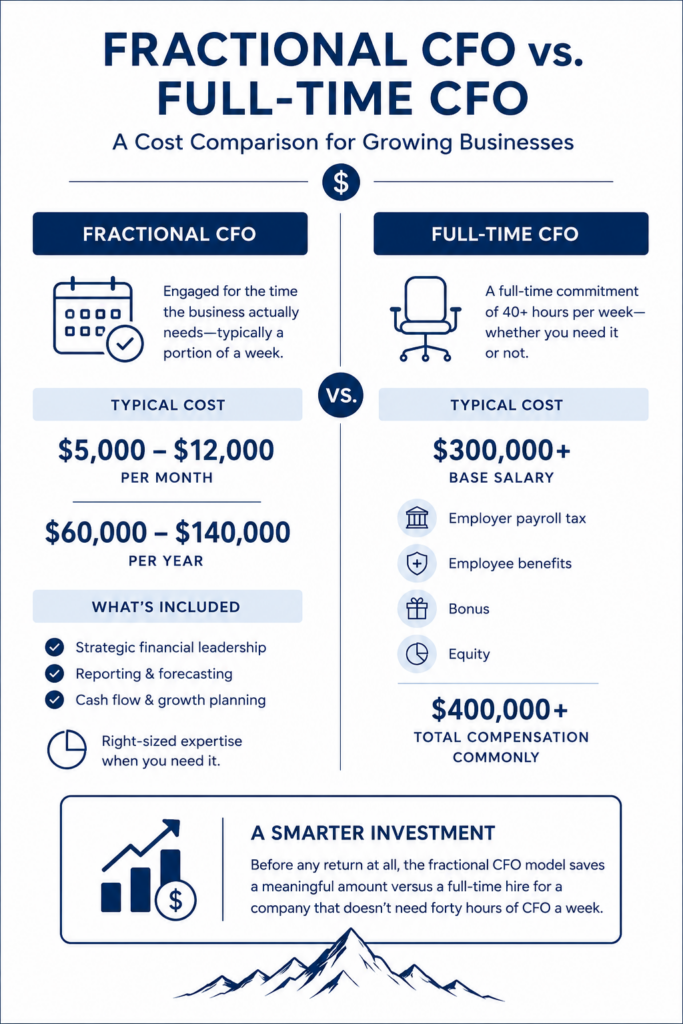
It varies with the stage and what is happening, commonly ranging from a few days a month for a steady-state company to a couple of days a week around a raise or a board push. Cost typically lands somewhere in the range of $5,000 to $12,000 a month depending on scope and intensity, against $250,000-plus in total compensation for a full-time SaaS CFO. The model exists so a company doing a few million in ARR can get real CFO leadership without a full-time salary.

3. How is a fractional CFO different from an interim CFO?

A fractional CFO works part-time on an ongoing basis, often across more than one company, and is the right model when you need consistent CFO-level thinking but cannot justify a full-time hire. An interim CFO works full-time for a defined window, usually three to nine months, and is the right model when you have lost your CFO or need concentrated coverage through a transition. Fractional is part-time and ongoing; interim is full-time and time-bound.

4. When do we graduate from a fractional CFO to a full-time one?

Usually when the volume and complexity of the financial work genuinely require full-time attention, which often arrives somewhere past $20M to $30M in ARR, or sooner if you are moving through back-to-back transactions or scaling unusually fast. A good fractional CFO will tell you when you are approaching that line and can help define and evaluate the full-time hire. Until then, paying for full-time when you need part-time is cost without return.

5. Can a fractional CFO really own our metrics and board work part-time?

Yes, when they are genuinely senior and the engagement is scoped right. The metrics architecture, the model, and the board narrative are CFO-level work measured in expertise and judgment, not raw hours. A senior SaaS fractional CFO who has built these before can establish them and keep them current on a part-time cadence, operating through your existing finance staff for the day-to-day. The key is hiring real seniority and giving the engagement a clear scope.

The Right Fractional CFO Answers the Questions Before the Board Asks

The SaaS companies that handle growth well are the ones that put senior, SaaS-experienced financial leadership in place before the board questions started outrunning their answers, scoped the engagement clearly, and used the fractional model to get CFO-level discipline without a full-time cost they could not yet justify. The metrics got calculated correctly, the model became defensible, and the board conversations stopped being a scramble.

We help SaaS founders and CEOs in Boulder, Denver, and across the country build investor-grade finance functions with experienced fractional leaders who have run finance at venture-backed and PE-backed SaaS companies. Through our fractional CFO services, we own the metrics, the model, the rev rec, and the board cadence on the days your business needs it, and scale up when a raise or a transaction calls for more.

Book a CFO strategy call with Ascent CFO Solutions and put the right SaaS financial leadership in place before the next board meeting.

Cash Flow Management Strategies for Small Business: What Every Founder Needs to Know

You closed the biggest contract of the year. Six weeks in, you can’t afford to deliver it.

The math looks fine on paper. The deal is profitable, the margins are healthy, the team is excited. But the new hires you put on payroll started before the first invoice goes out. Materials needed a 50% deposit on day one. The customer pays Net 60. By the time you reconcile what came in and what went out, you have a profitable contract and a bank account that says otherwise.

Profitable on paper, broke in the bank. This is one of the most common ways a growing business runs into trouble, and it has very little to do with how good the business is. It has everything to do with cash flow management, or more often, the absence of it.

For founders running businesses between $2M and $20M in revenue, cash flow is rarely the problem people think it is. The bank balance is a snapshot, not a strategy. By the time the snapshot looks bad, your options have already narrowed. Real cash flow management is the practice of knowing, by the week, what cash you’ll have, where it’s going, and how that lines up with the decisions you’re about to make.

This article walks through the cash flow strategies that separate founders who are guessing from founders who are running their business with clarity.

Why Growth Burns Cash

Cash flow problems rarely come from a bad business. They come from the timing gap between when you spend cash and when you collect it. That gap is called the cash conversion cycle (the number of days between paying for inputs like labor, materials, software, and rent, and collecting cash from customers).

Three patterns make that gap worse as you grow.

You hire ahead of revenue. To deliver new work, you bring people on. Their first paycheck hits before the project produces a dollar of cash. The faster you grow, the more aggressive that gap becomes.

Your customers pay slower than your suppliers expect to be paid. A customer who pays Net 60 is, in effect, financing their operations using your cash. Multiply that by every active project and the working capital required to run the business climbs faster than revenue.

Your fixed costs ratchet up. Bigger office, more software seats, higher insurance premiums, expanded benefits. Each one is a reasonable decision in isolation. Together they raise the floor of how much cash the business needs to keep operating, even in a slow month.

None of these are problems on their own. They become problems when the founder is managing the business by checking the bank balance and reacting. Growth amplifies whatever is already true about how you manage cash. If the discipline isn’t there at $5M, it will not magically appear at $15M.

The Discipline Behind Real Cash Flow Management

There is a single practice that does more than any other to give founders cash flow control: the 13-week rolling cash flow forecast.

A 13-week forecast lays out, by week, the cash you expect to bring in and the cash you expect to send out for the next quarter. It is updated every week. As actuals come in, last week’s column gets replaced with what really happened, a new week gets added at the end, and the forecast extends another seven days into the future.

Why 13 weeks? Long enough to see real timing problems coming. Short enough that the assumptions are still grounded in reality. Twelve months out, anything you forecast is a guess. Thirteen weeks out, you can see the payroll run that lands on the same Friday as a big tax payment, the customer whose receivable is aging past 60 days, the gap between when a deposit comes in and when the project starts billing.

The forecast itself is straightforward. The discipline is what matters. Updating it weekly forces you to stay in contact with the financial reality of your business, not the version that lives in your head.

A founder running a 13-week forecast for the first time almost always discovers something uncomfortable in the first month. A customer who is consistently late. A subscription renewal that auto-bills $14,000 every quarter. A pattern in payroll that doesn’t line up with the receivables coming in. None of those discoveries make the cash situation worse. They just make it visible.

Five Cash Flow Strategies Every Founder Should Run

The 13-week forecast is the foundation. These five strategies are how you put it to work.

1. Build and maintain a 13-week rolling cash flow forecast.

Start with three weeks of actuals and ten weeks of forecast. Update every Monday. Review it with whoever else needs to see it: your finance lead, your operations lead, sometimes a co-founder. Treat the weekly review as non-negotiable. The first version will be wrong. The second will be less wrong. By month three, you will have a forecast that tells you the truth about your business.

2. Tighten your accounts receivable cycle.

Most founders accept their customers’ payment terms without negotiating. The faster you collect, the less working capital your business needs to operate. Specific moves that work:

  • Send invoices the day work is delivered, not at month end.
  • Require a deposit on any project over a defined threshold (often 25 to 50 percent for project-based businesses).
  • Offer a small early-payment discount, such as 1% Net 10, where it makes sense, especially with slow-paying enterprise accounts.
  • Set up automatic payment reminders at 7, 14, and 21 days past due. Have a real conversation at 30.
  • Track Days Sales Outstanding (DSO, the average number of days it takes to collect after invoicing) and watch it monthly.

A business that drops DSO from 52 days to 38 days frees up a meaningful chunk of cash without changing a single sales contract.

3. Manage accounts payable deliberately.

The other side of the equation is what you pay and when. The goal is not to stretch every supplier to the limit. The goal is to align your outflows with your inflows so the business doesn’t get caught short.

Categorize your vendors. Some need to be paid on time every time because the relationship matters more than the cash. Others are willing to extend terms, take quarterly billing, or negotiate annual prepayment discounts. Map who is who. Pay the strategic ones promptly. Push the others toward terms that work for your cash cycle.

4. Set a cash reserve target tied to operating expense, not gut feel.

Most founders carry whatever cash happens to be in the account. A more useful frame is to define a target: a specific number of months of operating expense you will hold in reserve at all times. Three months is a reasonable starting point for a stable business. Six months gives real strategic optionality. Less than two months means you are running closer to the edge than you probably realize.

Once the target is set, every cash decision becomes simpler. A new hire, a marketing investment, a piece of equipment: does this purchase keep you above your reserve target, or push you below it? If it pushes you below, you are not saying no to the purchase. You are saying not until cash supports it.

5. Establish a credit facility before you need one.

The best time to set up a line of credit is when you don’t need it. Banks underwrite credit based on the last 12 to 24 months of financial performance. A business with steady revenue, clean books, and a profitable trajectory can negotiate favorable terms. The same business in a cash crunch six months later has a much harder conversation.

A line of credit is not a replacement for cash flow management. It is insurance for the timing gaps that even a well-run business hits. A customer pushes a payment 30 days, a major project starts a month later than planned, a piece of equipment fails. The line absorbs the shock without forcing a rushed decision.

Talk to a CFO

If you are running a business between $2M and $20M and you do not have a 13-week rolling cash flow forecast in place, that is the first thing a fractional CFO will build with you. From there, the conversation moves to the working capital cycle, reserve targets, banking relationships, and the financial discipline that lets you make decisions on something other than the bank balance.

Book a CFO strategy call with Ascent CFO Solutions and start with cash flow clarity.

Talk to a CFO
An Experienced CFO is Within Reach

Get right-sized financial leadership from experienced CFOs ready to lead your team.

The Mistakes That Erode Cash Flow Discipline

Even founders who know the strategies above tend to drift into a few specific mistakes. They are worth naming.

Managing cash by checking the bank balance. The balance is the result of decisions you already made. Cash flow management is about the decisions you are about to make.

Confusing profitability with cash. A profitable business can run out of cash. A business losing money can be cash-positive for a quarter because of a deposit cycle. The two numbers tell you different things.

Letting receivables age out of habit. Every founder has a customer they “don’t want to push.” Those customers are financing themselves with your cash. Pushing them is a business conversation, not a personal one.

Treating the credit line as operating capital. A line of credit is for timing gaps and short-term opportunities. When a business runs on its line month after month, the line is no longer a tool. It is a sign that the underlying cash flow needs to be fixed.

Skipping the weekly review. The 13-week forecast loses its value the moment it stops being updated. A spreadsheet by itself does nothing. The weekly review is what makes the forecast work.

Cash Flow Becomes a Strategic Tool

Once a founder has the 13-week forecast running, the receivables tightening, the reserve targets defined, and the credit facility in place, cash flow management stops being a survival exercise. It becomes the lens through which strategic decisions get made.

You can see, six weeks out, whether the new hire you are considering is supportable. You can see, three months out, whether the seasonality in your business will require a draw on the credit line or whether you will fund it from operating cash. You can see, in advance, the months that will be tight and the months that will throw off enough cash to fund a strategic investment.

That is the difference between running the business by gut and running it with a real financial picture. The gut never goes away. Most founders earned theirs the hard way, and it is usually right. But the gut is sharper when it is paired with a forecast that says, in plain numbers, where the business is headed.

FAQs About Cash Flow Management for Small Business

1. How often should I update my cash flow forecast?

Weekly. A 13-week rolling forecast loses most of its value if it gets reviewed monthly. The whole point is catching timing gaps before they hit, which means you need eyes on it before the week begins.

2. What is a healthy cash reserve for a $5M to $20M business?

A starting target is three months of operating expense held in reserve. Six months gives you the flexibility to make strategic moves, like a key hire, a competitive opportunity, or a slower quarter, without putting the business at risk. Less than two months of reserve usually means cash flow is driving the business rather than the other way around.

3. What is the difference between profit and cash flow?

Profit measures what your business earned over a period after expenses. Cash flow measures the actual money moving in and out of the business in that period. The two diverge because of timing: when you bill, when customers pay, when you pay suppliers, when you buy inventory or equipment. A business can be profitable and cash-poor, or unprofitable and cash-positive in any given month.

4. When should I bring in a fractional CFO for cash flow management?

Most founders feel the need for a fractional CFO when the business hits one of three thresholds: revenue around $3M where the founder can no longer carry the full financial picture in their head; a growth phase where hiring or expansion is creating cash flow stress; or a transition like a new product line, an acquisition, or a fundraise where the financial complexity outpaces the founder’s bandwidth.

5. Do I need a 13-week forecast if my business is steady and profitable?

Yes. Steady, profitable businesses are exactly where a 13-week forecast pays off, because the discipline is what keeps them steady. The forecast catches the slow drift before it becomes a problem: a customer aging past 60 days, a vendor renewing at a higher rate, a pattern in payroll that no longer matches the revenue cycle.

Cash Flow Is the Foundation of Every Strategic Decision

Most of the financial mistakes that take down growing businesses are cash flow mistakes in disguise. The founder who hires too aggressively, the one who takes a contract that drains working capital, the one who misses a tax payment because the bank balance looked healthier than the obligations against it. None of those are bad founders. They are founders running the business without the cash flow discipline that growth requires.

We help founders and CEOs of growth-stage companies in Boulder, Denver, and across the country build the financial infrastructure that makes cash flow a strategic tool rather than a recurring crisis. Through our fractional CFO services, we put the 13-week forecast in place, tighten the working capital cycle, set the reserve targets, and build the financial discipline that lets you make every decision with cash flow clarity.

Book a CFO strategy call with Ascent CFO Solutions and put cash flow management on the right footing for the next stage of your business.

When It Becomes Too Much: 6 Moments That Force Companies to Call a CFO

The moment a founder picks up the phone to talk to a CFO is rarely dramatic.

It is usually a Tuesday morning. You are staring at a bank balance, or a board deck due Friday, or a question your CPA asked you that you cannot answer. The business is doing fine, by most measures. Revenue is up. The team is shipping. Customers are happy. But somewhere underneath the operational reality, the financial complexity of the company has outgrown what you can carry in your head, and you know it.

The founders who reach out are not usually in crisis. They are running good businesses. They have just hit one of a handful of moments where the financial leadership the business needs has moved beyond what the founder, the bookkeeper, or the controller can deliver alone. Six of those moments come up again and again. Each one looks different on the surface, and each one is a signal that the company has reached a point where the cost of waiting is higher than the cost of bringing in real financial leadership.

Here are the six moments. If one or more of them describes where you are right now, the conversation you have been putting off is probably the one you should have this week.

1. Cash Flow Stops Feeling Predictable

You used to be able to look at the bank balance and know, more or less, whether the next few weeks were going to be tight or comfortable. That instinct is no longer working.

The business has gotten too complex for the bank balance to be a reliable signal. There are too many receivables in motion, too many vendors on different terms, too many fixed costs that pull cash in patterns you no longer track in your head. A month that should have been strong feels strained. A month that should have been tight throws off more cash than expected. You cannot tell, three weeks out, whether you will be in good shape or scrambling.

What is actually happening: the working capital cycle has outgrown founder intuition. With one or two customers and a handful of vendors, gut works. With twenty customers on different terms, lumpy revenue, payroll that has doubled, and tax obligations that are now meaningful, the math no longer lives anywhere except in a forecast.

The CFO closes the gap by building a 13-week rolling cash flow forecast and the discipline of weekly review around it. The output is not just a spreadsheet. It is the ability to make every spending decision against a clear picture of what cash will look like for the next quarter.

2. The Numbers Tell a Different Story Than Your Gut

You feel busy. The team is busy. Revenue is up. But the books are saying something different, and you cannot fully reconcile what you are seeing.

Revenue grew 30 percent and profit grew 5 percent, and nobody can explain why. A product line you assumed was your best earner is your worst. A major customer who feels like a win is actually losing you money once you load in delivery cost. The financial reality of the business and the founder’s mental model of the business have diverged, and the longer they stay diverged, the more decisions get made on the wrong picture.

What is actually happening: the company has crossed a complexity threshold where contribution margin, customer profitability, and operational efficiency stop being intuitive. The P&L tells you the topline. It does not tell you which customer, product, or service is funding the business and which is draining it.

The CFO closes the gap by building the second layer of financial analysis: customer profitability, product-level margins, fully loaded delivery costs, and the unit economics that show where the business is actually making money. That analysis often produces uncomfortable findings in the first 60 days. It also produces the clearest path to better margins the business has ever had.

3. A Capital Event Is on the Horizon

You are about to raise a round, take on a line of credit, sell to a strategic acquirer, or buy another business. Suddenly your financials are about to be looked at by people who underwrite deals for a living.

The financials that have served you for years internally are not the financials that get a deal done. Investors and lenders need a forward-looking model with defensible assumptions, clean historical financials, scenario planning, a clear story about unit economics, and a finance leader who can answer their questions in their language. Sending your bookkeeper into a diligence call is the fastest way to lose leverage in a deal.

What is actually happening: the financial bar has shifted from “accurate enough to run the business” to “rigorous enough to underwrite a transaction.” Those are different products. The first is built around historical accuracy. The second is built around forward-looking credibility.

The CFO closes the gap by translating the business into the format the deal demands. Investor-grade financial model. Clean diligence room. Clear narrative about why the numbers will look the way the model says they will. A founder who walks into a deal with this work done is negotiating from a different position than one who is scrambling to assemble it during the process.

4. The Board or Your Bank Is Asking Questions You Cannot Answer

The questions used to be straightforward. How is revenue. What is the team doing. When is the next launch. Now the questions are harder.

What is your CAC payback. What does the model say about runway in a downside case. Why did gross margin compress two points last quarter. What happens to cash if you slow hiring by 90 days. The board or the bank is asking you to engage at a level of financial precision the business has never operated at, and the answers you give are landing softly because you are not sure they are right.

What is actually happening: the business has reached a stage where the people around the table expect financial leadership to be a real seat, not a function the founder runs in their spare time. The questions are not unreasonable. They are the questions any sophisticated stakeholder asks of a company at this size. The answer cannot be the founder’s best guess.

The CFO closes the gap by being the one in the room who owns the financial answers. The board gets a finance leader who can model scenarios live, defend assumptions, and translate operational decisions into financial outcomes. The bank gets a counterpart who speaks their language. The founder gets the room back.

5. Your Finance Leader Leaves, Goes on Leave, or Hits the Ceiling of Their Role

Your controller resigns. Your CFO takes parental leave. Your finance lead is excellent at the work that got the company to $5M and visibly out of their depth on the work the company needs at $15M. The financial function of the business is suddenly running on borrowed time.

This is the moment that produces the most acute pressure, because the gap is concrete and immediate. Books still need to close. Payroll still needs to run. The board still needs reporting. A bank covenant still needs to be tracked. There is no time to run a six-month executive search and the founder cannot personally fill the role.

What is actually happening: the company has a continuity problem layered on top of a leadership problem. The continuity problem is solvable in days. The leadership problem deserves more thought than the urgency allows. Trying to solve both with one permanent hire under pressure tends to produce a hire that fits neither need well.

The CFO closes the gap by stepping in immediately as interim leadership. The books keep closing. The board keeps getting reporting. The team gets stable management. And the founder gets the time and the framework to make the right permanent decision rather than the fastest one. In many cases the interim engagement also identifies what the right permanent role actually looks like, which is rarely what the founder thought it was at the start.

6. You Are Considering an Exit, Succession, or Major Restructure

You are starting to think about selling the business in two or three years. A family member is being prepared to take over. A co-founder is exiting. The business needs to be carved into two pieces. Whatever the specific situation, the company is approaching a structural change that will be evaluated by sophisticated outside parties, and the financial readiness for that change is not where it needs to be.

This is the moment most founders see coming and still wait too long to address. The work that maximizes outcome in an exit, succession, or restructure does not happen in the final six months. It happens in the two to three years before, when there is time to clean up the financials, build a defensible margin profile, document the recurring revenue base, and shape the business into something that can be evaluated on its merits rather than on the founder’s narrative about it.

What is actually happening: enterprise value, the number a buyer or successor will pay for the business, is set by financial credibility. A business with three years of clean, well-presented financials commands a different multiple than the same business with messy books and a founder explaining what every line means. The founder who starts preparing in year one of a three-year window walks into the transaction with leverage. The founder who starts preparing six months out walks in with apologies.

The CFO closes the gap by treating the next two to three years as a runway to a transaction. Financial cleanup, margin work, KPI tracking, recurring revenue documentation, customer concentration management, and the systems that make the business defensible to a buyer or auditor. The work is not glamorous. It is the work that puts millions of dollars on the right side of the table at close.

The Pattern Underneath the Moments

Six different moments. The same pattern underneath all of them.

Each moment is a point where the financial complexity of the business has moved past what founder bandwidth, bookkeeper output, or controller-level reporting can deliver. The work has not gotten harder in the abstract. The stakes attached to getting it right have risen, and the people the founder is now answering to, whether that is a board, a bank, a buyer, or the business itself, expect a level of financial leadership the company has not yet built.

Founders tend to wait too long for two reasons. The first is that the moments above sneak up. None of them announce themselves with a single clear event. The second is that bringing in a fractional CFO feels like a bigger step than it is. The image most founders carry is of a full-time hire with a full-time price tag, when the actual engagement is a senior leader plugged in for the hours the business needs and the work the moment requires.

The cost of waiting is rarely the cost of the engagement. It is the cost of the deal that closed at a lower multiple, the round that took longer to close, the cash flow surprise that forced a rushed decision, the customer profitability problem that ran for another two quarters before anyone surfaced it. Those costs do not show up on a P&L line, but they are usually the most expensive thing the business is paying for.

FAQs About When to Bring in a CFO

1. How do I know if I need a fractional CFO or just a better controller?

A controller produces accurate historical reporting. A CFO produces forward-looking analysis, scenario planning, capital strategy, and the kind of financial leadership that engages with boards, banks, and investors. If the gap you are feeling is about getting the books closed faster or cleaner, you probably need a controller. If the gap is about making decisions, raising capital, or answering harder questions from sophisticated stakeholders, you need a CFO.

2. What size company is right for a fractional CFO?

Most fractional CFO engagements make sense for businesses between $2M and $50M in revenue. Below $2M, the financial complexity rarely justifies the cost. Above $50M, most companies have moved to a full-time CFO. Inside that range, the question is less about revenue and more about which of the six moments above the business is in.

3. How fast can a fractional CFO ramp up?

A senior fractional CFO with experience in similar businesses is typically operational within two to four weeks. The first 30 days produce a baseline assessment of the financial function. The first 60 to 90 days produce the systems, models, and reporting cadence the business will run on going forward.

4. Will a fractional CFO replace my existing finance team?

No. A fractional CFO works alongside the existing team and almost always makes that team more effective. The bookkeeper, controller, or finance lead keeps doing their work. The CFO sits above it, owns the strategic and forward-looking analysis, and translates the team’s output into decisions for the founder, the board, and outside stakeholders.

5. How is a fractional CFO different from a consultant?

A consultant produces deliverables. A fractional CFO produces ongoing financial leadership. The difference shows up most clearly in how decisions get made. A consultant is gone after the project closes. A fractional CFO is in the room every week, owns the financial picture as it evolves, and is accountable for the financial outcomes the business is producing.

The Right Time to Have the Conversation Is Before the Moment Demands It

Every founder we work with describes the moment that brought them in. The cash flow week that did not balance. The board question that landed wrong. The diligence call that exposed the gap. The CFO email that announced a departure. The buyer conversation that started before the financials were ready.

The pattern in every one of those stories is the same. The founder saw the moment coming. The founder waited a quarter, or two, or four, before acting. By the time the call happened, the business had already paid for the delay.

We help founders and CEOs of growth-stage companies in Boulder, Denver, and across the country build the financial leadership their business needs at the moment it actually needs it. Through our fractional CFO and interim CFO services, we step into the six moments above and produce the financial clarity, the investor-grade reporting, and the strategic guidance that makes the next phase of the business defensible from a financial standpoint.

Book a CFO strategy call with Ascent CFO Solutions and have the conversation before the moment forces it.

The Fractional CFO Readiness Checklist: Is Your Business Ready to Make the Hire?

Revenue is growing. The team is expanding. Your bookkeeper is doing their job. So why does every major financial decision still feel like a calculated guess?

The Fractional CFO readiness checklist exists because most founders and CEOs ask the wrong question. They ask whether they can afford a fractional CFO. The more accurate question is whether they can afford to keep operating without one.

Demand for interim and fractional CFO roles has surged 310% over 2020, with 51% of all C-suite requests now being for CFO roles. That number is driven by growth-stage companies between $2M and $50M in revenue that have finally recognized the gap between what a bookkeeper produces and what a CFO-level strategist delivers.

This article gives you a concrete set of criteria to evaluate your own readiness, explains the cost of waiting, and shows you what the right engagement looks like when the timing is right.

What a Fractional CFO Actually Does That Your Current Finance Function Doesn’t

Before running through any readiness checklist, it helps to be precise about the role. A fractional CFO is not a part-time bookkeeper. The work is fundamentally different in scope and output.

Your bookkeeper records what happened. A fractional CFO determines what to do next. They dig into your pricing to see if your margins actually hold up, review vendor contracts and push back on terms that don’t serve you, and think through your capital structure so you’re not leaving money on the table.

The outputs that distinguish fractional CFO work from standard accounting include forward-looking cash flow models, scenario analysis for major decisions, investor-ready financial reporting, KPI frameworks tied to strategic goals, and board-level narrative that connects numbers to direction. None of those outputs come from a bookkeeper, a controller, or an accounting software subscription.

The Fractional CFO Readiness Checklist: 10 Criteria to Evaluate Now

Work through each item honestly. The more items that apply, the more urgency the timing carries.

Operational readiness signals:

  • Your financial reporting is entirely backward-looking, with no forward-looking cash flow model or scenario framework in place
  • Major decisions: hiring, market expansion, capital investment — are being made without financial modeling to back them up
  • You cannot produce a 24-month cash flow projection within 48 hours when a lender or investor requests one
  • Your KPI framework tracks activity (revenue, headcount, expenses) but not the metrics that drive decisions (gross margin by segment, CAC payback period, burn multiple, LTV)
  • Department heads are operating without financial visibility into their own performance

Growth and transition signals:

  • You are within 12 months of a fundraise, an acquisition, a sale, or entry into a new market
  • Your revenue has crossed or is approaching $1M ARR and financial complexity is outpacing your current finance function
  • A board member, lender, or investor has asked a financial question you couldn’t answer with data on hand
  • Your financial model lives in one spreadsheet owned by one person, with no documentation, version control, or succession plan
  • You are spending significant executive time inside your own financials rather than directing the business

Revenue alone doesn’t determine CFO readiness, but it is a useful starting point. At $500K to $1M, strategic guidance on pricing, cost structure, and cash management often delivers meaningful ROI. At $1M and above, you almost certainly need CFO-level strategic guidance.

The Cost of Waiting: Why Timing the Hire “Right” Usually Means Too Late

The most common mistake growth-stage founders make with the Fractional CFO readiness checklist isn’t failing the criteria. It’s passing the criteria and doing nothing about it for another six months.

A fractional CFO who joins six months before a fundraise builds the financial infrastructure, cleans the books, develops the model, and establishes board reporting rhythms. When investors arrive, everything is ready. A fractional CFO who joins two weeks before a fundraise is doing triage, not strategy.

The same dynamic applies outside of fundraising. Revenue cycle gaps, margin compression, and cash flow surprises don’t announce themselves. Financial mistakes are quiet at first. A pricing issue doesn’t announce itself until you’re six months into a contract you can’t get out of, and a cash crunch doesn’t register until payroll is two weeks away. By the time the numbers start signaling a problem, the correction window has already narrowed.

The counterintuitive truth is that the businesses that benefit most from fractional CFO engagement are not the ones in crisis. They’re the ones growing fast enough that their current financial infrastructure is becoming a liability rather than an asset.

What Investor-Grade Financial Infrastructure Requires

One of the most common blind spots in the Fractional CFO readiness checklist conversation is the assumption that accurate books equal investor-ready books. They don’t.

Investors evaluating a growth-stage company are not primarily asking whether the financials are accurate. They assume a baseline of accuracy. What they’re evaluating is whether the financial infrastructure signals operational maturity and whether the leadership team thinks about capital and strategy the way a scalable company needs to.

The infrastructure layer that most $2M to $20M companies are missing includes:

  • A rolling 24-month cash flow model with documented assumptions and at least three scenarios (base, upside, downside)
  • Cohort-level unit economics, specifically CAC (customer acquisition cost), LTV (lifetime value), and CAC payback periods by customer segment
  • A board reporting package built around narrative and forward-looking metrics, not just historical statements
  • KPI frameworks limited to 3 to 5 company-level metrics that connect directly to strategic decisions
  • Financial models that are documented, version-controlled, and transferable rather than dependent on a single person’s institutional knowledge

Nearly three-quarters of fractional professionals bring 15 or more years of hands-on experience to every engagement. That depth of experience is what builds these systems efficiently rather than iteratively and it’s what separates a company that walks into a raise ready from one that scrambles to assemble a data room under diligence pressure.

Fractional CFO vs. Full-Time CFO: How to Know Which Model Fits

The fractional model is not a compromise. For companies at the $2M to $30M revenue stage, it is frequently the more strategically sound choice.

A full-time CFO at a growth-stage company comes with a fixed cost structure that most organizations at this stage cannot optimize around. Fractional CFOs allow businesses to scale hours and duties based on current needs, which is especially beneficial for companies with fluctuating workloads or during specific growth phases.

The fractional model makes strategic sense when the business needs CFO-level thinking on a defined set of problems: a raise, a financial infrastructure build, a board reporting overhaul, a cash flow model. But doesn’t require daily CFO presence to manage routine operations. When the business reaches a stage where CFO-level decisions are happening every day across multiple functions simultaneously, the calculus shifts toward a full-time hire.

Boulder and Denver-area companies have a particular advantage here. The Front Range business ecosystem has strong local demand for fractional financial leadership, with tech, SaaS, health, biotech, and professional services companies all navigating growth complexity that outpaces their internal finance functions. National remote capabilities mean access to experienced fractional CFOs isn’t limited by geography.

FAQs: Fractional CFO Readiness

1. How do I know if my business is ready for a fractional CFO or just needs a better bookkeeper? 

If your questions are about recording what happened, a bookkeeper handles that. If your questions are about what to do next — whether to hire, how to price, how much runway you have, what a raise requires — those are CFO-level questions. A bookkeeper provides accurate data. A fractional CFO turns that data into decisions.

2. Is there a revenue threshold that determines fractional CFO readiness? 

Revenue is a useful signal but not the only one. The revenue threshold where optimization opportunities typically justify CFO costs begins around $500K to $1M. Above $1M ARR, the complexity of decisions almost always justifies the engagement. But companies approaching a raise, an acquisition, or a major operational shift may need fractional CFO support regardless of where revenue currently sits.

3. How far in advance of a fundraise should we engage a fractional CFO? 

Six to twelve months is the target window. Companies that engage fractional CFO support at least 90 days before fundraising report 40% fewer due diligence issues than those who wait until the process begins. Starting six months out is the minimum. Starting twelve months out gives you time to build infrastructure, surface problems, and correct course before investors are in the room.

4. Can a fractional CFO work alongside our existing controller or bookkeeper? 

Yes, and that is the standard structure. The controller or bookkeeper handles the historical reporting layer — closing the books, reconciling accounts, maintaining compliance. The fractional CFO operates above that layer, building forward-looking models, setting the strategic finance agenda, and translating financial data into decisions for the board and leadership team. The roles are complementary.

5. What does a fractional CFO engagement typically look like in practice? 

Most engagements begin with a diagnostic of existing financial infrastructure, followed by a build phase where the forward-looking layer is constructed: cash flow models, KPI frameworks, board reporting packages. The ongoing engagement then shifts to a review and advisory cadence, typically including weekly cash and performance reviews and monthly board-ready reporting. The scope adjusts based on what the business is navigating.

How Ascent CFO Solutions Supports Growth-Stage Companies Nationwide

We work with founders, CEOs, and executive teams who have run through this Fractional CFO readiness checklist and know what they’re looking at. The gap between their current financial infrastructure and where they need to be is real, and the window to close it is shorter than it feels.

Our services are built for organizations that need executive-level financial leadership on a timeline and structure that fits their operational reality. We offer:

We design the forward-looking reporting layer that sits above your existing finance function, build the models your board and investors need to make confident decisions, and embed the financial discipline that compounds over time rather than scrambling when it matters most.

If you are approaching a raise, navigating a pivot, scaling a team, or simply recognizing that your current financial infrastructure was built for an earlier version of your company — this is the right time to start.

Are you ready for a fractional CFO? Find out with our Free Fractional CFO Readiness Scorecard and learn the full diagnostic framework in a single-page format you can run through with your leadership team. Or book a CFO strategy call with Ascent CFO Solutions to talk through where your business stands and what the right engagement looks like.

Fractional CFO Readiness Scorecard

AscentCFO
SOLUTIONS
Self-Assessment · 2026 ascentcfo.com
Fractional CFO Readiness Scorecard

Is Your Business Ready for a Fractional CFO?

Check every statement that applies to your business today. Be honest — the value is in the gaps.

How to use this. Each checked box equals 1 point, 10 maximum. The more criteria that apply, the stronger the case for engaging a fractional CFO. Add up your score and look up your verdict below.
01

Operational Readiness Signals

5 criteria
02

Growth & Transition Signals

5 criteria
0 / 10
Your Score

Check the statements that apply

0 – 3
Monitor quarterly
4 – 7
Start planning
8 – 10
Engage now
03

Your Personalized Breakdown

Operational Readiness
0/ 5 checked

Growth & Transition
0/ 5 checked

What a fractional CFO would prioritize for you
    Score 4 or higher? Let’s talk.

    Book a free CFO strategy call. We’ll walk through your results, identify the highest-impact gaps, and outline what the right engagement looks like.

    Book a CFO Call
    Disclaimer. Provided for informational purposes only. Not financial, accounting, tax, or legal advice. AscentCFO makes no warranties as to outputs. Consult a qualified professional before making decisions.
    © 2026 AscentCFO
    ascentcfo.com

    An Experienced CFO is Within Reach

    Start Building Financial Clarity Today