Ascent CFO Solutions made the Inc. 5000 List of America’s Fastest Growing Private Companies!

Managing Cash Flow During the Slow Season

By Pam Wismer, Fractional CFO, Ascent CFO Solutions

This article was originally published in Construction Business Owner Magazine.

The very mention of fluctuating cash flow can cause anxiety for construction company owners. Without sufficient planning for a slow season, even seasoned businesses may find themselves in a cash crisis from time to time. While weather can be an obvious culprit for midsized general contractors — particularly those in nonresidential construction such as commercial, road and highway, or heavy construction — a slow season can also be related to factors such as project life cycles, regional labor shortages, or a poorly quoted or scoped job. In severe circumstances, a company must be strong enough to survive the cash drought without becoming insolvent and remain well-positioned for new projects as the market improves.

Consider these tips to financially prepare for and navigate an unexpected slow season.

Even the Best Plans Require Review

A well-managed job-level forecasting model allows a company to anticipate future cash ebbs and flows. Jobs rarely go exactly as planned, often facing unexpected challenges. But there are many factors a company can control: job design, cost adjustment sales contract clauses, pay-when-paid subcontractor contract clauses, site management and supervision, business processes that provide current and accurate information, efficient billing practices, and invoice collection practices are just a few. Investing time and effort into a well-thought-out forecasting model should be a priority even during the busy season. Waiting until business slows down is too late to implement cash strategies that can mitigate an impending cash crunch.

Consider This Cautionary Note

Without a forecasting model, a company may experience uncontrolled growth. During this phase, companies often envision endless opportunities and ramp up personnel and expenses in anticipation of the continued rise. However, uncontrolled growth can lead to operational inefficiencies and financial strain. The use of forecasting software (much like project management and accounting software) and incorporating input from project managers, the finance team and other key stakeholders can greatly enhance the accuracy and efficiency of forecasting. Creating scenarios — best, worst and most likely — will assist in strategic discussion and decisions. These scenarios provide insight for short, medium and long-term planning. During the chaotic busy season, it may seem unrealistic or counterintuitive to divert attention to processing fundamentals, but having efficiencies in place when the slow season arrives will prove to be time well spent.

Continued Focus & Reaction to Details

A forecasting model remains effective only when using the best available information of the last updates. As with any forecasting, ongoing maintenance and consistent, accurate updates are necessary to achieve long-term visibility into potential cash flow issues. Even with operational excellence, unplanned changes (change orders, equipment and supply chain delays, subcontractor issues and inflation) need to be evaluated and updated as either critical or noncritical job updates. In addition, unavoidable or surprising delays in customer payments may cause a domino effect. Clear and transparent communication with both customers and vendors about realistic payment expectations is essential for effective planning.

While job costs and estimates are included in the forecasting model, other company costs such as overhead payroll, benefits, business insurance, rent, legal and tax payments need to be addressed as well. It costs money to run a company! While jobs are active, margins are built into contracts to support these additional costs. But what about when jobs are inactive?

Preparations and plans need to be developed for gaps in project life cycles. Hoping to land the next big contract may not be enough to eliminate the slow season impact. Data visualization is a fantastic way to take the guesswork out of the massive data available to construction companies. Data visualization techniques are visual representations in the form of charts, graphs and diagrams — usually in an executive dashboard — that allow teams to quickly digest data, trends, key performance indicators (KPIs) and forecasted cash flows to make informed decisions.

Rainy Day Fund

There is little argument over the need for a cash reserve at all companies, in all industries. But how much? Wouldn’t cash be better reinvested into the company, used for large asset purchases or placed in outside investments?

This decision-making can feel like a tightrope, finding balance between investing in the future and saving for a rainy day. In cases where lenders are involved, debt covenants may dictate cash reserve. But for all others, a good rule of thumb is keeping a cash reserve between three and six months of expenses. This reserve may need to hold the company over during the slow season, so it is critical to understand the entire universe of cash inflows and outflows.

Armed with a current forecasting model and data visualization highlights, a company can see the expected excess and shortfall months. It can be tempting to pay cash for large asset or equipment purchases during cash excess months, but often the better choice is financing these purchases and funding the cash reserve. Transfers to the cash reserve account in the cash-excess months (while not jeopardizing the overall cash plan) is one strategy to build and maintain a cash reserve. Alternatively, a percentage of each invoice can be transferred to a cash reserve account, which spreads the transfers out and may feel less painful.

The reserve account might be held in a money market or even staggered certificates of deposit (CDs). Consult with a banker or financial advisor for the most lucrative alternatives.

Correcting Course

Another valuable item in the business toolkit is the 13-week rolling cash-flow model. This is particularly useful for companies heading toward or currently experiencing a cash crunch. This very detailed view of cash inflows and outflows allows management to navigate on a daily and weekly basis and identify priorities (and where borrowing funds may be needed) with ease. By utilizing the current accounts payable and accounts receivable aging, payroll requirements, any debt service payments and automatic bank pulls, a “sources/uses” forecast can be created down to the day. By relying on these three important tools — forecasting model, data visualization highlights and the detailed 13-week model — strategies to extend the cash runway can be implemented.

Operational efficiency is always a great place to start prioritizing improvements with an immediate impact. Possible areas for improvement include processing change orders quickly, negotiating accounts payable/rent/debt payment terms, considering borrowing options, invoice financing, limiting purchases of additional inventory and encouraging early payments with discounts. In addition, an evaluation of employee versus subcontractor status and the pros and cons of maintaining fixed overhead are worthwhile exercises.

Planning for the slow season in the construction industry is not only about survival, but also about positioning the company for long-term success. By implementing forecasting models, maintaining clear communication with stakeholders and building a financial cushion, companies can weather any storm. As challenges arise, the ability to adapt quickly, manage cash flow meticulously and make informed decisions will set the company apart.


Pam Wismer is a Fractional Chief Financial Officer (CFO) with Ascent CFO Solutions, partnering with leadership teams to give them clear visibility into how to drive growth in their businesses. With more than 35 years of professional finance experience, including nearly 15 years in the construction industry, Wismer truly enjoys helping business leaders overcome financial challenges.

How Ascent CFO Solutions Unified and Streamlined Emergenetics Global Financials

About Emergenetics

  • Company Size: <100 employees globally 
  • Industry: Learning and Development Consulting Services
  • Products + Services: Fractional CFO + Insights by Ascent CFO

Emergenetics knows what it takes to help individuals, consultants, corporate organizations, nonprofits, K-12 and higher education groups across the world build inspiring and inclusive workplaces to attract and retain top talent. In 2019, Emergenetics was scaling their business and knew it was time to bring in expert financial help and began working with the team at Ascent CFO Solutions.

The Challenges

Emergenetics came to Ascent CFO Solutions with 3 distinct challenges: 

  1. Five QuickBooks instances for each of their global entities operating in 3 currencies; USD, Euro and SGD.
  2. A time-consuming expense management process.
  3. No way to visualize the right financial information for the right people at the right time.

The Solutions

1. Five QuickBooks Instances + Insights = One Elegant Solution

Given the complexity and global nature of Emergenetics business, they were a natural fit for Insights by Ascent CFO. Built on top of PowerBI and other tools, Insights allows Ascent CFO clients to unify and visualize their financials from multiple data sources.

In this case, Ascent CFO Solutions took Emergenetics’ five QuickBooks instances that spanned three currencies (USD, Euro and SGD) and unified all of the financial data into a master file with a static currency rate applied. This allowed Emergenetics to roll all of their financials globally into a single view using USD. 

Prior to the consolidated view Insights gave Emergenetics, they were constantly building time-intensive manual reports to extract the necessary information about their financials. 

Now that Insights displays current and relevant financial information, it frees up more time for Emergenetics staff to spend on projects and activities to grow their business.

Bonus: Ascent CFO customized Emergenetics Insights views to match their colors, fonts and brand.

2. Expense Management Inefficiencies 

The addition of Insights to Emergenetics allowed them to streamline their expense management process.

Prior to working with Ascent CFO, the Emergenetics expense management process was a resource heavy, report driven activity. Each department leader would be emailed a static report with their team’s expenses from the previous month by the Emergenetics controller. They would then have to go back to the controller with questions, requests for more data and any issues the report uncovered. Ultimately the old expense reporting process wasn’t always accurate, helpful or dynamic. 

With the implementation of Insights, department heads now have access to a live view of their team’s expenses. They can drill down into specific expenses to uncover and resolve issues in real time instead of having to wait for a report to be sent to them. 

““Insights has been a game-changer for us, saving our company approximately 10 to 15 hours of monthly report generation. This efficiency boost has not only been fantastic but has also led to increased satisfaction among department leaders. They now manage team expenses seamlessly, eliminating the need for time-consuming back-and-forth emails to resolve issues.””

— Marie Unger, CEO, Emergenetics

3. The Right Information for the Right People

The third challenge Emergenetics brought to Ascent CFO was the lack of ability for specific employees and executives to see current and relevant financial information. 

Ascent CFO’s analysts got to work building customized, dynamic financial data visualizations for executives, the CEO and the Board of Directors using advanced permissioning so that Emeregenetics could ensure both transparency and data protection. 

  • The CEO Report

    Emergenetics CEO Marie Unger previously had to send individual requests for financial reports to her controller and Ascent CFO Jodi Mercer. This old way of doing things was inconvenient for all involved, time intensive and created a lag between when Marie needed information and when she received the information. Ascent CFO built Marie a custom dashboard using Insights that puts all of her business-critical financial information in one location that she can access anytime that is convenient for her. The numbers update in real time so she can be assured she always has the latest and greatest data to help her make critical business decisions. 
  • The Board Report

    Ascent CFO worked with CEO Marie Unger and the Board of Directors to build a custom Insights view that allows the board to see relevant, real-time financial information about the company.Prior to Insights, financial reporting for the Board was a very time-intensive, manual process. Just like the reporting for the executive team and department leaders, reports for the Board were static and lacked the appropriate level of information. Insights allowed Emergenetics to visualize the company’s financials for the Board using customized graphs and charts instead of just columns of numbers. Visualizing the information in this way helps to contextualize the numbers, allowing the Board and Emergenetics executive team to have richer and more meaningful discussions about the company’s financials.
  • Leadership Reports

    As previously mentioned, Emergenetics came to Ascent CFO with 5 QuickBooks instances. Within each QuickBooks instance were five to six individual departments. This meant there were 25+ unique departments across 10+ leaders needing access to their team’s specific financial information. Using row-level security practices, analysts at Ascent CFO visualized each department’s data to ensure leaders have access to their team’s financials, but not the financials of other teams or data not relevant to their role. The impact of giving department leaders at Emergenetics access to live financials has resulted in the executive team’s ability to drive greater accountability across the company.

“Working with Ascent and our customized Insights financial data reports has allowed us to tackle challenges head on, improve our team’s collaboration and drive our company into the future.”

— Marie Unger, CEO, Emergenetics

In Summary

In partnership with Ascent CFO and the Insights product, Emergenetics accomplished:

  1. Self-service financial data reporting and visualization
  2. Huge efficiency gains for expense management and reporting
  3. Unification of financial data across 5 global QuickBooks instances and consolidation of currency to USD.

5 Common Icebergs An Experienced CFO Can Help High-Growth Firms Avoid

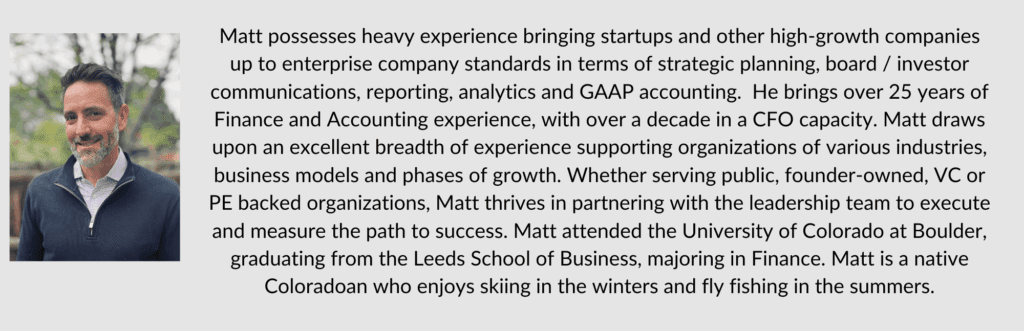
By Matt Kelly

While navigating through times of rapid growth and expansion, businesses often encounter specific challenges that can sink the ship if not recognized and avoided. An experienced CFO can help businesses identify and steer clear of these hidden dangers, helping to ensure smoother sailing to financial success.

As someone who has spent 15 years in finance roles at Fortune 150 companies and another 12 years as a CFO for high-growth firms, I specialize in leading organizations through various phases of growth, circumventing the pains and risks that commonly go along with them. Whether with a VC-funded, PE-backed, or Founder-owned firm, many of the same challenges present themselves. Here are some of the most frequently encountered: 

Ensuring the basics of your company organization are seaworthy – before getting too far from shore

Many companies are founded quite simply. Understandably most of the initial efforts are spent refining the product and GTM strategy and there is rarely much time or money spent setting up a detailed legal structure. Many times they register their trade name, get an EIN, draft up brief Articles of Incorporation and ownership documents and set off to build a business.

However, as soon as possible, a detailed legal and risk review should take place. Owners must know exactly who owns what- both profits and losses. Companies need to walk through multiple future scenarios and know exactly what happens in each case. Who gets what from a prosperous future sale? How would those gains be taxed? What about liabilities from a large lawsuit? What classes of stock will be utilized in the operating agreement, and what rights will each class have as far as participation rights, anti-dilution provisions, voting rights, etc.

Experienced CFO’s can lead this review, in tandem with good corporate counsel. We’ve seen relationships between founding partners become strained and these legal structures tested. We’ve helped design deal terms to optimize, not gross, but net gains. We’ve seen a potential sale threatened due to a seemingly innocuous document that in fact threatened the entire S-Corp status. We’ve quickly set up insurance to cover major liability gaps. We’ve even helped founders close loopholes that would have allowed them to be voted out of their own companies.

Constant assessment of your crew – ensure you always have the right talent onboard for each stage of the company’s journey

Conditions change very rapidly at growing companies. The skills required to perform a position successfully one year may totally change the next. Often companies begin as a small group of individual contributors, all hacking and hustling to get the company to viability. The next year those same mavericks may be struggling to manage teams of employees or to build documented processes.

Thorough financial and resource planning can help identify these skill set necessities before they arrive. In some cases, upskilling can take place in advance to help resources adapt and grow into those new sets of challenges. In other cases, new resources can be targeted with experience in those next phases of planned growth.

Speaking of Crew – Make sure your Accounting & Finance function isn’t malnourished

Don’t get too far into your journey before building out your top-tier Accounting & Finance function.

It is very common for businesses to neglect Finance and Accounting in their early phases. And most times they get away with it, as basic bookkeeping and simple cash management suffices while you are busy proving your concept and fighting your way to profitability.

But when you have reached the point where the business is expanding rapidly and many employees are now depending on it for their livelihood, it is time to ensure the growth and health of the company are sustained.

A strong Finance and Accounting practice brings organized and GAAP compliant accounting. It includes thoughtful planning, timely reporting, and insightful analytics. It ensures solvency through strong financial controls and cash planning and management.

It can be difficult to determine a specific amount or percent of Revenues to spend to achieve a healthy Accounting & Finance function. This depends largely on the size and complexity of the organization.

So examine your own situation. If it feels like you don’t have clarity of your results, if you don’t have solid planning and focused direction, then you likely have under-invested in your Finance and Accounting function. And know that this doesn’t have to break the bank. If your business is not large enough to require or afford a full-time CFO, by all means enlist one on a fractional basis.

Don’t sink the boat with too much cargo – when too much success can lead to serious threats

In the early stages of a company, much of the focus is (rightfully) placed primarily on  product development and sales. However, when traction starts to occur at scale, this poses a number of very real risks to the entire business if not properly planned for.

Obvious is the burden on cash. Most businesses will experience a major cash pinch in times of rapid sales growth. An experienced CFO will help you plan ahead of time for the proper amount of growth capital required if you hit or exceed your plan. And they can help you secure it most cost-effectively.

Also common are difficulties in producing or implementing your product at true scale. Oftentimes smaller organizations are running on highly manual and minimally documented procedures for the production or delivery of their products. These quickly fracture when attempting to be run at scale. A detailed planning process helps each department know about the desired growth for a coming year and then thoughtfully plan for proper resources required to achieve those goals.

Sometimes this is additional tech infrastructure. Other times it is planned investment in Operational or Procedural process improvements. A good CFO will lead the planning process to identify and address these risks in advance of your rapid success.

Focus on the Destination

Consideration of your ultimate goal is crucial. Is there a desired sale or transition plan in the future? In how long and to whom? Maybe you plan to transition the business to a family member, or slowly sell chunks of equity to employees. Perhaps the plan is to sell to a strategic buyer, to a PE firm or to go public. All of these destinations require different paths. Your legal structure, organization of your documents, your preparation for diligence and legal pre-work can all be charted out well in advance, optimized for your specific desired outcome.

In the vast ocean of business challenges, an experienced CFO can be a valuable member to have onboard. They will collaborate with your leadership team to thoughtfully plot the course and they can lean on their experience to confidently navigate the way around these, and many other potentially hazardous icebergs. Wishing you smooth sailing!

The Importance of Having a Rolling Forecast for a Company Scaling Their Business

In the dynamic landscape of business growth and expansion, having a rolling forecast plays a pivotal role in the strategic planning and decision-making processes. Unlike traditional static budgets that can become obsolete by mid-year, a rolling forecast enables companies to adapt to changing market conditions and scale their business effectively. 

Let’s explore 4 reasons why a rolling forecast is essential for companies navigating growth:

  1. Agility and FlexibilityA rolling forecast provides companies with the agility and flexibility needed to respond to market shifts and unexpected events swiftly. By updating forecasts regularly, businesses can make informed decisions based on real-time data, allowing them to adjust strategies, resource allocation, and financial planning to align with evolving circumstances.
  2. Continuous Planning and MonitoringUnlike annual budgets that may lose relevance as the year progresses, a rolling forecast facilitates continuous planning and monitoring of business performance. Companies can regularly track their progress against forecasted targets, identify variances, and take corrective actions in a timely manner to stay on course towards their growth objectives.
  3. Enhanced Decision-MakingHaving a rolling forecast enhances decision-making by providing management with current and accurate information to support strategic initiatives. By incorporating up-to-date  operational data, competitive insights, and market trends into the forecasting process, companies can make informed choices that drive sustainable growth and profitability.
  4. Strategic AlignmentA rolling forecast ensures that financial planning remains aligned with management’s strategic goals and business objectives. By incorporating short-term and long-term forecasts into a cohesive plan, businesses can maintain a clear vision of their trajectory and make informed decisions that support sustainable growth.

As companies scale their business and navigate the complexities of growth, having a rolling forecast is instrumental in driving agility, enabling continuous planning, enhancing decision-making, and maintaining strategic alignment. By embracing a dynamic forecasting approach, businesses can adapt to changing environments, seize opportunities, and achieve sustainable success.

Do you have questions or are you looking for some support with this? Reach out: ascentcfo.com

Essential Interview Questions for CFO Candidates

Selecting the right Chief Financial Officer (CFO) is a pivotal decision for any organization. Beyond technical proficiency, the ideal CFO possesses strategic vision, leadership acumen, and cultural fit. 

Here are key interview questions to uncover these crucial qualities and ensure you’re hiring the best candidate for the role:

  1. Strategic Vision: “Can you outline your approach to long-term financial planning and strategy development?” This question assesses the candidate’s ability to align financial goals with broader organizational objectives and steer the company towards sustainable growth.
  2. Leadership and Team Management: “How do you foster collaboration and cohesion within your finance team?” Understanding the candidate’s leadership style and team-building skills is essential for ensuring a cohesive and motivated finance department.
  3. Risk Management: “How do you identify and mitigate financial risks in a rapidly changing business environment?” A strong CFO must be adept at identifying potential risks and implementing strategies to safeguard the company’s financial interests.
  4. Communication and Stakeholder Engagement: “How do you communicate financial insights and strategies to non-financial stakeholders?” Effective communication is crucial for translating complex financial data into actionable insights that drive informed decision-making across the organization.
  5. Adaptability and Innovation: “Can you provide examples of how you’ve adapted financial strategies to respond to market shifts or technological advancements?” This question evaluates the candidate’s ability to innovate and adapt financial processes in a dynamic business landscape.
  6. Cultural Fit: “What values do you prioritize in a company culture, and how do you embody them as a CFO?” Assessing cultural fit ensures alignment with the organization’s values, fostering collaboration and cohesion across departments.
  7. Track Record and Achievements: “Can you share a specific accomplishment or initiative from your previous roles that you’re particularly proud of?” This question provides insights into the candidate’s track record of success and their ability to drive meaningful impact.

By asking these interview questions, organizations can delve beyond technical competencies and uncover the strategic insight, leadership qualities, and cultural alignment necessary for a successful CFO hire.

Let’s chat essential interview questions.

7 Surprising Realities When Raising Capital

Raising capital is a pivotal step for businesses aiming to scale, yet it’s a journey laden with unexpected twists and turns. While the fundamentals are widely understood, there are several surprising aspects that entrepreneurs and CFOs should be aware of. Here are seven insights to consider when embarking on the quest for funding.

  1. Relationships over Pitches: While a compelling pitch is essential, building strong relationships with investors often carries more weight. Cultivate genuine connections by attending networking events, seeking introductions, and engaging in meaningful conversations beyond the boardroom. Some investors often put team before the business model.
  2. Timing Is Everything: The timing of your fundraising efforts can significantly impact your success. Market conditions, industry trends, and even macroeconomic factors can influence investor sentiment. Be mindful of timing and seize opportunities when the market is favorable. Also, timing any fundraising to occur after hitting significant company milestones including revenue scaling, product expansion, etc. will allow for a step-up in valuation.
  3. Due Diligence Goes Both Ways: While investors scrutinize your business during due diligence, savvy entrepreneurs also assess potential investors. Evaluate their track record, portfolio companies, and alignment with your vision to ensure a mutually beneficial partnership. Check references with portfolio company founders to learn more about how they operate in the boardroom.
  4. The Power of Bootstrapping: Bootstrapping isn’t just a fallback option; it can be a strategic choice. By demonstrating revenue growth, proving market traction, and minimizing dilution, bootstrapping can increase your leverage and valuation in future fundraising rounds.
  5. Investors Want to Invest in People: Beyond your business idea, investors are investing in you. Your passion, resilience, and ability to execute are key determinants of investment decisions. Showcase your leadership qualities and vision to instill confidence in potential investors.
  6. Flexibility Is Key: Plans rarely unfold exactly as anticipated in the fundraising process. Stay adaptable and open to pivoting your strategy based on investor feedback, market dynamics, and evolving business needs.
  7. Rejection Is Inevitable, Resilience Is Essential: Rejection is par for the course in fundraising. Embrace rejection as a learning opportunity, refine your pitch, and persevere with resilience and determination.

Raising capital is a multifaceted journey filled with surprises. By understanding these nuances and approaching fundraising with diligence, agility, and perseverance, entrepreneurs can navigate the challenges and unlock opportunities for growth and success. 

Looking for some support with this? Let’s get started

When to Bring a Fractional CFO on board from Seed to Series A

As startups transition from the seed stage to Series A funding, strategic financial management becomes increasingly critical. While many founders initially handle finances themselves or rely on part-time assistance, knowing when to bring a Fractional Chief Financial Officer (CFO) into the fold can be a game-changer. 

In the seed stage: resources are often tight, and founders wear multiple hats, including financial oversight. However, as the business gains traction and secures seed funding, the complexity of financial operations grows. This is the stage where a Fractional CFO can provide invaluable expertise in financial planning, budgeting, and establishing robust financial processes.

By the time a startup approaches Series A funding: the need for strategic financial leadership becomes more pronounced. Investors scrutinize financial metrics closely, and a solid financial strategy can be a key differentiator in securing funding. A Fractional CFO brings a depth of experience in navigating fundraising, preparing financial forecasts, and communicating financial insights effectively to investors.

A Fractional CFO offers scalability and flexibility, aligning with the evolving needs of the business. Instead of committing to a full-time hire, startups can access top-tier financial expertise on a part-time basis, optimizing resource allocation and minimizing overhead costs.

By engaging a Fractional CFO at the right time, startups can set a solid foundation for sustainable growth and financial success. Is this the right time for your business? Reach out: ascentcfo.com

Essential CFO Skills for Navigating Acquisitions

Acquisitions represent both exciting opportunities and complex challenges for a business to navigate. As a key player in the acquisition process, the Chief Financial Officer (CFO) must possess a unique set of skills to ensure a successful outcome. 

Firstly, financial acumen is paramount. A CFO must have a deep understanding of financial statements, valuation methodologies, and deal structures. This includes analyzing the financial health and performance of both the target company and the acquiring company, identifying potential synergies, and assessing the financial risks and rewards of the acquisition. By conducting thorough financial due diligence, the CFO can mitigate risks and maximize the value of the deal.

Strategic thinking is another critical skill for CFOs involved in acquisitions. They must be able to align the acquisition strategy with the overall business objectives and long-term growth plan. This involves evaluating the strategic fit of the target company, identifying opportunities for market expansion or diversification, and developing a clear integration plan to realize synergies post-acquisition. By taking a holistic and forward-thinking approach, the CFO can ensure that the acquisition creates sustainable value for the company.

Effective communication and negotiation skills are also essential for CFOs in acquisition scenarios. They must be able to articulate the financial implications of the deal to key stakeholders, including the board of directors, investors, and employees. Additionally, CFOs play a crucial role in negotiating the terms of the acquisition, including purchase price, payment structure, and post-acquisition adjustments. By building consensus and fostering open communication, the CFO can facilitate a smooth and successful acquisition process.

In conclusion, the CFO’s role in an acquisition requires a diverse skill set encompassing financial expertise, strategic thinking, and effective communication. 

It’s important to acknowledge that not all full-time CFOs have the specialized skill set needed to successfully navigate a high-stakes acquisition. Consider bringing in a Fractional CFO on a part-time basis who has first-hand experience in leading acquisitions. This way you can feel confident that your financial leader can navigate the complexities of acquisitions and drive value creation for your company.

Contact Ascent CFO Solutions to learn more about bringing a Fractional CFO with specific acquisition experience onto your team.

Maximizing Your Fundraising Success: The Role of Your CFO

Fundraising is a critical milestone for any business, marking a pivotal moment in its growth trajectory. While CEOs and founders often take the lead in pitching to investors, the role of the Chief Financial Officer (CFO) in fundraising should not be underestimated. 

Here’s what your CFO should be doing to ensure fundraising success for your company:

First and foremost, the CFO plays a central role in financial strategy and planning. Before embarking on a fundraising journey, they should collaborate closely with the CEO to develop a robust financial forecast model and determine the capital requirements of the business. This involves conducting thorough due diligence on the company’s financial health, identifying key performance indicators, and projecting future financial performance. By providing investors with clear, data-driven insights into the company’s financial trajectory, the CFO instills confidence and credibility in the fundraising process.

In addition, the CFO is responsible for crafting the financial narrative. While the CEO articulates the vision and mission of the company, it’s the CFO’s job to translate that vision into financial terms that resonate with investors. This includes preparing detailed financial models, forecasts, and valuation analyses that effectively communicate the company’s growth potential and investment opportunity. By aligning financial projections with strategic objectives, the CFO ensures that the fundraising pitch is compelling and coherent.

During the fundraising process, the CFO also plays a key role in investor relations. This involves engaging with potential investors, answering their financial questions, and addressing any concerns they may have. Additionally, the CFO negotiates the terms of the investment, ensuring that the deal structure is favorable to the company while also satisfying the requirements of investors. By fostering transparent and open communication with investors, the CFO helps build trust and foster long-term relationships that extend beyond the fundraising round.

In summary, the CFO’s involvement in the fundraising process goes beyond number-crunching; it’s about strategic financial planning, effective communication, and investor relations. By leveraging their financial expertise and insights, the CFO can maximize fundraising success and pave the way for sustainable growth and prosperity.

Consider bringing in a part-time Fractional CFO as a dedicated resource to focus on your fundraising efforts. Contact Ascent CFO Solutions to find a Fractional CFO with the fundraising experience your company needs.

An Experienced CFO is Within Reach

Start Building Financial Clarity Today