Ascent CFO Solutions made the Inc. 5000 List of America’s Fastest Growing Private Companies!

How to Structure the Financials Section of a Pitch Deck: Important Considerations for Founders

Key Takeaways

  • Investors expect a structured, narrative-driven financials section that clearly connects projections, assumptions, and use of funds to measurable business drivers and milestones.
  • Credibility and capital efficiency are critical—your financials must align with actual performance, demonstrate disciplined use of capital, and present consistent, stage-appropriate metrics throughout your deck.
  • Avoid common mistakes by grounding projections in data, maintaining consistency across slides, and preparing to defend your assumptions with bottom-up analysis and clear documentation.

You might also be interested in: “How to Build the Perfect Pitch Deck”


Investors scan your pitch deck financials in under two minutes. Your numbers either tell a confident, data-driven story or investors move on to the next deck. Most founders treat this section like an afterthought, cramming spreadsheets onto slides without connecting the dots between growth and capital efficiency.

Success requires a tight framework: projections, unit economics, assumptions, scenarios, and use of funds. Each figure must link to a driver you can measure and manage. Think of your financials as an operating plan in slide form, not just numbers. 

Fractional CFOs help founders build this investor-ready structure. Schedule a call to get started.

What Financial Projections Should Be Included in a Pitch Deck

Investors evaluate financial projections in a pitch deck to assess whether your business model can deliver scalable growth potential. Your financials need to translate into concrete financial projections that demonstrate both ambition and defensible assumptions while showing how their capital creates tangible returns.

Include a 36–60 Month Financial Model with Quarterly Year 1 Detail

Your pitch deck should present a comprehensive view spanning three to five years, with Year 1 broken down quarterly and subsequent years shown annually. Include your profit and loss statement, cash flow forecast, and a balance sheet summary that reconciles to your cash position. Investors expect to see “revenue, costs, and profitability over the next 3–5 years” with realistic assumptions backing every projection.

Connect Assumptions to Measurable Operating Levers

Building on this foundation, every financial projection must tie back to specific business drivers you can track and influence. Link your revenue forecasts to pricing strategies, conversion rates, customer churn, hiring plans, and operational capacity. Show sensitivity scenarios and demonstrate how these changes impact your cash runway through detailed forecasting. The Wisconsin SBDC guide emphasizes building forecasts from “measurable components” including units sold, average selling price, and cost structure.

Map Capital Deployment to Specific Value Milestones

Finally, investors want to see how their money translates into measurable progress beyond simply sustaining operations. Connect your use of funds directly to revenue targets, margin improvements, and runway extension milestones. Show when you’ll achieve cash flow breakeven and what specific operational achievements justify future funding rounds. As noted in University Lab Partners’ funding guide, your use-of-funds slide should map spending to milestones and demonstrate how capital accelerates growth rather than just maintaining current trajectory.

How Investors Evaluate the Financials Section of a Pitch Deck

When potential funders review your financials, they’re not just looking at numbers—they’re evaluating your business judgment and strategic thinking capability. Understanding how investors evaluate the financials section of a pitch deck helps you present forecasts that build confidence rather than create concerns.

VCs evaluate your financial models based on several key criteria, focusing on credibility, capital efficiency, and consistency across all materials. You should:

  • Test for credibility by matching forecasts to current performance – Your growth assumptions must connect logically to existing traction, sales capacity, and market realities. J.P. Morgan emphasizes that potential funders expect financial projections backed by evidence rather than unsupported claims.
  • Demonstrate capital efficiency through burn metrics and payback periods – Highlight your burn multiple (new ARR per dollar spent), customer acquisition cost payback timeline, and how this funding round extends runway to specific value-creation milestones. VCs want to see disciplined capital deployment that drives measurable progress.
  • Ensure consistency across all slides and supporting materials – Your unit economics, growth rates, and key assumptions must align perfectly with earlier slides covering market size, go-to-market strategy, and traction metrics. LTSE research shows that inconsistencies between pitch deck sections immediately damage credibility.
  • Focus on stage-appropriate metrics that matter most – Early-stage companies should emphasize CAC, LTV, and LTV-to-CAC ratios, while later-stage businesses need to show path to profitability and unit economics that support sustainable growth at scale.
  • Anticipate the verification process during due diligence – Potential funders will compare your pitch deck forecasts against your data room models and actual performance trends. Any material differences require clear explanations tied to specific operational changes or market developments. 

Fractional CFO services can help ensure your financial models meet institutional standards before investor meetings.

Which Key Metrics Matter Most in Pitch Deck Financials

Investors evaluate your financials to assess three things: evidence of sustainable growth, healthy unit economics, and efficient capital deployment. The key metrics in pitch deck financials you choose should tell a cohesive story about how your business generates revenue and manages resources while scaling responsibly.

  • Growth and retention metrics: Include MRR/ARR growth rates, Net Revenue Retention from customer cohorts (aim for 110%+ in SaaS models), monthly churn rates (5-20% is realistic for early-stage companies), and average sales cycle length to demonstrate demand durability and revenue predictability.
  • Unit economics fundamentals: Present customer acquisition cost by marketing channel, lifetime value calculated from actual customer cohorts over time, gross margin by product line, and CAC payback periods (target under 12 months for most SaaS models) to prove each customer generates profitable returns.
  • Capital efficiency benchmarks: Show your burn multiple (new ARR added per dollar burned), Rule of 40 score for SaaS businesses (growth rate plus profit margin should exceed 40%), and sales efficiency using the Magic Number (quarterly revenue growth divided by prior quarter sales spend) to help investors benchmark your performance against industry standards.

How to Present Financial Data Clearly and Confidently to Investors (FAQ)

Founders often struggle with the mechanics of presenting financials—from slide count to scenario placement. These answers address how founders can present financial data clearly and confidently to investors through tactical decisions that determine whether your numbers build confidence or create confusion during your pitch.

How many financial slides should we include and in what order?

Keep your core financials to 2-3 slides within a 10-12 slide deck. Place them near the end after establishing your market opportunity and traction. Lead with revenue projections and unit economics, followed by a cash bridge showing runway and milestones. Research industry norms and follow commonly expected sections rather than reinventing structure.

Should we include our valuation in the pitch deck?

Avoid showing valuation directly in your main deck slides. Instead, reference your funding ask and use of funds, then address valuation during investor meetings when directly asked or in term sheet discussions. This approach keeps focus on your growth story rather than price negotiations. Your cap table and dilution analysis belong in the data room where investors can model different scenarios privately.

Where should scenario analysis and sensitivities go—slides or data room?

Present your base case projections in the deck with one optimistic scenario for context. Detailed sensitivity analysis and multiple scenarios belong in your data room alongside your full financial model. This keeps your pitch focused while demonstrating analytical rigor to investors who conduct detailed analysis during due diligence.

What are the most common financial mistakes founders make?

The most critical mistakes include unrealistic projections without supporting data, missing cash bridge analysis, and inconsistent metrics across slides. Fix these by grounding projections in market research, showing clear runway calculations, and ensuring your KPIs match throughout your deck. Investor-grade modeling helps avoid these pitfalls before investor meetings.

How can we defend our financial assumptions confidently?

Build assumptions from bottom-up analysis using customer data, market benchmarks, and operational capacity constraints. Document your methodology and be ready to explain key drivers like pricing, conversion rates, and hiring plans. Practice explaining how each assumption connects to your business model and why your projections are achievable given current traction.

Turn Your Financials Into a Compelling Investor Narrative

Your pitch deck financials must tell a coherent story that connects projections to operational reality. Investors evaluate credibility through consistent metrics, defendable assumptions, and clear cash runway visibility. The right structure transforms complex data into compelling evidence of growth potential and capital efficiency.

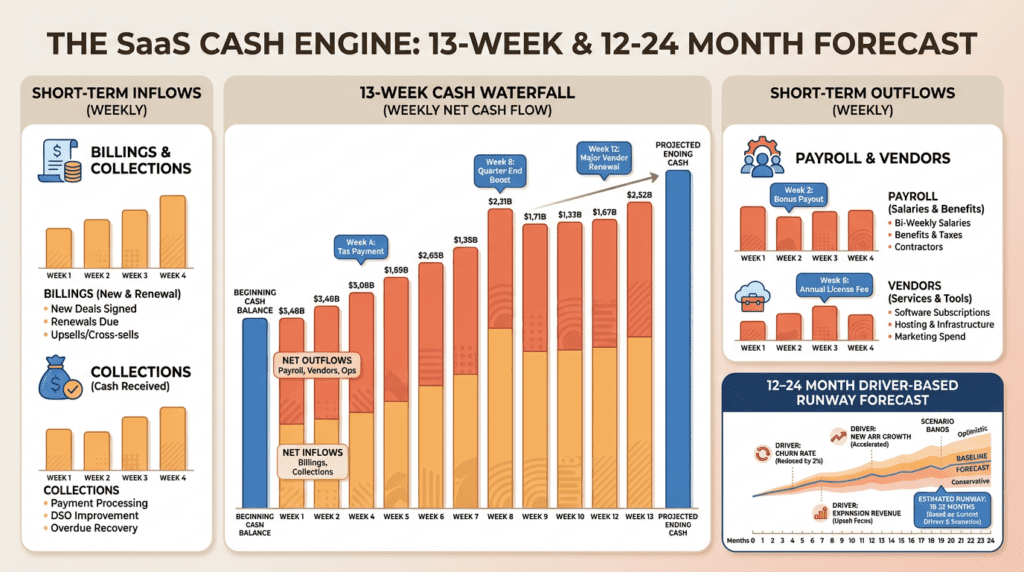
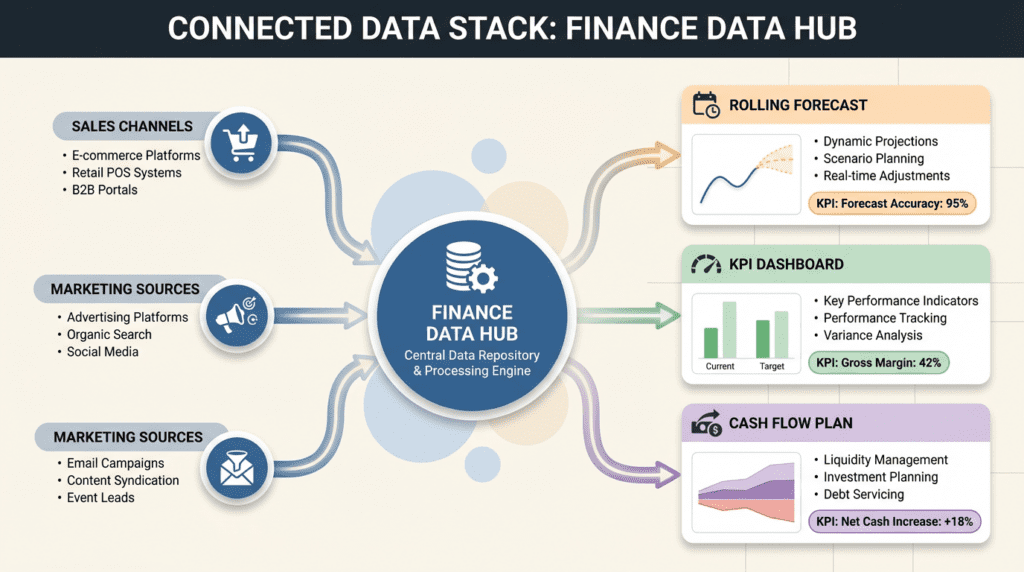
To achieve this level of investment-grade presentation, implement rolling forecasts, a 13-week cash view, and integrate your CRM, billing, and accounting systems. This unified data foundation supports the credible narrative investors demand when reviewing your pitch deck.

Ready to validate your financial story against investor expectations? Fractional CFO services for pitch deck preparation can transform your numbers into a professionally prepared narrative.

Schedule a call with an experienced Fractional CFO. We build the models and dashboards that clearly demonstrate your growth potential.

View our complementary resource: “How to Build the Perfect Pitch Deck”

How to Prepare for the Sale of Your Company

Key Takeaways

  • Early, structured sell-side preparation—ideally starting 12-24 months before going to market—significantly increases your company’s valuation and reduces deal risk.
  • Disciplined financial, operational, and legal readiness, including clean GAAP financials, organized data rooms, and risk mitigation strategies, builds buyer confidence and streamlines due diligence.
  • Engaging experienced advisors, such as Fractional CFOs, ensures your business tells a compelling, data-driven story and navigates complex deal terms, maximizing your exit outcome.

Buyers pay for certainty—reduce surprises and you increase the value of your company; increase ambiguity and buyers discount value or walk away. 

Well-prepared middle market companies that invest 12-24 months in comprehensive sell-side readiness report significantly higher satisfaction with exit outcomes. Seasoned entrepreneurs start building their valuation thesis, cleaning financials, and de-risking operations at least a full year before engaging potential buyers.

Sell-Side Readiness: What It Is and Why It Dictates Your Exit

Sell-side readiness is a structured preparation process that transforms your company from an operational business into a buyer-ready business. This comprehensive approach aligns three critical elements:

  1. valuation optimization (understanding what drives your multiple)
  2. process discipline (monthly closes, audit-ready financials, organized data rooms)
  3. risk mitigation (legal housekeeping, compliance documentation, leadership succession planning)


When these components work together, they create a cohesive story that buyers can evaluate with confidence.

The timing of this preparation is equally important. Starting your readiness work 12-24 months early compounds your negotiation leverage significantly. Each month of consistent financial closes, scalable operations, and consistent KPI monitoring builds credibility with buyers and reduces their perceived risk. 

Your readiness becomes measurable through concrete indicators: closing books within five business days, maintaining a complete virtual data room, producing investor-grade financial reports, and having documented succession plans for key roles. These aren’t just preparation activities—they’re the foundation that determines whether buyers see premium value or discount your asking price, which is why many companies engage exit planning expertise well before going to market.

Here are 14 steps to make your company exit-ready.

(1/14) Business Valuation Strategy: Clarify Your Exit Goals

Your business valuation strategy starts with understanding who will buy your company and how they calculate value.

Strategic buyers pursue synergies and often pay premiums using revenue or EBITDA multiples, while financial buyers focus on consistent returns through leveraged structures. Most mid-market companies use EBITDA multiples as the primary framework, though high-growth businesses may command revenue-based valuations. Your M&A advisory team should help you research comparable transactions within your industry and size range to establish a realistic valuation band.

Beyond understanding buyer perspectives, identify your value drivers and detractors to prioritize pre-sale improvements that maximize your multiple. Key drivers include gross margin trajectory, customer retention rates, and revenue predictability, while detractors like customer concentration or declining margins reduce buyer confidence. 

Working capital efficiency directly impacts free cash flow and can swing purchase price by 10-20%. Build base, optimistic, and conservative scenario models through cash flow forecasting that incorporate realistic assumptions about working capital changes and capital expenditure requirements to anchor your target price and establish a clear walk-away point before entering negotiations.

(2/14) Financial Statement Preparation: Have GAAP-Ready, Audit-Traceable Numbers

Buyers evaluate your company based on the reliability of your financial data, making financial statement preparation the foundation of your entire sale process. Consistent monthly closes with reconciled accounts signal operational discipline and financial control, while messy financials trigger price discounts or deal abandonment.

Your monthly close discipline directly impacts buyer confidence and negotiation leverage. Most organizations target a 5-10 day close, but achieving consistent 5-day closes demonstrates the financial rigor buyers expect from acquisition targets.

  • Close monthly within 5 business days with fully reconciled cash, accounts receivable, accounts payable, inventory, and accrued expenses
  • Adopt GAAP accounting policies for revenue recognition, lease accounting, and software capitalization where material to your business
  • Create buyer-expected schedules including revenue recognition rollforwards, deferred revenue reconciliations, and inventory costing methodologies
  • Document capitalization policies for fixed assets, intangibles, and development costs with supporting depreciation schedules
  • Implement 12-18 month audit trails with locked prior periods and version-controlled supporting workpapers for all material accounts

With disciplined financial processes in place, you can focus on building the performance metrics that prove your growth story to potential acquirers. Fractional CFO expertise can help establish these systems and ensure your financials meet buyer expectations throughout the preparation process.

(3/14) Sell-Side Due Diligence: Build a Banker-Grade Data Room

A well-organized virtual data room becomes your competitive advantage during sell-side due diligence. Some best practices include:

  • Structuring your room with clear categories—financial, legal, HR, tax, commercial, and technology—each with granular access permissions and version control. 
  • Building folders that mirror buyer expectations
  • Assigning document owners to each section
  • Implementing audit trails that track every access and download. 

Companies that invest in this upfront organization, like those in our M&A advisory engagements, answer buyer questions faster and maintain deal momentum.

Beyond organization, pre-building your Q&A process distinguishes thorough preparation from last-minute scrambling. Create response logs using standard request lists and assign subject matter experts to each category before buyers submit their first question. Target 24-48 hour response times with automated notifications and escalation procedures. Run a mock diligence review with your team or external advisors to surface missing documents, inconsistent data, or unclear explanations. 

This proactive approach, demonstrated in cases like our Nordic Ice engagement, reduces buyer surprises and preserves your negotiating position throughout the process.

(4/14) Performance Metrics Analysis: Prove Repeatable Growth

Your organized data room sets the stage, but the metrics within it determine your valuation. Buyers evaluate repeatable revenue models through specific KPIs that demonstrate sustainable unit economics and predictable growth patterns.

The right metrics provide evidence of scalable operations across different market conditions. Focus on KPIs that show both profitability and expansion potential:

  • Track LTV/CAC calculation methods above 3:1 with payback periods under 12 months to establish profitable acquisition
  • Monitor net revenue retention rates by customer cohort to show existing accounts drive expansion revenue reliably
  • Calculate cohort gross margins by product and channel to reveal which offerings generate durable profitability
  • Segment sales cycle length by deal size and customer type to establish predictable conversion timelines
  • Document KPI definitions in a glossary with 24-month historical data snapshots for uniform presentations

Companies with segmented, well-documented metrics command higher valuations and complete diligence faster. Custom dashboards transform raw numbers into compelling evidence that acquirers can underwrite with confidence.

(5/14) Operational Efficiency Improvements: Expand Margin Before Market

Strategic operational efficiency improvements start with quick wins that produce measurable, lasting results before you engage buyers. 

Focus on vendor renegotiations, SKU rationalization, and routing automation—changes that directly impact your bottom line within 90 days. Margin enhancement opportunities work because they address waste systematically while creating documentation buyers can verify during diligence.

Supply chain visibility and Sales & Operations Planning (S&OP) stabilization prevent the costly surprises that erode EBITDA. Stockouts trigger expensive expedited shipments, while excess inventory ties up working capital and creates write-offs. Companies that implement integrated forecasting and demand planning can reduce these margin drains. 

Create a before/after bridge that quantifies your savings—buyers pay premiums for proven efficiencies with supporting documentation, not promises of future improvements.

(6/14) Legal and Compliance Review: Eliminate Deal Breakers Early

Missing corporate documents, unresolved disputes, and compliance gaps become major valuation risks under buyer scrutiny. Your legal and compliance review process must identify and address issues that could derail negotiations or trigger price reductions during due diligence.

  • Refresh your cap table and confirm all equity issuances have proper board approvals and documentation
  • Review customer and vendor contracts for change-of-control clauses that could trigger renegotiations or terminations
  • Document IP assignments from employees and contractors; verify trademark and patent registrations are current
  • Address privacy compliance with updated policies, data mapping, and security audit records
  • Resolve outstanding disputes, liens, and regulatory issues before they appear in buyer diligence

Start this review 12-18 months before going to market to allow time for remediation. Organized documentation demonstrates operational maturity and reduces buyers’ perceived acquisition risk, protecting your negotiating position throughout the process.

(7/14) Risk Mitigation Strategies: Tighten Controls and Contracts

Strengthening internal controls around revenue recognition, approvals, and segregation of duties directly reduces your representations and warranties exposure during negotiations. 

Focus on established control activities like independent authorization, approval workflows, and access restrictions that prevent errors and fraud. Companies with robust segregation of duties controls reduce opportunities for someone to both perpetrate and conceal financial misstatements. Implement these changes through your Fractional CFO engagement to ensure proper documentation and testing during due diligence.

Customer and supplier concentration creates measurable financial risk that buyers discount heavily. Research shows companies with high concentration ratios experience reduced sustainable growth. Where diversification isn’t feasible, document formal mitigation plans with contract terms, alternative sourcing, and scenario planning that demonstrates risk awareness. Buyers pay premiums for predictable cash flows and penalize concentration without formalized contingencies.

Beyond operational risks, financial protection through insurance becomes equally important during M&A transactions. Refresh your Directors & Officers, cyber, and product liability policies to align with transaction-specific risks and emerging threats. D&O coverage becomes particularly important during M&A transactions, with standard purchase agreements typically requiring six-year runoff policies. Sellers might consider transactional risk insurance like representations and warranties policies, which typically cost 3-4% of coverage limits but can replace traditional escrow arrangements and reduce post-close disputes.

(8/14) Tax Implications of Business Sale: Choose the Right Structure

Tax structure decisions made 12-18 months before your sale can swing after-tax proceeds by 15-25%, making early planning one of your highest-impact moves. The tax implications of business sale decisions you make today determine how much money actually reaches your accounts after closing.

Early tax modeling prevents costly surprises when you’re negotiating with buyers who’ve already run their own numbers. The SBA identifies seven key tax strategies that sellers should evaluate, from purchase price allocation to installment sale structures.

  • Model asset versus stock sale scenarios with your tax advisor to compare after-tax proceeds and buyer appeal
  • Verify QSBS eligibility requirements early since qualified small business stock can exclude up to $10 million in federal gains
  • Assess state nexus exposure across jurisdictions where you operate, as economic nexus rules vary significantly by state
  • Clean up intercompany transactions and personal expenses to avoid IRS scrutiny under recent economic substance guidance
  • Structure rollover equity and earnout terms to optimize tax timing and minimize ordinary income treatment

These tax structure decisions require experienced guidance to navigate federal and state complexities while maximizing your net proceeds. An experienced CFO coordinates these moving pieces with your legal and tax advisors to build a cohesive exit strategy.

(9/14) Confidential Information Memorandum: Craft a Compelling Story

Your confidential information memorandum (CIM) serves as the primary marketing document that shapes buyer perception and initial offers. Successful CIMs combine a compelling narrative with detailed financial information, highlighting market tailwinds, your defensible competitive moat, and realistic growth levers. 

Focus on demonstrating momentum through consistent revenue growth, expanding margins, and proven customer retention rather than making unsupported claims. Your CFO should ensure the financial story is both ambitious and defendable, with clear explanations for any historical anomalies or seasonal patterns.

Beyond the narrative elements, consistency across your CIM, financial model, and data room becomes the foundation of buyer trust—misaligned numbers immediately raise red flags and erode credibility. Include a detailed working capital profile that explains how quickly you convert sales to cash and manage seasonal patterns. Investment banking experts recommend addressing working capital dynamics upfront to prevent buyers from applying conservative adjustments that reduce your valuation. This proactive approach demonstrates financial sophistication and reduces negotiation friction during the letter of intent phase.

(10/14) Buyer Identification Process: Map and Prioritize the Right Fits

Building the right buyer list determines whether you maximize valuation through competitive tension or waste months chasing misaligned offers. The most successful exits start with thorough research across both strategic and financial buyers, then apply careful filtering to focus time and effort on qualified prospects.

Here are the steps that turn buyer identification from guesswork into a systematic process that drives results.

  • Build comprehensive lists spanning strategic acquirers, private equity firms, and family offices using databases, industry networks, and transaction histories
  • Tier prospects by strategic fit, check size capability, and acquisition track record to prioritize outreach sequences and focus your time
  • Design confidential outreach with buyer-friendly NDAs and one-page teasers that generate interest without revealing company identity
  • Create scoring frameworks to evaluate inbound interest against your criteria for financial capacity, industry experience, and cultural alignment
  • Establish contact protocols identifying the single best initial contact at each target firm and tracking response rates across buyer segments

Companies that execute this process well often see multiple qualified offers that create competitive dynamics and drive higher valuations. The systematic approach balances confidentiality protection with market coverage to optimize your outcome. Next, you’ll need to structure deal terms that protect value beyond just the headline price.

(11/14) Deal Structure Planning: Beyond Price—Terms That Protect Value

Deal structure planning requires modeling multiple scenarios to understand how terms beyond the headline price can swing your realized value by 10–20% or more. Experienced CFOs model these scenarios upfront, comparing base-case, bull-case, and bear-case outcomes across different term structures to identify which combinations maximize your after-tax proceeds.

Beyond financial modeling, rollover equity decisions require careful alignment between your risk appetite and the buyer’s track record, particularly around governance rights that protect your ongoing investment. Legal analysis reveals that poorly structured earnouts often become litigation, making tight definitions and clear dispute resolution procedures essential for protecting your interests. Your M&A advisory team should aid in preparing a comprehensive Quality of Earnings (QoE) package that defends your normalized EBITDA with data-backed adjustments, clear methodologies, and consistent application across historical periods. 

This proactive approach, supported by robust data analytics, reduces buyer discounts during negotiations and minimizes post-close working capital disputes that can erode your final proceeds.

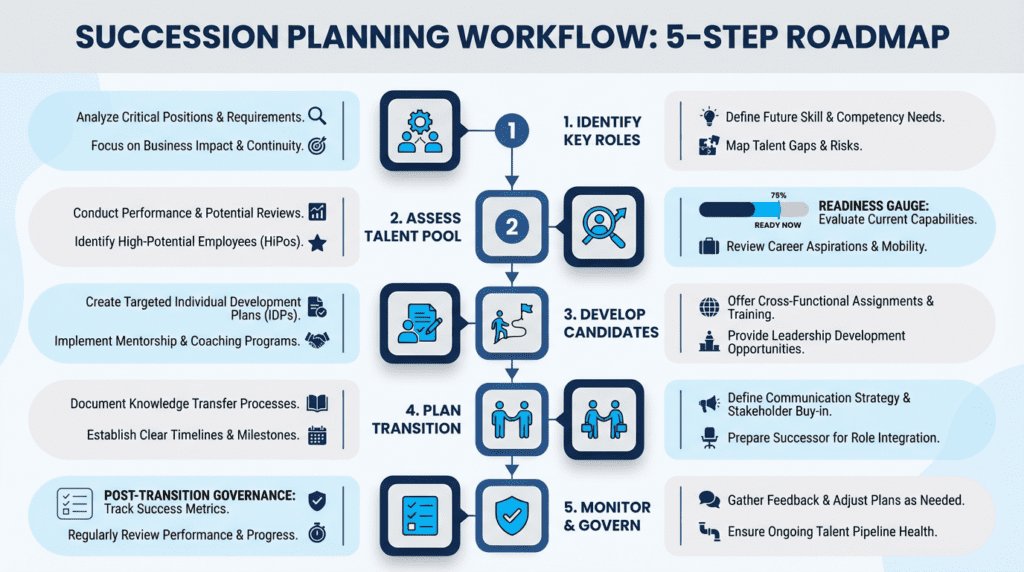
(12/14) Transition Planning for Leadership: Build a Succession-Ready Org

Leadership gaps during a transaction create significant value concerns and buyer hesitation. Research shows that seven of nine established firms lack formal succession plans, leaving critical knowledge trapped with departing leaders.

Effective transition planning for leadership requires structured timelines, documented processes, and aligned incentives to maintain continuity through close and beyond. 

Here’s how to build succession readiness that buyers trust:

  • Map succession coverage for C-suite and department heads with named backups, skill gaps, and phased accountability transfers (90-day knowledge overlap, 180-day independent operation, 365-day full transition)
  • Create knowledge-capture systems including customer relationship summaries, operational playbooks, and recorded decision-making processes to preserve institutional memory
  • Document critical processes through digital procedures that convert tacit expertise into explicit, transferable formats like SOPs and training materials
  • Structure retention incentives with service-based and performance metrics tied to post-close-integration milestones rather than just tenure
  • Engage interim leadership through Interim CFO services to bridge gaps and maintain financial continuity during executive transitions

Companies with documented succession frameworks experience smoother project continuity and faster operational pivots during ownership changes. Ascent CFO’s structured approach to interim leadership and M&A advisory support helps structure transition plans that protect value and reassure buyers about leadership stability.

(13/14) Stakeholder Communication Plan: Keep Teams, Customers, and Partners Aligned

A comprehensive stakeholder communication plan requires tiered messaging tailored to each audience’s needs and risk tolerance. Employees need reassurance about job security and culture preservation, while customers require continuity guarantees and service level commitments. Suppliers and lenders focus on contract stability and payment terms. 

Research shows that structured communication approaches during M&A transactions significantly improve employee retention and reduce operational disruption. Create audience-specific FAQs, timing controls, and documented escalation procedures to maintain alignment throughout the process.

Confidentiality management serves as the foundation for controlling information flow and preventing premature leaks that reduce valuations. Limit initial disclosure to senior executives and M&A advisors using formal NDAs and retention incentives. Assign a dedicated communications lead who can track sentiment, respond to concerns, and coordinate messaging across all stakeholder groups. Prepare leak response scripts and establish communication protocols that enable rapid, consistent responses while preserving deal momentum and team morale through strategic financial leadership.

(14/14) Post-Sale Integration Planning: Set the Table for Day 1 Success

Post-sale integration planning determines whether your deal creates or destroys value after close. Research shows that up to 85% of deals fail to deliver expected returns, often due to poor execution in the critical early weeks.

Successful integration requires advance coordination between your team and the buyer’s integration office. Start these conversations during final negotiations to avoid costly surprises and operational disruption. Focus on these core areas:

  • Define immediate priorities covering systems access, payroll continuity, benefits transfers, and customer communication protocols
  • Pre-align integration thesis on standalone operations versus platform roll-in to prevent costly strategy reversals
  • Map synergy roadmap with named owners, 30/60/90-day milestones, and measurable KPI targets for tracking progress
  • Establish joint steering committee with weekly check-ins between your leadership team and the buyer’s integration office
  • Secure operational continuity through interim IT access, cash management protocols, and vendor payment processes

Yale research emphasizes that stabilization priorities should be completed within 30 days of close, while broader integration unfolds over months. Professional M&A advisory and Fractional CFO support help structure these handoff plans effectively and reduce execution risk.

Well-planned integration protects your team’s efforts and maximizes the value you’ve built. Your preparation work pays dividends by demonstrating a smooth, predictable transition that buyers can execute confidently.


FAQ: How Do We Prepare for a Sale (Sell-Side Readiness)?

Business leaders preparing for an exit face dozens of tactical decisions that can make or break their transaction. These answers cut through the complexity with specific timelines, process steps, and decision frameworks that protect value and reduce surprises.

When should preparation start for a sale—12, 18, or 24 months?

Start sell-side preparation 12-24 months before going to market. Companies with clean financials and strong operations can prepare in 12 months. Those needing margin improvements, system upgrades, or legal cleanup require 18-24 months to avoid rushed fixes that buyers discount.

Do we need a Quality of Earnings (QoE) before going to market?

A sell-side QoE takes 4-6 weeks and often increases valuation by demonstrating normalized cash flow. It reduces buyer surprises and strengthens your negotiating position. Companies with complex revenue recognition—such as subscription models or multi-element arrangements—benefit most from pre-sale QoE work.

How do we manage confidentiality while engaging potential buyers?

Use staged information sharing starting with non-confidential information after signing robust NDAs. Create need-to-know circles that expand systematically as your process advances. Maintain separate data room access levels and designate single points of contact to control information flow.

What financial systems and reports do buyers expect to see?

Buyers expect monthly closes within 5 business days, accounting standards that buyers recognize, and detailed KPI reporting covering the last 24 months. Prepare income statements, cash flow forecasts, balance sheets, and forward projections. Document revenue recognition policies, working capital schedules, and customer concentration analyses.

What’s the difference between an IOI and LOI, and how should we respond?

An Indication of Interest (IOI) is a preliminary, non-binding expression of buyer interest with rough valuation ranges. A Letter of Intent (LOI) includes specific terms, price, structure, and often grants exclusivity. Respond to IOIs quickly but negotiate LOI terms carefully—exclusivity shifts leverage to the buyer.

What KPIs matter most to strategic vs. financial buyers?

Strategic buyers pay premiums for distribution access, proprietary data, and talent acquisition—they focus on synergy potential. Financial buyers prioritize recurring revenue, unit economics, and cash conversion metrics. Tailor your KPI presentation to emphasize the metrics your target buyer type values most.

How do we prepare leaders and teams for post-close integration?

Create 90/180/365-day transition plans with clear accountabilities and knowledge transfer documentation. Formalize succession planning and retention incentives for key personnel. Align on integration approach (standalone vs. platform) early to avoid value-destructive conflicts after closing.

Should we hire a Fractional CFO, banker, or both for sell-side readiness?

Fractional CFOs excel at financial preparation, QoE support, and systems cleanup over 12-18 months. Investment bankers manage buyer outreach, negotiations, and deal execution. Most mid-market companies benefit from both: a Fractional CFO for readiness work, then adding a banker for the active sale process.

You’re Ready to Capture Full Value—Now Build Your Sell-Side Plan

After working through 14 comprehensive readiness steps, your sell-side success depends on disciplined execution starting 12-24 months before market. Clean financials, operational improvements, and risk mitigation compound into higher valuations and smoother negotiations. Each month of advance planning reduces buyer surprises and strengthens your position.

The systematic framework transforms complex M&A theory into actionable milestones. From valuation strategy through post-close integration, structured preparation protects your team’s efforts and captures full enterprise value. Fractional CFO guidance accelerates this process with specialized expertise and flexible engagement models.

Ready to scope your timeline and build your sell-side strategy? Schedule a call with an experienced Fractional CFO to map your specific readiness milestones, assign ownership for each workstream, and create accountability for execution. Your successful exit starts with this conversation.

5 Financial Red Flags That Drive Investors Away

Every founder thinks their financials are ready. Due diligence proves otherwise.

The Gap Between Founder Metrics and Investor Standards

You’ve been running the business on the numbers that matter operationally. Revenue growth, customer acquisition, product velocity. These metrics drove your success so far.

Investors evaluate different questions. Can this business generate returns at scale? Where could capital get trapped? What happens under stress? How much do we trust these numbers?

The disconnect shows up fast when diligence begins.

Your monthly financials show revenue trends clearly. But when investors ask for cohort analysis, retention curves, or unit economics by channel, the data doesn’t exist in usable form.

Your cash position looks healthy today. But when they model forward scenarios, they can’t reconcile your burn rate claims with actual spending patterns in the details.

Your revenue recognition follows your interpretation of contracts. But when their audit team reviews, they question whether it aligns with accounting standards they expect.

None of these gaps mean you’ve done anything wrong. They mean your financial infrastructure was built for running the business, not for surviving institutional scrutiny.

The problem compounds because fixing these issues during diligence looks worse than having them resolved beforehand. Scrambling to produce analysis you should already have signals that financial discipline hasn’t kept pace with growth.

The specific issues that derail fundraising tend to cluster around five core areas. Each reveals something about your operational and financial maturity that extends beyond the numbers themselves.

Disclaimer: Many of the metrics we mention are SaaS specific, but the “red flag” concepts are relevant across industries. Contact us to discuss your situation and the specific metrics investors keep their eyes on in your industry.

Red Flag #1: Revenue Quality Issues

Investors don’t just want to see Revenue Growth. They want to understand where revenue comes from, how sustainable it is, and whether the numbers are defensible.

Revenue red flags to investors include:

Inconsistent revenue recognition practices immediately raise concerns. If you’re recognizing multi-year contracts upfront while competitors recognize ratably, investors question whether growth is real or just aggressive accounting. Even if your approach is technically acceptable, deviation from industry norms requires explanation that invites skepticism.

Concentration risk in the customer base makes investors nervous regardless of total revenue. If your top three customers represent 40% of revenue, the risk profile changes dramatically. Losing one relationship could crater the business. This concentration often develops naturally during early growth but becomes a major concern at scale.

Unclear distinction between recurring and non-recurring revenue creates doubt about business model sustainability. SaaS companies should have clean ARR or MRR metrics. If professional services revenue gets bundled with subscription revenue, or if one-time implementation fees inflate recurring metrics, investors lose confidence in the story you’re telling.

Revenue backing out of the business through churn that’s not clearly disclosed destroys credibility. If you’re adding $200K MRR monthly but losing $150K through churn, the net growth looks different than gross new logos suggest. Investors expect gross retention, net retention, and cohort data. Missing this analysis suggests you either don’t track it or don’t want to show it. Net retention in particular is a metric that many investors want to dig into.

Unusual spikes or dips without clear explanation trigger investigation. If Q4 was exceptionally strong, investors want to know if that’s seasonal, driven by one-time deals, or the beginning of accelerated growth. Patterns that don’t make sense operationally often signal accounting adjustments or unsustainable practices.

These issues rarely kill deals alone. But combined with other concerns, they create a narrative of financial immaturity that makes investors doubt whether you can scale responsibly.

Red Flag #2: Cash Management Weaknesses

How you manage cash reveals operational discipline in ways profit-and-loss statements don’t capture.

Cash management red flags to investors include:

No rolling cash flow forecast is among the most common and damaging gaps we see. Founders often track cash position as a point-in-time metric. Investors want to see 12 to 24 months projected forward with scenario planning built in. Without this, you can’t credibly discuss runway or capital needs.

Burn rate that’s difficult to defend or explain creates immediate concern. If your burn has been increasing faster than headcount or revenue growth, investors want to understand why. If you can’t articulate what’s driving spend and how it connects to growth, they assume operational discipline is weak.

Working capital issues hidden in strong revenue growth often surprise founders during diligence. You might be growing 80% year-over-year while simultaneously running low on cash because receivables stretch out, customers pay slowly, or you’re funding inventory growth. Investors need to see working capital analyzed separately from profitability.

Unclear separation between company and founder finances in earlier-stage businesses raises serious concerns. Personal credit cards covering business expenses, unclear reimbursement policies, or company funds used for ambiguous purposes all signal that financial boundaries aren’t established. This looks unprofessional at best and concerning at worst.

No contingency planning for cash emergencies suggests you’re operating without margin for error. Investors expect to see lines of credit established, relationships with banks in place, or clear plans for what happens if revenue dips or a major customer delays payment.

The underlying message these weaknesses send is that you’re managing cash reactively rather than proactively. At early stages, that’s survivable. At the scale where institutional capital becomes involved, these gaps often increase perceived risk and slow or complicate the process.

Red Flag #3: Unit Economics That Don’t Add Up

Unit economics tell investors whether your business model actually works at scale. Gaps here often kill deals even when top-line growth looks impressive.

Unit economics red flags to investors include:

CAC and LTV calculations that can’t be defended immediately undermine your growth story. If you claim a 5:1 LTV:CAC ratio but can’t show the underlying cohort data, payback period analysis, or churn assumptions, investors assume the numbers are optimistic at best.

Ignoring fully-loaded costs in CAC calculations is a classic mistake. Founders often calculate CAC using only direct ad spend or sales commissions. Investors want to see fully-loaded costs including sales team salaries, marketing overhead, tools, and allocated administrative costs. The ratio deteriorates significantly when calculated properly.

LTV based on assumptions rather than observed behavior creates skepticism. If you’re calculating lifetime value using assumed churn rates from industry benchmarks rather than your actual data, investors question whether you understand your business. Early-stage companies sometimes lack sufficient data, but that’s a different problem than having data and not using it.

Gross margins that are lower than expected for your business model raise questions about pricing power, cost structure, or competitive position. For SaaS businesses, many institutional investors look for gross margins in the 60–80% range depending on model and stage. If yours are significantly lower, investors need clear explanations about what’s different and when margins will improve.

Deteriorating unit economics as you scale is particularly concerning. If your CAC is rising while LTV stays flat or decreases, something is breaking in your growth model. Investors see this as evidence that your early success came from easy wins that won’t continue.

These metrics matter because they reveal whether growth is profitable or just expensive. Investors don’t fund businesses that spend a dollar to make ninety cents, regardless of revenue growth rate.

Red Flag #4: Financial Infrastructure Gaps

The systems and processes supporting your financials matter as much as the numbers themselves.

Financial infrastructure red flags to investors include:

Using cash-basis accounting beyond the earliest stages signals financial immaturity. Accrual accounting becomes necessary as complexity increases. If you’re still on a cash basis at a meaningful revenue scale, investors question whether your finance function can support the business you’re building.

Month-end close taking more than two weeks suggests process problems. Many investors view timely month-end closes as a signal that the finance function can keep up with the pace of the business. Longer timelines indicate either understaffed accounting teams, poor systems, or both. This delay means you’re making decisions on stale data and likely can’t respond quickly when things change.

No reconciliation process for key accounts creates doubt about number accuracy. If your bank balances, accounts receivable, or deferred revenue balances aren’t reconciled monthly, errors accumulate. Investors discovering reconciliation gaps during diligence assume other problems exist that haven’t been found yet.

Lack of documentation for accounting policies makes numbers difficult to trust. How do you handle revenue recognition? What’s capitalized versus expensed? How are reserves calculated? Without documented policies applied consistently, investors can’t trust that numbers are comparable period-over-period.

Spreadsheet dependency for critical financial processes becomes risky at scale. If your entire forecasting model, commission calculations, or revenue recognition lives in complex Excel files maintained by one person, investors see single-point-of-failure risk. This often indicates you’ve outgrown your systems but haven’t invested in upgrading them.

No formal budgeting or variance analysis process suggests you’re not managing to a plan. Investors want to see budget versus actual analysis with explanations for meaningful variances. Operating without this framework indicates reactive rather than proactive financial management.

These infrastructure gaps compound as the business grows. What worked at $2M revenue creates chaos at $10M. Investors evaluating your company at $10M are modeling what happens at $50M. If your current infrastructure is already strained, they doubt your ability to scale.

Red Flag #5: Team and Governance Concerns

Financial credibility extends beyond numbers to the people and processes managing them.

Team and governance red flags to investors include:

A Controller or Accounting Manager overwhelmed by current scale is a common issue. The person who handled your books at $3M revenue often can’t manage the complexity at $15M. If your finance team is visibly struggling, investors worry about what happens when growth continues.

No separation of duties in financial processes creates both fraud risk and error risk. If the same person approves invoices, cutting checks, and reconciling bank accounts, you lack basic controls. Investors expect segregation of duties appropriate to your size.

Board receiving insufficient or late financial information suggests either capability gaps or transparency concerns. Investors joining your board expect timely, accurate financial packages. If current board members don’t receive this, future investors assume they won’t either.

Founder making all financial decisions without appropriate input indicates centralization risk. At earlier stages this is normal. As complexity increases, founders need to delegate financial decision-making to qualified team members. Continuing to bottleneck everything through the founder signals you haven’t built a scalable leadership model.

No relationship with a reputable accounting firm for audits or reviews raises questions. If you’ve never had an independent firm assess your financials, investors wonder what issues might be hiding. The cost of a review or audit is small compared to the credibility it provides.

Lack of basic financial controls and policies suggests operational immaturity. Do you have approval hierarchies for spending? Travel and expense policies? Procurement processes? These seem bureaucratic but their absence at scale creates both financial risk and cultural problems.

Team and governance issues are harder to fix quickly than most financial gaps. Investors evaluating these concerns are really asking whether your organization is ready for institutional capital and the scrutiny that comes with it.

How These Issues Look Different Across Business Models

The specific red flags that matter most vary depending on your business model and stage.

SaaS businesses face intense scrutiny on revenue quality, retention metrics, and the efficiency of customer acquisition. Investors expect clean recurring revenue metrics, cohort analysis showing retention curves, and CAC payback periods that make sense. Professional services revenue mixed into subscription revenue or lumpy implementation fees create immediate concerns.

Marketplace or platform businesses get challenged on take rate sustainability, supplier and buyer concentration risk, and network effects that actually exist versus those claimed in pitch decks. Unit economics needs to show both sides of the marketplace. Gross merchandise volume growth without improving take rates often signals competitive pressure.

Service businesses with project-based revenue need exceptional clarity on backlog, pipeline conversion rates, and utilization metrics. Investors want to see how efficiently you deploy team capacity and whether growth requires proportional headcount increases. Gross margins and project profitability visibility matter more than in product businesses.

Manufacturing or physical product businesses face working capital scrutiny, inventory management questions, and supply chain risk assessment. Investors need to understand cash conversion cycles, supplier concentration, and how you manage inventory turns. Growth that requires proportional working capital investment creates financing challenges.

The underlying principles stay consistent across models: investors need to trust your numbers, understand your economics, and believe you can manage complexity as you scale. How those principles manifest in specific metrics changes based on what you’re building.

What Investor-Ready Actually Looks Like

From an investor perspective, strong companies share common traits:

  • Month-end close within 5 to 10 business days
  • Board-ready financial packages with variance analysis and forward commentary
  • Clear cohort analysis showing retention, expansion, and contraction
  • Defensible unit economics with documented assumptions
  • Rolling forecasts with downside scenarios
  • Controls and policies appropriate to scale
  • Finance leadership that understands strategy, not just reporting

These companies move through diligence quickly because there is nothing to excavate.


Why All of This Gets Harder as You Grow

Financial complexity doesn’t scale linearly with revenue. It compounds.

At $2M in revenue, basic bookkeeping and simple cash management might suffice. One or two people can handle your financial operations while also doing other jobs.

At $10M, you need proper accounting systems, formal processes, and specialized roles. The person who handled your books at $2M is likely overwhelmed. But the business can still function with gaps because the founder can fill holes through direct involvement.

At $30M, gaps become crises. Systems strain, errors multiply, and decision-making suffers from poor information. The infrastructure that should have been built at $10M now needs emergency implementation while trying to manage a complex, fast-growing business.

This progression happens faster than most founders expect. The time to build financial infrastructure is before you desperately need it, not after it’s already breaking.

Investors evaluating you at $10M aren’t asking whether your systems work today. They’re asking whether they’ll work at $30M and beyond. If your current infrastructure is already strained, the likelihood of a “yes” is lower.

When Getting Help Makes Sense

Most founders do not need a full-time CFO early-on. But many need experienced perspective sooner than they expect.

Signals include:

  • Board questions you struggle to answer
  • Anxiety about diligence
  • Financial decisions made without confidence in the data
  • A finance team that is busy but not effective

An honest assessment before fundraising often saves months of wasted effort and materially improves outcomes.

If you are considering fundraising in the next 6 to 18 months and want to understand how your financial infrastructure will look under investor scrutiny, that conversation should happen sooner rather than later.

Diligence does not punish ambition. It punishes fragility.

Get the Financial Help You Need

We work with founders preparing for institutional fundraising who need honest assessment of whether their financial infrastructure will survive diligence.

Our focus is on realistic assessment, not sales pitches. If your situation is strong and issues are minor, we’ll tell you that. If significant gaps exist, we’ll be direct about what needs fixing and what it takes to get there.

If you’re considering fundraising in the next 6 to 18 months and want to understand how your financial infrastructure looks from an investor perspective, a conversation makes sense.

Book a discovery call when you’re ready for an honest look at whether your financials help or hurt your next raise. We’ll connect you with an experienced Fractional CFO who will tell you what they see and what it means.

BONUS: Questions That Reveal Whether You Have a Problem with Your Financial Operations

Ask yourself these questions honestly. If you can’t answer them quickly and confidently, investors will struggle with them too.

1. Can you produce a rolling 18-month cash flow forecast in the next 48 hours? 

Not just the current cash position. Actual weekly or monthly projections showing expected inflows, outflows, and ending balances under your base case and a reasonable downside scenario.

2. Do you know your fully-loaded CAC and true LTV by customer cohort? 

Can you show how these metrics have trended over time? Can you defend the assumptions underlying your calculations?

3. Could your Controller explain your revenue recognition policy to an auditor right now?

Is it documented? Applied consistently? Defensible under accounting standards relevant to your industry?

4. If your best finance person quit tomorrow, would the business keep running smoothly? 

Or does critical knowledge and process live entirely in one person’s head?

5. Can you explain why your burn rate is what it is? 

What percentage goes to the product? Sales and marketing? G&A? How do these allocations compare to benchmarks for businesses at your stage?

6. Do you know your gross margin percentage by product or service line? 

Can you explain why it’s at that level and when you expect it to improve or deteriorate?

7. Would an investor trust the numbers you’re showing them? 

Have they been reviewed by anyone external? Do they reconcile with bank statements and tax filings?

These aren’t gotcha questions. They’re basic financial literacy for businesses operating at scale. Struggling to answer them suggests your financial infrastructure hasn’t kept pace with business complexity.

Year In Review 2025

A Note from Dan DeGolier

All,

As we wrap up 2025, I’m filled with gratitude — not just for what Ascent CFO Solutions achieved this year, but for who helped make it possible: our clients, partners, and extraordinary team.

The global economic backdrop presented its challenges for everyone — geopolitical uncertainty, tariff pressures that created planning headwinds across industries, and evolving interest rate policy that, thankfully, eased moderately later in the year. While that environment made forecasting more complex than in past cycles, it also reinforced a core truth: companies with clarity around their financial strategy thrive — even amid uncertainty.

This year feels like a true inflection point for Ascent. I’ve been blown away by the culture we’re building and the level of alignment across our leadership team as we continue to grow and do meaningful, high-impact work for our clients. We invested intentionally in strengthening our foundation — upgrading our sales and marketing infrastructure, continuing to adopt AI tools that support better and faster outcomes, and reinforcing a belief I’ve shared before: we don’t want to grow for growth’s sake, but rather in a way that’s deliberate and sustainable, with the right people serving the right clients. More than anything, I feel immense pride in the team we’ve built and the way they continue to show up for each other and for our clients.

As we enter 2026, I encourage you to think about this quote from Sameer Dholakia, Partner at Bessemer Venture Partners: “Everything that got you to where you are… isn’t going to get you where you want to be” (SaaStr). Scaling, whether from $2M to $20M in revenue or beyond, requires a different mindset and structure than early-stage startup success. 

This idea resonates powerfully with our perspective on scale:

  • Systems and processes matter more than ever — from financial planning and analysis to sales forecasting and operational rigor.
  • Leadership evolution is critical. Growing companies must assess whether current roles and structures serve the next stage of growth — and embrace change when necessary.
  • Profitability becomes a strategic priority. The narrative of “growth at all costs” continues to give way to a more sustainable approach: control your destiny, drive toward profitability, and do so with capital discipline.
  • Fractional leadership continues to play an important role for growing companies — particularly at the CFO level. More businesses are choosing experienced, flexible financial leadership that can meet them where they are, help bring focus to what matters most, and support thoughtful planning for what comes next.

I hope you and your loved ones enjoy a restful holiday and a thoughtful close to your own year. If there’s anything I can do to support you on your journey into 2026, please reach out.

Here’s to entering the new year with clarity, momentum, and confidence in the path ahead.

Cheers,
Dan 

Dan DeGolier
Founder & CEO
Ascent CFO Solutions


Another Year with an Amazing Team!

Here are some highlights from our team events and gatherings this year.

“The Ascent CFO Solutions team has been super professional and extremely impactful at our company. We were in an entirely different spot when we signed on with Ascent CFO, and the team has helped us mature immensely – so much so that we hired our own Controller and have a real finance department now! Thank you again for such a valuable engagement.” – T.R. Ludwig, CEO, Brooklyn Solarworks


What Companies Are Asking For in 2026

Interim CFO

Companies that need full-time or near full-time CFO support benefit from our Interim CFO Services. Whether managing planned departures, parental leave, sudden exits, or leadership transitions, we provide immediate continuity in financial operations and strategic guidance. Our team steps in within 48 hours to maintain reporting cadences and keep growth initiatives on track. Meanwhile, our in-house recruiter can help you identify and hire top finance and accounting talent to fill a permanent position.

Reporting, Automating & Visualizing Data

Think about how much more clear (and faster) your strategic and day-to-day decisions could be with a single, real-time view of your numbers and KPIs. You have a lot of potential in your data—the next step is cleaning it up and putting it together in a way that lets you and your team instantly see what’s working, what’s not, and where to focus next. That’s what Insights by Ascent CFO delivers.


Client Showcase

At Ascent CFO Solutions, we’re lucky to partner with bold, brilliant companies doing meaningful work across a variety of industries. As we close out the year, we want to extend a special cheers to the following clients:

Big wins for cybersecurity! RADICL was named a 2025 Colorado Companies to Watch winner, a well-deserved nod to their innovation and impact. As a cybersecurity leader, RADICL protects small and mid-sized businesses that are critical to America’s defense and infrastructure. We’re proud to support a company safeguarding what matters most.
See the full list of 2025 winners

Thirty-five years of spreading light. Sunsense Solar celebrated its 35th anniversary, marking more than three and a half decades of leadership in renewable energy and sustainability. That’s a legacy worth celebrating—and a future that’s looking very bright.
Read more about their anniversary celebration

Momentum is flowing at Rinse! This year they announced a $23M Series D, expanded operations into Canada, and hired their own Internal Controller—a clear signal of a maturing organization and finance function. We love seeing companies hit this exciting stage of growth.
Read the Series D announcement

Global recognition alert: Healthmine was named to TIME’s “World’s Top HealthTech Companies of 2025”, highlighting their leadership at the intersection of healthcare and technology. Innovation with impact—and international applause to match.
Read the Businesswire announcement
See TIME’s full list

To the moon (and beyond)! CisLunar Industries was recently featured on NPR’s Marketplace Morning Report as part of its series on the emerging Lunar Economy, spotlighting their role in building the future of space infrastructure. They were also selected for a $1.9M Space Force contract to develop revolutionary space power and propulsion technology—and they’re seeing strong momentum in funding their Seed Round. Colorado innovation, cosmic scale.
Listen to the NPR feature
Read about the Space Force contract

Congratulations to all of our clients on an incredible year of progress, innovation, and impact. We’re honored to be part of your journey.


Ascent CFO Career Opportunities

Do you know talented finance & accounting professionals who thrive in a fast-paced and flexible environment and want to work across diverse industries?

Please send these opportunities to your network!

We’re actively searching for Controllers to join our team of fractional finance professionals. Fractional Controllers are experienced accountants with strong leadership abilities, responsible for leading accounting processes for our client organizations.

We’re always looking for talented CFOs, Accounting Managers, and Senior Accountants too!


Team Member Spotlight

Meet a few of the talented professionals we’re grateful to have on board this year! 

Molly Jones,
VP of Client Success and Operations

Molly brings over 15 years of diverse experience across accounting, recruiting, HR, sales, and operations, helping organizations solve complex business challenges and unify cross-functional goals. Her passion for problem-solving and deep industry perspective drive client success and operational excellence at Ascent CFO Solutions.


Kristen Mello, Director of Sales

With more than 20 years of revenue and sales leadership experience across SaaS, proptech, professional services, and talent marketplaces, Kristen excels at building scalable go-to-market strategies and driving growth. She has consistently led high-performing teams and strengthened sales operations to accelerate business success. 


Alex Vorobieff, MBA,
Fractional CFO

Alex is a seasoned financial executive with over 30 years of experience helping companies across industries evolve their business models, improve financial systems, and drive sustainable growth. He has guided both startups and mature organizations through critical transitions and brings deep expertise in strategic financial leadership with a track record of transforming financial operations.


Kimberly Ferguson, MBA,
Accounting Manager

Kim serves as an Accounting Manager, applying her MBA-level expertise to oversee accurate financial reporting and support robust accounting operations. She plays a key role in maintaining financial integrity and enabling smooth day-to-day finance functions for our clients.


Derek Johnson,
Fractional CFO

Derek brings nearly 20 years of finance and accounting experience working with venture- and private-equity-backed companies across industries such as SaaS and consumer goods. He has built financial processes from the ground up, led diligence and integration for M&A, and supports clients with actionable financial strategy.

We invite you to learn more about all the experienced professionals on your Ascent CFO team who can help your business gain financial clarity and reach its full potential: Meet Your Team

“Ascent CFO has been a great partner, enabling our company to grow with confidence. As a former FP&A professional and current start-up CEO, I knew I needed to bring in the experts once our company started to take off. The Ascent CFO team stepped in with Fractional CFO and accounting services that saved me mountains of time. They have my strongest recommendation!” – Gary Calnan, CEO, CisLunar Industries


2025’s Most Popular Resources

More Popular Resources:


We are proud and honored to be recognized for our growth and excellence through local and national awards this year.


Thank you for being here. We are wishing you a joyful and prosperous 2026!

Happy New Year!

From Chaos to Clarity: How to Build Financial Forecasts That Drive Real Decisions

Your financial forecast sits in a spreadsheet gathering digital dust while you make decisions based on gut feel and bank balance checks. This article shows you how to build forecasts that actually shape your strategy instead of just impressing investors once a year.

You built a forecast when you raised your last round. The investors loved it. Your board approved it. Then you filed it away and never looked at it again because reality diverged from your projections by month two, and updating it felt like rearranging deck chairs on the Titanic.

Now you’re six months into the year, and someone asks about your burn rate. You open that forecast, see numbers that bear no resemblance to actual performance, and realize you’ve been flying blind for half a year. The forecast that took you 40 hours to build has delivered exactly zero decision-making value.

Here’s what most founders don’t realize: forecasts fail not because reality is unpredictable, but because most forecasts are built for the wrong purpose. You’re creating static documents designed to satisfy external stakeholders when what you actually need are dynamic models that illuminate trade-offs and guide choices. The difference between these two approaches determines whether your forecast becomes a strategic asset or expensive theater.

Why Most Financial Forecasts Gather Dust

Most founders approach forecasting the same way they approached term papers in college. Create something impressive-looking, submit it to the authority figure, then never think about it again until the next deadline.

Your forecast probably lives in a complex Excel file with multiple tabs, intricate formulas, and assumptions buried three layers deep. It took weeks to build. It looks professional. It projects confidence about the future. It’s also completely useless for making actual decisions.

Traditional forecasts fail in three predictable ways:

1. They’re built for a moment in time, not ongoing use.

  • Created for fundraising, board decks, or investor updates
  • Optimized to impress rather than to operate
  • Difficult to update due to rigid structure and deeply embedded formulas
  • Become outdated within weeks, turning into static historical artifacts

2. They confuse precision with accuracy.

  • Show revenue three years out down to the exact dollar
  • Yet can’t predict next quarter within a reasonable range
  • False precision creates a misleading sense of control
  • Precision distracts from understanding real, high-impact drivers of the business

3. They lack the flexibility to answer real operational questions.

  • Can’t easily model hiring decisions like “What if we hire three engineers instead of five?”
  • Can’t show runway impact of delaying a product launch
  • Require hours of manual reconstruction to run new scenarios
  • Result: leaders make decisions without the forecast, defeating its purpose

The pattern plays out the same way in every fast-growing company. You spend enormous time creating a forecast that immediately becomes obsolete, then operate without any financial visibility until the next formal planning cycle forces you to repeat the process. Meanwhile, your competitors with better financial forecasting systems are making data-driven decisions weekly while you’re still trying to close last month’s books.

What a Real Decision-Driving Forecast Actually Does

Strategic financial planning is about understanding the relationships between variables well enough to make informed trade-offs.

A real forecast shows you what levers you can actually pull. It illuminates the connections between headcount, revenue growth, and runway. It reveals which assumptions matter most and which ones are just noise. It transforms abstract strategy discussions into concrete scenarios with measurable consequences.

Here’s what changes when your forecast actually works. You can model hiring decisions before posting job descriptions instead of making gut calls. You understand exactly how delaying revenue affects your next funding timeline. You spot cash crunches three months before they happen instead of discovering them when you’re scrambling for emergency capital.

Your board meetings shift from reporting what happened to discussing strategic options. Instead of explaining why you missed targets, you’re walking through scenarios showing trade-offs between growth speed and burn rate. The conversation becomes forward-looking because you have tools that illuminate paths instead of just documenting outcomes.

Business modeling for startups succeeds when it accepts uncertainty rather than pretending it doesn’t exist. You’re not trying to predict exactly what will happen. You’re building a framework that helps you understand what matters most and respond intelligently when reality diverges from expectations.

The mental shift matters enormously. Stop thinking about forecasts as documents you create and think about them as systems you maintain. The value comes from the ongoing process of updating assumptions, testing scenarios, and refining your understanding of how your business actually works.

The Core Components of a Decision-Worthy Forecast

Building a forecast that actually drives decisions requires getting specific about what you’re measuring and why it matters.

1. Revenue Modeling Comes First, but Not the Way You Think 

You don’t need to forecast every customer and contract individually. You need to understand your revenue drivers and model them at the right level of detail. For SaaS companies, that means new bookings, expansion revenue, and churn by cohort. For e-commerce, it’s traffic, conversion rates, and average order values. Model the drivers, not the outcome.

Your revenue model should answer questions like “what happens if we close 20% fewer deals but increase deal sizes by 30%?” If it takes you more than five minutes to answer that question, your model is too rigid to be useful.

2. Expense Forecasting Separates Fixed From Variable Costs and Ties Spending to Strategic Decisions 

Your largest expense category is probably headcount, so model it at the departmental level showing when each role starts and what they cost fully loaded. Don’t just project “salaries increase 15% per year.” Show exactly who you’re hiring, when, and why.

Other expenses should flex based on revenue or headcount drivers where logical. Marketing spend might scale with revenue targets. Software costs often scale with team size. Build these relationships explicitly so your forecast updates intelligently when assumptions change.

3. Cash Flow Visibility Matters More Than Profit 

Your P&L might show positive income while your bank account empties because customers pay in 60 days and your vendors expect payment in 30. Model cash timing explicitly. Show when money actually moves, not just when revenue and expenses are recognized for accounting purposes.

This becomes critical when evaluating growth investments. That new salesperson might generate $500K in annual revenue, but they’re getting paid for six months before their pipeline converts to cash. Your forecast needs to show both the P&L impact and the cash timing impact so you understand the true cost of growth.

4. Scenario Planning Capabilities Transform Forecasts From Static to Strategic 

Build your model so you can quickly adjust key assumptions and see ripple effects across the entire business. What happens if growth slows by 25%? What if your next funding takes six months longer than expected? What if you need to cut the burn rate by 30% in 90 days?

These scenarios aren’t pessimistic planning. They’re strategic preparation. Having pre-built scenarios lets you respond quickly when conditions change instead of scrambling to understand implications while you’re in crisis mode.

Key metrics that actually matter include:

  • Monthly and quarterly revenue by major category or product line
  • Gross margins showing unit economics and contribution margins
  • Operating expenses by department with headcount detail
  • Monthly burn rate and cumulative cash position
  • Runway under current plan and under stress scenarios
  • Customer acquisition costs and lifetime values for major segments

Building Your Forecast: A Practical Framework

You don’t need a finance degree to build a useful forecast. You need clear thinking about your business model and the discipline to maintain what you build.

Start With Your Revenue Model Because Everything Else Flows From Growth Assumptions

Look at your historical data and identify patterns. How long does your sales cycle actually take? What’s your real win rate, not your hopeful projection? What does customer expansion look like after year one?

Build conservatism into your revenue model from the start. Most founders consistently overestimate their ability to close deals and underestimate sales cycle length. Use your historical conversion rates, not industry benchmarks. Assume new reps take six months to ramp, not three. These conservative assumptions make your forecast actually useful rather than aspirationally misleading.

Model Your Team Growth With Brutal Honesty About Hiring Timelines 

You probably can’t hire a VP of Engineering, two senior developers, and a product manager all in Q2. Recruitment takes longer than you think. Onboarding takes longer than you think. Budget for gaps between people leaving and replacements starting. Show exactly when each new hire starts contributing to expenses and when they start contributing to results.

Your revenue forecasting should account for real sales cycles and implementation timelines. That big enterprise deal you’ll close next quarter probably won’t generate revenue for 60-90 days after signing. Factor in these delays so your cash forecast reflects reality instead of hopeful timelines.

Build In Quarterly Review Cycles Where You Update Assumptions Based on Actual Performance 

Set aside two hours every 90 days to refresh your forecast. Look at what happened versus what you expected. Understand why major variances occurred. Update your assumptions for remaining quarters based on what you’ve learned.

This quarterly discipline transforms forecasting from a once-yearly burden to an ongoing strategic process. You’re constantly refining your understanding of how your business works, which makes every subsequent forecast more accurate and useful.

Connect Your Forecast to Your Decision-Making Process Explicitly 

Before making any significant investment, refer to your forecast. Before committing to aggressive growth targets, model the cash implications. Before promising investors a specific growth trajectory, make sure your forecast shows how you’ll actually deliver it.

The goal isn’t perfection. The goal is creating a systematic way to think through the financial implications of strategic choices before you commit to them.

Common Forecasting Mistakes That Kill Usefulness

Even founders who understand forecasting principles often make predictable errors that destroy the value of their work.

1. Optimism Bias Ruins More Forecasts Than Any Technical Error 

You’re building your business because you believe in its potential, which makes it nearly impossible to forecast conservatively. Your sales team will definitely hit quota this quarter. That product launch will absolutely drive the growth you modeled. Your churn rate will certainly improve as you enhance the product.

Combat this by stress-testing every major assumption. Take your revenue forecast and multiply it by 0.7. Does your runway still work? Take your expense forecast and multiply it by 1.2. Can you still hit your goals? If small variations in assumptions destroy your plan, you don’t have a plan, you have a prayer.

2. Forgetting About Working Capital Sinks Forecasts for Product Businesses

That inventory you need to buy before you can sell it? That shows up as a cash outflow before revenue appears. Those customer deposits you collect? They’re cash positive now but create revenue recognition obligations later. Model the cash timing separately from the accounting treatment.

3. Ignoring Hiring Ramp Time Makes Forecasts Useless for Team Planning

Your new enterprise sales rep won’t close their first deal on day one. Model realistic ramp periods. Show reduced productivity during onboarding. Account for the training time your existing team spends getting new hires up to speed. These details determine whether your growth plan is realistic or fantasy.

4. Building Forecasts That Require Manual Updates Guarantees They’ll Become Stale 

If updating your forecast for actual results requires touching 50 cells across 10 tabs, you won’t do it monthly. Build your model so actuals flow in automatically or semi-automatically. Make updating easy, or it won’t happen.

5. Hiding Assumptions Makes Forecasts Impossible to Interrogate 

Every number in your forecast comes from an assumption. Revenue per customer. Conversion rates. Employee costs. Churn percentages. Make these assumptions explicit and visible. Document them. Review them. Update them. Hidden assumptions become lies you tell yourself about how your business works.

When DIY Forecasting Hits Its Limits

Most founders can build a basic forecast that supports early-stage decisions. But complexity grows faster than intuition about how to model it.

You’ve outgrown DIY forecasting when you can’t answer board questions about scenarios without days of spreadsheet work. When your actual results consistently vary from forecast by more than 25%. When you’re making million-dollar decisions based on gut feel because your forecast doesn’t illuminate the trade-offs. When fundraising conversations stall because your financial projections don’t withstand investor scrutiny.

These aren’t signs you’ve failed. They’re signals your business has grown complex enough to benefit from professional financial leadership who builds models for a living.

Cash flow forecasting becomes particularly critical as you scale. The difference between running out of cash in September versus December determines whether you raise your next round from strength or desperation. Professional forecasting prevents these emergencies by showing you cash crunches quarters before they arrive.

Scenario planning capabilities separate useful forecasts from decorative ones. You need to model different growth trajectories, various funding scenarios, and strategic pivots without rebuilding your entire model each time. This requires sophisticated model architecture that most founders don’t have time to build while also running their businesses.

The opportunity cost of DIY forecasting grows as your business scales. The 10 hours per month you spend maintaining forecasts is time you’re not spending on product, sales, or team building. The decisions you delay because you can’t quickly model implications cost more than you realize. The fundraising rounds that take longer because your financial story doesn’t hold up under scrutiny directly impact your growth trajectory.

What Professional Financial Modeling Actually Delivers

Bringing in experienced financial leadership changes forecasting from a compliance burden to a strategic advantage.

You get models built for ongoing use instead of point-in-time presentations. Professional financial leaders build forecasting systems that update quickly, answer scenario questions in real-time, and illuminate trade-offs clearly. The infrastructure supports monthly updates without heroic effort, so your forecast stays current enough to actually drive decisions.

You gain strategic frameworks for evaluating growth investments. Should you hire those three engineers or invest in that marketing campaign? Professional modeling shows you the cash implications, payback periods, and break-even timelines for each option. The decision becomes data-informed instead of purely intuitive.

You develop sophisticated scenario planning that prepares you for multiple futures. Best case, base case, stress case scenarios show you different strategic paths and their implications. You understand exactly what levers to pull if growth accelerates or what cuts to make if you need to extend the runway. Having these scenarios pre-built means you respond to changes quickly instead of reactively.

Your fundraising conversations shift from defensive to strategic. When investors probe your assumptions, you can defend them with data and model alternative scenarios in real-time. This confidence changes negotiation dynamics. You’re not just asking for money, you’re showing investors exactly how you’ll deploy it and what outcomes to expect.

Board meetings become forward-looking strategy sessions instead of backward-looking performance reviews. You spend less time explaining variance and more time discussing strategic options. Your board adds more value because you’re giving them tools to evaluate trade-offs rather than just reporting results.

The transformation happens quickly. Most companies see immediate value from professional forecasting within the first planning cycle. Decisions that previously required weeks of analysis take hours. Strategic questions that went unanswered because the data didn’t exist suddenly become answerable. The cost of professional financial strategy for scale-ups pays for itself through better decisions and faster execution.

Building Your Forecasting Capability Today

You have two paths forward. You can continue struggling with forecasts that look impressive but don’t drive decisions, or you can build the financial infrastructure that actually supports your growth.

1. Start by auditing your current forecasting process honestly. 

Can you update your forecast for actual results in under two hours? Can you model hiring decisions quickly enough to support active recruitment? Can you show your board three different strategic scenarios and their cash implications? If you answered no to any of these questions, your current approach isn’t serving you.

2. Consider what strategic questions you can’t answer right now because your forecasting doesn’t support them. 

How long does your runway extend if growth slows by 20%? What happens to unit economics if you shift from direct sales to channel partners? How much earlier do you need to start fundraising if your next round takes six months instead of three? These unanswered questions represent blind spots that grow more dangerous as you scale.

3. Evaluate the opportunity cost of your current approach. 

How many hours per month do you spend on forecasting and financial analysis? What’s your hourly value as a founder? What aren’t you doing because you’re buried in spreadsheets? The real cost of DIY forecasting includes both the visible time investment and the invisible opportunity cost of what you’re not building while you’re maintaining forecasts.

4. Think about upcoming inflection points that will require sophisticated financial planning. 

Fundraising rounds, major product launches, geographic expansion, M&A conversations. All of these strategic moments require financial models that illuminate trade-offs and withstand scrutiny. Building that capability takes time, so start before you’re in crisis mode.

The gap between where you are and where you need to be probably looks daunting right now. But you don’t need to solve everything at once. You need to take the next logical step toward financial clarity that actually drives decisions instead of just documenting hopes.

Financial Clarity at Your Fingertips

The forecasts that drive real decisions don’t come from templates or complex Excel formulas. They come from deeply understanding your business model, building flexible systems that illuminate trade-offs, and maintaining discipline around updating assumptions as you learn. Most founders don’t have the time, expertise, or desire to build this themselves while also scaling their businesses.

That’s exactly why Fractional CFO Services exist. You get experienced financial leaders who have built these forecasting systems dozens of times across different business models and growth stages. They know what works, what doesn’t, and how to build infrastructure that scales with you instead of breaking every time you double in size.

The visibility you gain happens quickly. Within your first planning cycle working with a fractional CFO, you’ll have forecasts that actually answer the strategic questions keeping you up at night. You’ll understand your cash position three quarters out instead of three weeks out. You’ll make hiring and investment decisions confidently because you can see their financial implications clearly.

Your board meetings will transform from explaining historical variance to evaluating future scenarios. Your fundraising conversations will shift from defensive posturing to confident strategy discussion. Your daily operations will benefit from having clear financial guardrails that guide decisions without slowing you down.

Ascent CFO Solutions specializes in building these forecasting systems for companies at exactly your stage. We work with startups and scale-ups who have outgrown DIY finance but aren’t ready for a full-time CFO. Our fractional CFO services give you experienced financial leadership scaled to match your actual needs and budget.

We start by understanding how your business actually generates cash, not just how it looks in your accounting system. We build forecasting models that connect directly to your strategy, showing you exactly how different decisions affect runway, growth trajectory, and cash position. We create scenario planning frameworks that prepare you for multiple futures instead of assuming one optimistic path.

If you’re still making strategic decisions without clear financial models showing implications, you’re operating with one hand tied behind your back. Your competitors who have this visibility are moving faster, scaling smarter, and avoiding the expensive mistakes that come from operating blind.

Take an honest look at your financial forecasting today. If you’re spending hours maintaining forecasts that don’t actually drive decisions, if you can’t answer basic scenario questions without days of analysis, if your board meetings still focus more on historical variance than future strategy, those are signals worth addressing now rather than later.

Your next phase of growth depends on having financial clarity before opportunities arrive, not scrambling to create it while they’re slipping away. The chaos you’re experiencing isn’t permanent. Building from chaos to clarity is faster than you think when you bring in expertise that’s done it before.

Book a discovery call with Ascent CFO Solutions today. We’ll evaluate your current forecasting setup, identify the gaps creating blind spots, and show you exactly what it looks like to have financial models that actually drive strategic decisions. You’ll walk away with clarity about what’s possible and a roadmap for building the financial infrastructure your growth demands.

Fractional CFO Services

The True Cost of DIY Finance: How Missed Metrics and Delayed Reporting Hurt Growth

Trying to manage your company’s finances without expert help might seem cost-effective until missed numbers and slow reporting stall your growth plans. This article breaks down how DIY finance can hold your business back.

You started your business because you had a brilliant idea and the drive to make it happen. Now you’re juggling product development, sales calls, hiring decisions, and somewhere in that chaos, you’re also trying to keep your books straight. Managing your own finances in your industry (e.g. SaaS, Retail, etc.) feels like the smart move when budgets are tight. 

But here’s what most founders don’t realize until it’s too late: DIY finance quietly drains resources in ways that spreadsheets never capture. Missed financial metrics and slow reporting don’t just create accounting headaches. They actively stall the growth you’re working so hard to achieve.

The Appeal and Reality of DIY Finance

Most founders start handling their own finances for three reasons. First, hiring a full-time CFO feels impossibly expensive when you’re still proving your concept. Second, you want control over every dollar flowing through your business. Third, trusting someone else with your numbers feels risky when the stakes are this high.

So you build elaborate spreadsheets. You subscribe to QuickBooks or Xero. You tell yourself you’ll get to the reports next week, once this big client deal closes or that product launch settles down.

But companies don’t stay simple. Your revenue streams multiply. Your cost centers and expense categories expand. Investors start asking questions you can’t answer without several hours of spreadsheet archaeology. What worked at $500K in revenue becomes inadequate at $2M.

What Are “Missed Metrics” and Why They Matter

Financial metrics are the vital signs of your business. Miss them, and you’re flying blind.

Cash flow tells you whether you can make payroll next month or what vendors to pay and when. Burn rate shows how long your cash runway lasts before you need more funding. Profit margins reveal which products or services actually make you money. Revenue growth indicates whether your strategy is working or could be working even better.

Here’s what happens when you lose track of these numbers. You miss early warnings that your biggest client is about to churn. You can’t explain to investors why your cash flow forecasting doesn’t match reality. You discover expense problems three months too late to fix them without layoffs.

Too many founders confidently pitch their growth story to VCs, only to stumble when asked basic questions about unit economics or customer acquisition costs. The opportunity evaporates because they couldn’t produce reliable data. The numbers existed somewhere in their systems, but not in a format anyone could actually use for decision-making.

Startup financial challenges often look like revenue or cost problems from the outside. But dig deeper, and you’ll find they’re actually visibility problems. You can’t fix what you can’t see, and you can’t optimize what you don’t measure.

The Costs of Delayed Financial Reporting

Late financial reports don’t just slow you down. They weaken your ability to lead with clarity, protect cash, and pursue opportunities with confidence.

Decision Making Slows

Without current numbers, even simple decisions stall. Expansion plans, hiring choices, or pricing adjustments wait on data that should already be available. By the time the picture becomes clear, faster competitors have already acted.

Leadership Credibility Erodes

When decisions consistently lag, your board and leadership team begin questioning whether the financial function can support the pace of the business.

Investor Confidence Weakens

Outdated reporting signals risk. Your investors will likely expect you to report against an annual budget, in a timely manner. If you can’t, they will assume deeper issues. This often results in tougher terms, prolonged negotiations, or deals falling apart entirely.

New Product Risks Go Unseen

Even winning products can lose money when cost structures, margins, and projections are built on outdated or inaccurate data.

Operational Risk Rises

Delayed reporting can blindside you with preventable issues like late or underpaying taxes, missing a bank covenant l, or misallocating funding. 

Internal Alignment Breaks Down

If the numbers behind strategy aren’t current, your team loses trust in the direction of the business. Execution slows because no one feels confident they’re moving on solid ground.

Fundraising Gets Harder

Outdated reports slow due diligence, force manual clean-up, and shift investor focus away from your potential and onto your financial controls.

When your financial foundation is shaky, every growth decision becomes slower, riskier, and more expensive. It’s clear that strong financial leadership will be critical to avoid these pitfalls. But how do you bring in an expert without taking a huge gamble on a new executive leader?

Speak to a CFO
An Experienced CFO is Within Reach

Get right-sized financial leadership from experienced CFOs ready to lead your team.

Why Fractional Finance Leadership Changes the Game

You don’t actually need a $350K full-time CFO to solve these problems. You need someone who knows how to build financial systems that give you the visibility and control you’re missing.

That’s exactly what Fractional CFO services provide. You get experienced financial leadership for a fraction of the cost, scaled to match your actual needs. Maybe that’s 10 hours a week while you’re still in early growth. Maybe it’s 20 hours during fundraising or acquisition discussions.

The value shows up immediately in three areas. First, you get proactive reporting instead of reactive scrambling. Your key metrics are updated regularly and are used to drive behavior in your business. Your board meetings focus on strategy instead of explaining why this quarter’s presentation is based on last quarter’s numbers.

Second, you gain strategic insights you couldn’t develop on your own. Someone who’s guided dozens of companies through scaling challenges spots problems before they become crises. They’ve already seen the patterns you’re encountering for the first time.

Third, your financial strategy for scale-ups becomes something more than “try not to run out of money.” You build models that account for different scenarios. You create forecasts that actually help with planning. You develop systems that scale as you grow, instead of breaking every time you double in size.

Cost of accounting errors can add up quickly when you’re learning everything through trial and error. Fractional finance leadership gives you access to expertise that prevents those errors before they hit your Balance Sheet or P&L.

The flexibility matters especially for companies operating in competitive markets. You’re not locked into a full-time hire who might not fit your needs six months from now. You’re bringing in exactly the level of support that matches your current stage and challenges.

How to Assess Your Finance Setup Today

Most founders know their financial systems need work. The question is whether those issues are merely annoying or are actively dangerous to your growth.

Start by asking yourself these questions: 

  1. Can you produce accurate financial statements within five business days of month-end? 
  2. Do you have a 13 week cashflow forecast and do you review it weekly? 
  3. Can you answer investor questions about 8 to 10 KPIs of your business without scrambling through spreadsheets for an hour? 
  4. Do you actually understand your unit economics and customer lifetime value?

If you answered no to two or more of those questions, you’ve got visibility problems that will cost you opportunities.

Here are some red flags that demand immediate attention: 

  1. You regularly discover expenses you forgot to account for in your budget. 
  2. Your actual cash balance consistently varies by more than 15% from your cash flow forecast. 
  3. You can’t explain month-over-month changes in your key metrics without significant research. 
  4. You consistently find customer billing errors or find customers not paying within their agreed terms.
  5. You’ve delayed important decisions because you weren’t confident in your financial data.

The conversation about bringing in fractional finance expertise gets easier once you recognize these patterns. Financial systems require specialized knowledge, especially as your business grows more complex.

The assessment doesn’t need to take weeks. An experienced Fractional CFO can evaluate your current systems, identify the gaps, and propose solutions in a single conversation. The question is whether you’re ready to have that conversation before your growth stalls or after.

A Smarter Path to Growth

DIY finance looks inexpensive on your P&L. It shows up as time you’re not billing, opportunities you never see, and especially decisions you make with incomplete information. Those costs rarely appear in your accounting system, but they’re real and they’re significant.

Every month that you operate without clear metrics and timely reporting is a month you’re navigating by gut feel in a business environment that rewards data-driven decisions. Your competitors with better financial visibility move faster, pivot smarter, and scale more efficiently.

The smartest founders recognize that financial leadership isn’t about keeping books. It’s about building systems that accelerate growth by giving you the information you need, when you need it, in formats you can actually use for decision-making.

Ascent CFO Solutions works with companies facing exactly these challenges. We provide CFO Fractional Services that give you experienced financial leadership without the full-time commitment. Our focus is helping startups and scale-ups build the financial systems they need to make better decisions and grow more confidently.

Take an honest look at your financial reporting today. If you’re seeing delays, missing metrics, or struggling to answer basic questions about your business health, those are signals worth addressing now rather than later. Your next phase of growth depends on having financial clarity before opportunities arrive, not scrambling to create it while they’re slipping away.

If you’re ready to eliminate guesswork and finally get the financial visibility your business deserves, book a discovery call with a Fractional CFO today. It’s the fastest way to get clarity, support, and a path forward grounded in real numbers.

What is the Quick Ratio Formula and Why Should I Care?

When you’re running a growth-focused business, cash is critical – critical to your ability to pay your bills, your ability to invest in your business and your ability to respond to unexpected challenges. That’s where the “Quick Ratio Formula” comes into play. It’s a simple financial health check that shows how prepared your company is to meet short-term obligations without leaning on inventory or longer conversion cycles.

At Ascent CFO Solutions, we think of the Quick Ratio as a stress test for liquidity. It helps leadership teams, investors, and lenders quickly see whether the business can cover its bills if operating cash flow tightens.

The Quick Ratio Formula

The formula is straightforward:

Quick Ratio = (Cash + Marketable Securities + Accounts Receivable) ÷ Current Liabilities

Here’s what that really means:

  • Cash: Your most liquid asset; ready to deploy immediately.
  • Marketable Securities: Short-term investments that can quickly be converted to cash.
  • Accounts Receivable (A/R): What customers already owe you and are expected to pay soon.
  • Current Liabilities: All short-term debts and obligations due within 12 months.

Unlike the Current Ratio, which includes inventory and prepaid expenses, the Quick Ratio strips things down to only those assets that can be converted into cash almost immediately.

Why It Matters

For growing companies (especially in SaaS, tech, or any business scaling quickly) liquidity risk can creep in faster than you think. A healthy Quick Ratio (commonly 1.0 or higher) tells stakeholders that you have enough liquid assets to cover your near-term obligations.

  • Above 1.0 → You can comfortably cover short-term liabilities.
  • Exactly 1.0 → You’re balanced but have little cushion.
  • Below 1.0 → Potential red flag for lenders, investors, or future fundraising.

But context matters. A SaaS company with predictable recurring revenue might operate safely at a lower ratio, while a manufacturing company with longer receivables collection  cycles may need a higher buffer.

Example Calculation

Let’s say your balance sheet shows:

  • Cash: $250,000
  • Marketable Securities: $50,000
  • Accounts Receivable: $300,000
  • Current Liabilities: $500,000

Quick Ratio = (250,000 + 50,000 + 300,000) ÷ 500,000 = 1.2

This means you have $1.20 in liquid assets for every $1.00 in near-term liabilities—a sign of solid short-term financial health.

Speak to a CFO
An Experienced CFO is Within Reach

Get right-sized financial leadership from experienced CFOs ready to lead your team.

Using the Quick Ratio in Decision-Making

At Ascent CFO, we don’t just calculate ratios—we interpret them in the context of your growth strategy. Here’s how we leverage the Quick Ratio with clients:

  • Cash Flow Planning: If your ratio is trending down, we help build forecasts and scenario plans to get liquidity back on track.
  • Investor Relations: A strong ratio strengthens your fundraising story, showing investors you can weather volatility.
  • Banking & Credit: Lenders often look at the Quick Ratio when assessing creditworthiness, especially in covenant reporting.
  • Growth Trade-offs: Sometimes, deploying cash aggressively for growth makes sense even if the ratio dips—but you need the right financial model to back that decision.

Limitations of the Quick Ratio

While the Quick Ratio is a valuable snapshot of short-term liquidity, it’s not the full picture. Over-reliance on this single metric can lead to blind spots. Here are a few things to keep in mind:

  1. Accounts Receivable ≠ Cash in Hand
    Just because receivables are included in the formula doesn’t mean they’ll be collected on time. If your business struggles with collections, the Quick Ratio may paint an overly optimistic view.
  2. Industry Variations
    Different industries have different liquidity norms. A software company with predictable recurring revenue might operate safely at a lower ratio, while a distributor with thin margins and high payables may need a higher cushion.
  3. Static Snapshot
    The Quick Ratio only reflects a single point in time. A healthy ratio today can erode quickly if cash outflows accelerate or if major receivables are delayed. That’s why trend analysis is more meaningful than looking at one number in isolation.
  4. Doesn’t Capture Profitability
    Liquidity ≠ profitability. A company may have a strong Quick Ratio but still be unprofitable. Both perspectives are needed for well-rounded decision-making.

Key Takeaway

The Quick Ratio is more than an accounting metric, it’s a confidence score for your business’s short-term resilience. It tells partners, lenders, and leadership whether your company can pivot quickly without scrambling for cash.

If you’re scaling and want to ensure your liquidity keeps pace with growth, this is exactly where a Fractional CFO adds value. At Ascent CFO Solutions, we help you not just monitor ratios, but align them with strategy, growth targets, and ROI.

Schedule a discovery call to get started.

About the Author

Matt Kelly is a seasoned Fractional CFO who transforms Finance and Accounting functions into strategic assets for founder-owned, VC-backed, PE-backed, and acquired organizations. With over a decade of experience as a full-time CFO across five successful companies, he has led teams through profitable growth, acquisitions, ERP implementations, audits, VC funding rounds, and a private equity exit. His expertise is built on 15 years in finance leadership roles at three Fortune 150 companies, where he developed deep knowledge across every aspect of corporate finance. Matt specializes in elevating businesses to enterprise-level standards in financial planning, reporting, analytics, and GAAP-compliant accounting, empowering companies to make proactive, strategic financial decisions.

What Does a Fractional CFO Do for an SMB? Key Roles and Benefits Explained

Key Takeaways

  • Fractional CFOs deliver executive-level financial leadership to SMBs on a flexible, part-time basis, providing strategic planning, advanced modeling, and cash flow management without the cost of a full-time hire.
  • Outsourcing CFO services enables SMBs to scale financial expertise as needed, integrate best practices from multiple industries, and make data-driven decisions that support sustainable growth and improved profitability.
  • Engaging a Fractional CFO typically results in measurable ROI, including enhanced planning capabilities, streamlined financial operations, and increased access to capital, positioning businesses for successful scaling.

When your business reaches $2 million in revenue, the financial decisions you face become significantly more complex than simple bookkeeping and financial reporting. Research shows that fractional CFOs act as catalysts for small and medium enterprise survival and economic growth, providing executive-level financial leadership that transforms how businesses navigate scaling challenges. This has made understanding what a Fractional CFO does for an SMB increasingly relevant as growing companies seek sophisticated financial expertise without the full-time executive cost.

The answer lies in understanding how a Fractional CFO brings the same high-level thinking as a full-time CFO but works on a part-time or project basis. They deliver financial modeling, cash flow forecasting, and growth strategy development tailored to your business stage. They bridge the gap between basic accounting functions and full-time  advanced financial leadership at the c-suite level. Professional financial guidance that scales with growth becomes the foundation for informed decision-making and long-term success. 

Ready to discover how Fractional CFO services can support your transition to executive leadership?

The Strategic Role of a Fractional CFO in SMB Growth

A Fractional CFO transforms how SMBs approach financial strategy, helping businesses establish frameworks that support decision-making at every revenue milestone. They move beyond basic reporting to create comprehensive models that adapt to changing business conditions and provide reliable projections with multiple future scenarios. This strategic approach directly answers how a Fractional CFO can help small businesses grow by building scalable foundations rather than temporary fixes.

Beyond strategic framework design, Fractional CFOs provide the forward-looking insights that become the foundation for confident scaling decisions. Fractional CFOs implement rolling 13-week cash flow forecasts and conduct scenario analyses that model the impacts of rate changes, market shifts, and growth investments. They also strengthen risk management by building liquidity buffers and internal controls.

The part-time engagement model makes this executive-level leadership accessible without the $300,000+ annual commitment of a full-time CFO, delivering strategic guidance during your most growth-focused years. Companies between $2 million and $50 million in revenue benefit most from this flexible approach, as they can scale support up or down based on current needs and growth phases. This model enables SMBs to access proven CFO expertise from professionals with Fortune 500 backgrounds who bring best practices from multiple industries. The flexibility means you get strategic leadership exactly when you need it most—during fundraising, expansion planning, or preparing for major operational changes.

Key Financial Challenges Solved by Fractional CFOs

Growing businesses often encounter financial complexities that require specialized expertise to navigate successfully. Research shows that 60% of small business owners identify cash flow management as their top concern, while many face challenges with fundraising readiness and disconnected financial systems. 

Here’s how Fractional CFO services address these common pain points:

Cash Flow Volatility Management – Implement rolling forecasts and cash management policies that provide three-month(+) cash flow visibility, helping businesses avoid cash shortages and make confident spending decisions during growth phases.

Financial Systems Integration – Connect disparate accounting platforms, reporting tools, and business intelligence systems to create a single source of truth, enabling 60% higher likelihood of maintaining profitable growth through data-driven decisions.

Strategic Planning and Forecasting – Build comprehensive financial models that adapt to changing business conditions and provide scenario planning capabilities, with 85% of businesses reporting improved capacity to plan and predict performance after engaging CFO-level expertise.

Fundraising and Capital Access – Develop investor-ready financial models and clear financial stories that improve funding outcomes.

The Value of Outsourcing CFO Services for SMBs

The most compelling reason why an SMB should consider outsourcing CFO services lies in the flexibility to scale financial leadership precisely when needed. Unlike hiring a full-time CFO with salary and benefits averaging over $300,000 annually, outsourced CFO services typically start at $5,000 monthly and can be adjusted as business needs change. This flexible approach allows companies to access senior-level expertise during growth phases, fundraising rounds, or strategic transitions without the long-term commitment of a permanent hire. When market conditions shift or priorities change, SMBs can scale their financial leadership up or down monthly rather than navigating costly hiring and termination processes.

External financial leadership brings an invaluable outside perspective that internal teams often lack. Because they work across multiple companies and industries, these professionals can quickly identify inefficiencies, challenge existing assumptions, and spot opportunities that may be invisible to those working within the business daily. Industry experts note that this objective viewpoint helps entrepreneurs move from instinct-based decisions to data-driven strategies, often revealing new ways to optimize pricing, reduce costs, or improve cash flow management. The separation from internal politics and established processes allows outsourced CFOs to ask tough questions and recommend changes that might be difficult for an internal hire to suggest.

Beyond providing objective insights, Fractional CFOs accelerate process improvement by bringing proven methodologies from diverse industries and business models. Rather than learning through trial and error, SMBs gain immediate access to best practices refined across multiple client engagements, from cloud-based financial systems to advanced forecasting techniques. This sharing of proven strategies means that a manufacturing company might benefit from retail inventory management approaches, or a service business could adopt technology sector metrics and KPIs. The result is faster implementation of financial improvements and innovation.

Real-World Impact: How Fractional CFOs Transform SMBs

The measurable Fractional CFO impact on SMBs becomes clear when examining specific business transformations across different industries.

Ascent CFO Solutions gave an international consulting company a consolidated view of five Quickbooks instances spanning three currencies, streamlined their expense management process, and built customized, dynamic financial data visualizations for executives, the CEO and the Board of Directors, ensuring both transparency and data protection.

When a commercial real estate and technology company needed urgent help to assume key leadership positions and take over critical financial tasks, Ascent CFO Solutions stepped in to serve as the Fractional CFO and Fractional Controller (on an interim basis since it required full-time support). The Ascent CFO team helped the company establish operational excellence and fill open positions in the finance department.

A global FinTech company used Ascent CFO’s Fractional CFO firm to help prepare for the sale of their business. The Fractional CFO, serving as the Interim CFO, handled maintaining the data room and presenting the financials to prospective buyers, modeling future cash flows, reengineering the client’s financial reporting process, and implementing strategies to save cash and improve margins. Ascent CFO even went as far as to challenge a prospective buyer’s IRR analysis, pointing out errors in assumptions, moving the IRR needle and expected cash flow significantly, ultimately resulting in a signed purchase agreement.

The strategic foundation these processes create becomes even more powerful when combined with advanced analytics capabilities that Fractional CFOs can bring to SMBs. Companies can gain access to scenario planning tools that model different growth trajectories, cash runway projections, and investment outcomes, allowing leadership teams to evaluate opportunities based on data rather than intuition. 

When a SaaS company can quantify that reducing churn by two percentage points translates to specific monthly revenue retention, or when a manufacturer understands exactly how inventory turns impact working capital (the cash available for daily operations), these businesses make faster, more informed strategic choices that compound over time into sustainable competitive advantages.

Unlock Strategic Growth with Fractional CFO Services

The path from mid-sized success to scalable enterprise requires more than operational excellence—it demands strategic financial leadership that grows with your vision. Research confirms that Fractional CFOs serve as catalysts for SME survival and economic growth, providing the strategic financial advice, modeling, and risk mitigation that transform growing businesses into scalable enterprises. When you partner with experienced financial leaders who understand your growth stage, you gain the confidence to make strategic decisions backed by data-driven insights and proven frameworks.

Ascent CFO Solutions delivers this transformative partnership through tailored Fractional CFO Services designed specifically for mid-market businesses ready to scale. Our flexible approach integrates seamlessly with your leadership team, providing the strategic oversight that enables you to maintain the operational focus that built your success while navigating complex growth decisions with financial clarity.

Ready to transform your financial operations into a competitive advantage? Contact us today to discover how our Fractional CFO Services can elevate your business.

About the Author

Dan DeGolier is the Founder and CEO of Ascent CFO Solutions, bringing nearly 30 years of financial expertise to help entrepreneurs master their cash flow and secure the capital needed for growth. His diverse career spans roles as a CPA with a global accounting firm, full-time CFO with multiple private companies, and now as a Fractional CFO serving businesses across technology, SaaS, manufacturing, e-commerce, professional services, and beyond. Dan specializes in cash flow forecasting and financial clarity, empowering business leaders to understand their financial position and make proactive decisions that drive sustainable growth.

Cash Flow Blind Spots: Why Growing Companies Still Struggle to Make Payroll

The Hidden Truth: Cash Moves on Its Own Schedule

Growing companies often look successful on paper. Your revenue is rising, your team is expanding, and the business looks healthy. So why does payroll still feel like a panic button every other Friday? 

This tension has very little to do with profit; it’s about how cash actually moves through the business. It’s usually the result of blind spots that quietly form as a company scales, eventually creating a cycle where payroll becomes a guessing game instead of a predictable routine and the founder’s intuition no longer suffices.

One of the first signs of trouble appears when revenue and payroll stop moving in sync.

Billing Cycles vs. Payroll Timing

Agencies, contractors, manufacturers, and SaaS firms often bill clients on net-30 or net-45 terms, yet payroll runs every two weeks. That lag forces the business to finance its own operations in the gap between earned and collected revenue. Service businesses experience this constantly.

Simple changes help: bill earlier in the cycle, collect partial payments upfront, and maintain an operating reserve of at least one payroll cycle. Aligning billing and payroll timing prevents constant cash crunches.

Even when billing is managed perfectly, payroll stress can still surface, because the real issue often lies deeper.

Payroll Is a Signal, Not the Root Problem

A tight payroll cycle rarely starts as a payroll problem. It starts as underpriced projects, late invoices, and soft collections. The tension finally surfaces when it’s time to pay the team.

Companies that stay ahead of this track metrics like Days Sales Outstanding (DSO), current ratio, forecast accuracy, and cash conversion cycle. These numbers predict payroll risk weeks before it becomes visible.

In general, DSO should be within 5-10 days of the stated terms you offer customers, and a healthy current ratio is typically 1.2 – 2.0. By understanding and tracking these metrics, you can recognize the early warning signals.

Quick Self-Check

Ask three questions:

  • Do you know your cash position for the next 13 weeks?
  • Can you identify which clients or projects delay cash the most?
  • Does your finance team close the books within 10 business days every month?

Any “no” points to a blind spot worth fixing. Once those blind spots are identified, the next step is to replace reaction with structure.

How Growing Companies Regain Control

Businesses that stabilize cash flow share a few common habits. They forecast consistently, meet weekly to discuss liquidity, and close the books on time. These practices form the foundation of financial stability.

1) Build a Rolling 13-Week Forecast

List inflows tied to invoice dates and outflows tied to payroll, vendor terms, and taxes. Update weekly. Keep it short and visual enough for everyone on the leadership team to understand. Payroll should be prioritized as a non-negotiable expense within the rolling forecast. When the company is in a short-term crunch, identify and potentially defer non-essential spending, such as travel and discretionary projects.

2) Hold a Weekly Finance Huddle

Spend fifteen to thirty minutes reviewing the current cash position, upcoming changes, and key decisions. The goal isn’t reporting—it’s alignment.

3) Run a Clean Monthly Close

Close on schedule, reconcile every account, and publish a short variance report. Mark anything that affects liquidity in the next month.

4) Tune Working Capital

Adopt progress billing, request deposits for custom work, and standardize follow-ups for late payments. Negotiate longer vendor terms before you need them, and shorten payment terms with customers from net-30 to net-15.

5) Build a Real Safety Net via Cash Reserves and a Line-of-Credit

Establish a bank line of credit when your cash flow is strong, ensuring it’s available when cash flow is getting squeezed. Build a relationship with a banker early on, and use the line of credit with discipline rather than desperation—remember, a line of credit can bridge temporary cash flow gaps but it doesn’t solve chronic losses. Maintain cash reserves equal to one or two payroll cycles alongside a line of credit to cover seasonal fluctuations. Keep your cash reserve in a separate account if possible, and consistently add 1-2% of monthly revenue to build a solid safety net.

How Ascent CFO Solutions Helps Companies Fix Cash Flow Blind Spots

Ascent CFO Solutions works with scaling businesses that want to stop guessing and start leading with confidence. Our Fractional CFO services combine forecasting, financial modeling, and cash management into a steady rhythm that keeps growth predictable.

Our approach transforms what feels like constant cash flow firefighting into a structured rhythm that scales with your business. Here’s what that process looks like in action, and the tangible results it creates.

Ascent CFO Cash Flow ProcessResult
Build a 13-week rolling cash flow modelProactive planning and longer-term visibility
Establish weekly finance meetingsNo surprises, full documentation
Implement a reliable monthly closePredictable process and team alignment
Strengthen collections and billing processesEliminate gaps between earned and collected revenue—no payroll emergencies
Train internal staff to maintain clean numbersData becomes reliable and consistent
Create and refine robust dashboards that translate complex data into clear messagingLeaders regain confidence in data-driven decisions

Once these systems are in place, cash flow moves from uncertainty to control—freeing leadership to focus on growth instead of survival.

Get the Financial Clarity Your Team Deserves

If you’re tired of last-minute transfers, stressful payroll weeks, or cash surprises that disrupt growth, it’s time to bring structure to your financial operations. Schedule a consultation with Ascent CFO Solutions to build the forecasting, discipline, and stability your company needs to grow with confidence.

Below are answers to some of the most common questions we hear from leaders facing payroll challenges.


FAQs

Why do companies struggle with payroll even when revenue is strong?

Because revenue and cash rarely move at the same speed. Clients pay on net 30 or net 45 terms, often late, while payroll hits every two weeks. Without a structured cash flow forecast and disciplined collections, timing gaps create payroll pressure even in profitable companies.

What is the most common cash flow blind spot for growing businesses?

Not having a rolling 13-week cash forecast. Many leadership teams rely on static spreadsheets or bank balance snapshots, which do not show what will happen in the next several pay cycles. Without forward visibility, payroll surprises are inevitable.

How does a weak monthly close affect payroll?

If the books don’t have a concise and regular closing cadence, financial reports become inaccurate and outdated. A lack of financial clarity leads to poor decision-making and unreliable forecasting. A fast, consistent monthly close is essential for predicting payroll risk.

What habits help companies prevent payroll crises?

Healthy companies maintain a weekly finance huddle, update a 13-week forecast, standardize collections, and run a clean monthly close. These habits replace guesswork with a predictable financial rhythm that keeps payroll steady.

What is the biggest challenge of payroll?

The hardest part of payroll is timing. Salaries, benefits, and taxes must be paid on fixed schedules, even when client payments arrive late. For growing companies, managing this gap requires accurate forecasting and strict cash discipline. Without both, payroll becomes a recurring emergency instead of a routine process.

Why is payroll so difficult?

Payroll blends compliance, timing, and cash flow management. Taxes, benefits, and state filings can change. Add late receivables or inaccurate forecasting, and even profitable companies can miss deadlines. The challenge isn’t the math—it’s maintaining process consistency as the company scales.

What happens if a company doesn’t make payroll?

Missing payroll can trigger serious consequences. Employees can file wage claims, which lead to fines and legal action. Repeated delays damage morale and reputation, making it harder to hire or retain top talent. In some states, executives can even face personal liability for unpaid wages. Establishing cash flow visibility prevents this scenario long before it reaches crisis level.

How can Ascent CFO Solutions help stabilize payroll and cash flow?

Ascent CFO Solutions builds short-term cash forecasts, sets up weekly liquidity reviews, improves billing and collections systems, and installs a reliable monthly close process. This creates clear visibility, stronger cash discipline, and confidence that payroll will consistently run on time.


About the Author

Dan DeGolier is the Founder and CEO of Ascent CFO Solutions, bringing nearly 30 years of financial expertise to help entrepreneurs master their cash flow and secure the capital needed for growth. His diverse career spans roles as a CPA with a global accounting firm, full-time CFO with multiple private companies, and now as a Fractional CFO serving businesses across technology, SaaS, manufacturing, e-commerce, professional services, and beyond. Dan specializes in cash flow forecasting and financial clarity, empowering business leaders to understand their financial position and make proactive decisions that drive sustainable growth.

An Experienced CFO is Within Reach

Start Building Financial Clarity Today