Selecting the right Chief Financial Officer (CFO) is a pivotal decision for any organization. Beyond technical proficiency, the ideal CFO possesses strategic vision, leadership acumen, and cultural fit.
Here are key interview questions to uncover these crucial qualities and ensure you’re hiring the best candidate for the role:
Strategic Vision: “Can you outline your approach to long-term financial planning and strategy development?” This question assesses the candidate’s ability to align financial goals with broader organizational objectives and steer the company towards sustainable growth.
Leadership and Team Management: “How do you foster collaboration and cohesion within your finance team?” Understanding the candidate’s leadership style and team-building skills is essential for ensuring a cohesive and motivated finance department.
Risk Management: “How do you identify and mitigate financial risks in a rapidly changing business environment?” A strong CFO must be adept at identifying potential risks and implementing strategies to safeguard the company’s financial interests.
Communication and Stakeholder Engagement: “How do you communicate financial insights and strategies to non-financial stakeholders?” Effective communication is crucial for translating complex financial data into actionable insights that drive informed decision-making across the organization.
Adaptability and Innovation: “Can you provide examples of how you’ve adapted financial strategies to respond to market shifts or technological advancements?” This question evaluates the candidate’s ability to innovate and adapt financial processes in a dynamic business landscape.
Cultural Fit: “What values do you prioritize in a company culture, and how do you embody them as a CFO?” Assessing cultural fit ensures alignment with the organization’s values, fostering collaboration and cohesion across departments.
Track Record and Achievements: “Can you share a specific accomplishment or initiative from your previous roles that you’re particularly proud of?” This question provides insights into the candidate’s track record of success and their ability to drive meaningful impact.
By asking these interview questions, organizations can delve beyond technical competencies and uncover the strategic insight, leadership qualities, and cultural alignment necessary for a successful CFO hire.
Raising capital is a pivotal step for businesses aiming to scale, yet it’s a journey laden with unexpected twists and turns. While the fundamentals are widely understood, there are several surprising aspects that entrepreneurs and CFOs should be aware of. Here are seven insights to consider when embarking on the quest for funding.
Relationships over Pitches: While a compelling pitch is essential, building strong relationships with investors often carries more weight. Cultivate genuine connections by attending networking events, seeking introductions, and engaging in meaningful conversations beyond the boardroom. Some investors often put team before the business model.
Timing Is Everything: The timing of your fundraising efforts can significantly impact your success. Market conditions, industry trends, and even macroeconomic factors can influence investor sentiment. Be mindful of timing and seize opportunities when the market is favorable. Also, timing any fundraising to occur after hitting significant company milestones including revenue scaling, product expansion, etc. will allow for a step-up in valuation.
Due Diligence Goes Both Ways: While investors scrutinize your business during due diligence, savvy entrepreneurs also assess potential investors. Evaluate their track record, portfolio companies, and alignment with your vision to ensure a mutually beneficial partnership. Check references with portfolio company founders to learn more about how they operate in the boardroom.
The Power of Bootstrapping: Bootstrapping isn’t just a fallback option; it can be a strategic choice. By demonstrating revenue growth, proving market traction, and minimizing dilution, bootstrapping can increase your leverage and valuation in future fundraising rounds.
Investors Want to Invest in People: Beyond your business idea, investors are investing in you. Your passion, resilience, and ability to execute are key determinants of investment decisions. Showcase your leadership qualities and vision to instill confidence in potential investors.
Flexibility Is Key: Plans rarely unfold exactly as anticipated in the fundraising process. Stay adaptable and open to pivoting your strategy based on investor feedback, market dynamics, and evolving business needs.
Rejection Is Inevitable, Resilience Is Essential: Rejection is par for the course in fundraising. Embrace rejection as a learning opportunity, refine your pitch, and persevere with resilience and determination.
Raising capital is a multifaceted journey filled with surprises. By understanding these nuances and approaching fundraising with diligence, agility, and perseverance, entrepreneurs can navigate the challenges and unlock opportunities for growth and success.
As startups transition from the seed stage to Series A funding, strategic financial management becomes increasingly critical. While many founders initially handle finances themselves or rely on part-time assistance, knowing when to bring a Fractional Chief Financial Officer (CFO) into the fold can be a game-changer.
In the seed stage: resources are often tight, and founders wear multiple hats, including financial oversight. However, as the business gains traction and secures seed funding, the complexity of financial operations grows. This is the stage where a Fractional CFO can provide invaluable expertise in financial planning, budgeting, and establishing robust financial processes.
By the time a startup approaches Series A funding: the need for strategic financial leadership becomes more pronounced. Investors scrutinize financial metrics closely, and a solid financial strategy can be a key differentiator in securing funding. A Fractional CFO brings a depth of experience in navigating fundraising, preparing financial forecasts, and communicating financial insights effectively to investors.
A Fractional CFO offers scalability and flexibility, aligning with the evolving needs of the business. Instead of committing to a full-time hire, startups can access top-tier financial expertise on a part-time basis, optimizing resource allocation and minimizing overhead costs.
By engaging a Fractional CFO at the right time, startups can set a solid foundation for sustainable growth and financial success. Is this the right time for your business? Reach out: ascentcfo.com
Acquisitions represent both exciting opportunities and complex challenges for a business to navigate. As a key player in the acquisition process, the Chief Financial Officer (CFO) must possess a unique set of skills to ensure a successful outcome.
Firstly, financial acumen is paramount. A CFO must have a deep understanding of financial statements, valuation methodologies, and deal structures. This includes analyzing the financial health and performance of both the target company and the acquiring company, identifying potential synergies, and assessing the financial risks and rewards of the acquisition. By conducting thorough financial due diligence, the CFO can mitigate risks and maximize the value of the deal.
Strategic thinking is another critical skill for CFOs involved in acquisitions. They must be able to align the acquisition strategy with the overall business objectives and long-term growth plan. This involves evaluating the strategic fit of the target company, identifying opportunities for market expansion or diversification, and developing a clear integration plan to realize synergies post-acquisition. By taking a holistic and forward-thinking approach, the CFO can ensure that the acquisition creates sustainable value for the company.
Effective communication and negotiation skills are also essential for CFOs in acquisition scenarios. They must be able to articulate the financial implications of the deal to key stakeholders, including the board of directors, investors, and employees. Additionally, CFOs play a crucial role in negotiating the terms of the acquisition, including purchase price, payment structure, and post-acquisition adjustments. By building consensus and fostering open communication, the CFO can facilitate a smooth and successful acquisition process.
In conclusion, the CFO’s role in an acquisition requires a diverse skill set encompassing financial expertise, strategic thinking, and effective communication.
It’s important to acknowledge that not all full-time CFOs have the specialized skill set needed to successfully navigate a high-stakes acquisition. Consider bringing in a Fractional CFO on a part-time basis who has first-hand experience in leading acquisitions. This way you can feel confident that your financial leader can navigate the complexities of acquisitions and drive value creation for your company.
Contact Ascent CFO Solutions to learn more about bringing a Fractional CFO with specific acquisition experience onto your team.
Fundraising is a critical milestone for any business, marking a pivotal moment in its growth trajectory. While CEOs and founders often take the lead in pitching to investors, the role of the Chief Financial Officer (CFO) in fundraising should not be underestimated.
Here’s what your CFO should be doing to ensure fundraising success for your company:
First and foremost, the CFO plays a central role in financial strategy and planning. Before embarking on a fundraising journey, they should collaborate closely with the CEO to develop a robust financial forecast model and determine the capital requirements of the business. This involves conducting thorough due diligence on the company’s financial health, identifying key performance indicators, and projecting future financial performance. By providing investors with clear, data-driven insights into the company’s financial trajectory, the CFO instills confidence and credibility in the fundraising process.
In addition, the CFO is responsible for crafting the financial narrative. While the CEO articulates the vision and mission of the company, it’s the CFO’s job to translate that vision into financial terms that resonate with investors. This includes preparing detailed financial models, forecasts, and valuation analyses that effectively communicate the company’s growth potential and investment opportunity. By aligning financial projections with strategic objectives, the CFO ensures that the fundraising pitch is compelling and coherent.
During the fundraising process, the CFO also plays a key role in investor relations. This involves engaging with potential investors, answering their financial questions, and addressing any concerns they may have. Additionally, the CFO negotiates the terms of the investment, ensuring that the deal structure is favorable to the company while also satisfying the requirements of investors. By fostering transparent and open communication with investors, the CFO helps build trust and foster long-term relationships that extend beyond the fundraising round.
In summary, the CFO’s involvement in the fundraising process goes beyond number-crunching; it’s about strategic financial planning, effective communication, and investor relations. By leveraging their financial expertise and insights, the CFO can maximize fundraising success and pave the way for sustainable growth and prosperity.
Consider bringing in a part-time Fractional CFO as a dedicated resource to focus on your fundraising efforts. Contact Ascent CFO Solutions to find a Fractional CFO with the fundraising experience your company needs.
In today’s dynamic business landscape, companies face multifaceted financial challenges that demand strategic expertise and guidance. Enter the Fractional CFO – a flexible, cost-effective solution providing invaluable financial leadership without the commitment of a full-time hire. Here’s why your business needs one:
Fractional CFOs bring a wealth of experience to the table. These seasoned professionals have honed their skills across diverse industries, offering a breadth of knowledge that can be tailored to your specific needs. Whether it’s financial forecasting, risk management, or growth strategies, they have the know-how to steer your business towards success.
Fractional CFOs also offer scalability. As your business evolves, so do your financial requirements. Instead of bearing the overhead costs of a full-time CFO, opting for a fractional arrangement allows you to access top-tier talent on a part-time basis. This flexibility ensures you receive the level of support you need, precisely when you need it.
Fractional CFOs provide an objective perspective. Unlike internal hires who may be influenced by organizational biases, external CFOs offer impartial insights free from internal politics. This impartiality enables them to make data-driven decisions that prioritize the financial health of your business above all else.
Engaging a Fractional CFO can enhance your credibility with stakeholders. Whether you’re seeking investment, navigating regulatory compliance, or presenting financial reports, having a seasoned CFO on board lends credibility to your operations, instilling confidence in investors, creditors, and regulatory bodies alike.
The role of a Fractional CFO is targeted and adaptable; it’s about leveraging financial expertise to drive specific strategic decision-making and fuel sustainable growth. By embracing this flexible, on-demand model, businesses can access the strategic guidance needed to thrive in today’s complex economic landscape.
Many CEOs and company leaders know that there is a wealth of data within their organization that can help them gain essential insights to guide their company’s growth. So why does this data so often go underutilized? Why aren’t more leaders able to effectively use their organizational data to help them confidently make business decisions?
In this article, we tackle three problems that hold companies back from harnessing the power of their data and identify solutions to help company leaders finally make their data useful and actionable for growing their business.
Problem #1: You’re only looking backward. You can’t see what’s happening right now or what is likely to happen in the future.
A CEO of a $22 million wealth management company once remarked to us, “I know the data is there, but I never feel like I have the right data, at the right time, in the right place.” Can you relate?
Common places that leaders look for decision-making insights are financial statements (balance sheet, income statement, and cash flow statement). Companies with experienced bookkeepers and/or controllers can likely feel confident that their accounting is complete and accurate. However, this isn’t enough information for CEOs who are expected to operate in a fast-paced environment. Financials can take a long time to close, and they only look in the rearview mirror.
In addition to basic financial statements, many companies have data living in software systems for customer relationship management (CRM), sales pipeline, accounting, human resources, and more. The information is there, but it’s siloed, muddy, and not actionable. CEOs don’t have time to download and sift through multiple reports. They need the information at a glance.
CEOs and company leaders need to have their finger on the pulse and be predictive rather than purely reactive. They need to know what’s happening in their company right nowandanticipate what’s going to happen tomorrow, next month, next year, and in the future.
Solution: Add a strategic layer on top of these systems that consolidates and extracts the data to provide a real-time and forward-looking view in one place.
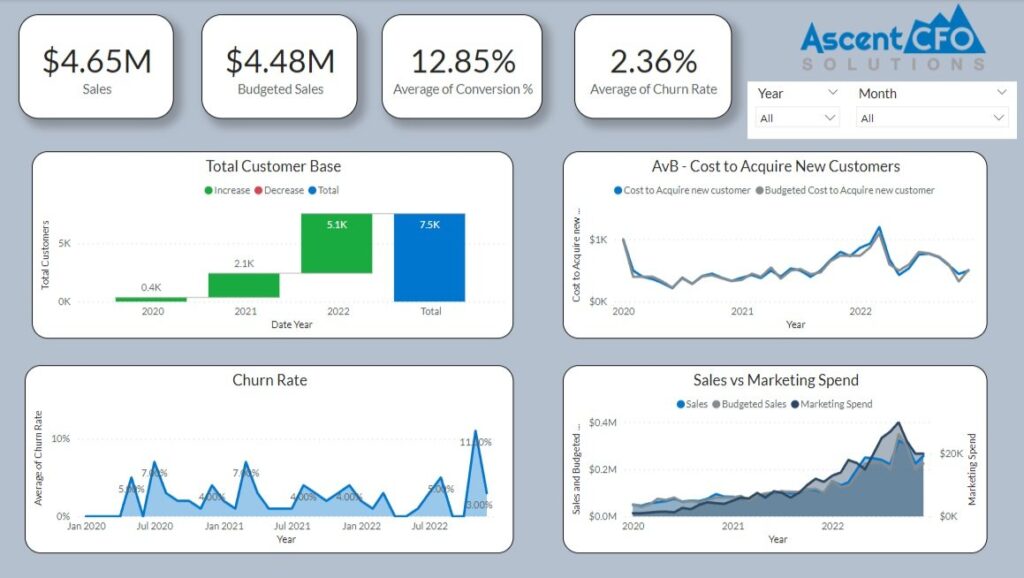
To access the right data, at the right time, in the right place, invest in a data visualization tool that is fully connected to your business and customized to provide the information your company needs. When data is pulled from across the entire organization, CEOs and company leaders can see a real-time, holistic view of their company in an easy-to-read and digestible format.
Insights by Ascent CFO, for example, is designed to be a singular place where leaders can visualize and interact with historic, current, and future metrics.
As strategic Fractional CFOs, we know the forward-looking piece is key. It’s challenging for CEOs to look forward 12, 24, or 36 months, but that’s what an investor wants you to do. And that’s what’s going to help you successfully guide your company. We work closely with companies to develop visual financial models so they can project forward with confidence and improve their decision-making.
When data is truly harnessed as a tool, leaders can have easy access to the information they crave immediately. They can see what is going on across their companyat that moment, and they can more confidently answer “what are the next 12 months going to look like?” to effectively lead their team.
Problem #2: You’re not tracking the right metrics and KPIs for your specific company.
As a company leader, you know you should be tracking metrics and KPIs, but how are you using them? Are you actually tracking the metrics and KPIs that are the most helpful for your day-to-day management?
It’s common for companies to “check the box” to say that they collect data and track KPIs without fully knowing why or what data is actually critical for their operations. A leader can search for the “10 most important KPIs in the financial services industry” but that won’t necessarily tell them which metrics are critical to their ability to make operating decisions. The answer to which data is critical for your organization is going to be different for every company, even within the same industry sector. Not every company is structured the same or has the same business plan. Every business has unique levers that it can pull.
What’s the lifetime value of a client? What’s the margin on each client? Each office? Each product or service line?Leaders need the right metrics and they need to be tracking them in real-time.
Solution:Extract the most important metrics and KPIs from your CEO and key operators. Not Google.
At Ascent CFO Solutions, every engagement begins with a deep-dive immersion phase in which our Fractional CFOs have conversations with the CEO and key operators to gain a comprehensive view of current business operations, challenges and market opportunities. We take the leaders out of their “day-to-day operator” headspace so they can take a step back and have a more strategic forward-looking view of the business, and we listen.
The result of these in-depth conversations is identifying specific key metrics of the business and developing a deeper understanding of the business’s expectations and priorities, but they begin with open-ended questions, such as:
“What keeps you up at night?”
“What are the opportunities that you have visibility into?”
“What are the challenges you see?”
“How does this impact your business?”
When the leader is open and candid, shares what’s on their mind, and lets us into the inner workings of the organization, we are able to see the business holistically and hone in on what’s important. We help leaders identify the key metrics in their company and track them in a way that has a positive impact on the growth of their organization.
Problem #3: You’re paying too much attention to revenue instead of cash.
Revenue and cash are not the same. Revenue (money generated from the sale of goods and services) is an important metric, but cash flow (how much cash is being produced or consumed) is the lifeblood of your business. You could project a healthy year: revenues are X, expenses are Y, and profit margin is Z. But what’s the timing of those revenues and expenses coming in? That could tell a very different story. Companies need to have a clear understanding of their historical and future working capital needs.
For example, your income statement may show strong month-over-month revenue growth, but if your accounts receivable are being stretched (signaled by a high days sales outstanding (DSO) – the average number of days it takes a company to collect cash from credit purchases), you may find yourself in a cash crunch. This will negatively impact your ability to pay your bills or make payroll. Cash is king (cliché but true)!
This is why it’s important to utilize accrual accounting (an accounting method that matches revenue and expenses when incurred) and have clear visibility into your cash flow cycle (how long it takes your company to convert resources into cash flow).
Solution:Look for a tool that can visualize cash flow and the interconnectedness of your business.
Cash flow is a metric that can be challenging to wrap one’s head around. Look for a tool that can visualize cash flow so you can more easily recognize and digest patterns in your cash that will help you make informed decisions. When CEOs see their cash visualized, it’s often a big lightbulb moment.
Every element of a business is interconnected. When a CEO pulls one lever, it affects other variables. As businesses grow, the complexities increase. Company leaders can do fairly well by just focusing on the blocking and tackling for a while – employing basic pricing models and paying attention to expenses, for example. But if a CEO really wants to grow and fine-tune their business, there is so much more they need to pay attention to. Bigger deals may require negotiating 30, 60, or 90-day payment terms. You probably need to hire more people. You probably have more product and service lines. What impact does all of this have on cash flow?
It’s easiest for a CEO to understand the health and inner workings of their business when it’s displayed visually. When they pull a lever, they can actually see what happens. Patterns become clear and problematic timing becomes much easier to recognize.
It’s worth investing in a tool that will go beyond numbers in a spreadsheet and display the interconnectedness of the business in a visual, intuitive way.
Start Harnessing Your Data for Growth Insights
It can be difficult to extract meaningful insights from your company’s data. But with the right tool and strategic guidance, it’s possible to have information at your fingertips that will enable you to make smarter, more informed decisions.
To learn more and watch a 2-minute video of Insights by Ascent CFO, click here.
Contact us to schedule a call to discuss your company’s unique needs and path to growth!
Nationally recognized Fractional CFO firm, Ascent CFO Solutions, launches an innovative, fully-customizable data visualization solution designed to provide greater visibility for CEOs and founders looking to expand and grow their businesses.
Founded by Dan DeGolier, Ascent CFO Solutions (with offices in Denver and Boulder), is a Fractional CFO firm offering Fractional and Interim CFO services, financial modeling, M&A, fundraising support, and robust data visualization solutions, to high-growth start-up and scale-up companies nationwide. The firm’s Fractional CFOs are a powerful resource for companies in all stages who need the strategic financial guidance of a CFO without the cost burden of employing someone full time. As businesses look to further increase the efficiency of their finance professionals, harness their data, and implement new technologies as part of their strategic plans in 2024, Ascent CFO is bringing new and robust data visualization solutions to CEOs and founders across industries.
Insights by Ascent CFO aims to accelerate the connection between a company’s abundant data and the leadership’s ability to make informed and timely decisions as they run the business and plan for growth. Leveraging innovative technologies, Insights by Ascent CFO is a fully customized solution based on a client’s data requirements and business needs. Ascent CFO Solutions provides a retained data analysis team that walks clients through every step of the onboarding process—gathering and connecting data sources, optimizing and improving data integrity, identifying metrics to visualize and track, training on navigating and manipulating the intuitive platform, and ongoing support for adjusting metrics and visualizations as a company’s growth ebbs and flows.
“As companies’ needs for timely and actionable information increase, we are excited to offer Insights by Ascent CFO to give the C-Suite and founders greater visibility into how their business is performing and what their areas of growth are. Our hope is that Insights provides current and prospective clients with a more automated, collaborative, and personalized view of their data sources in one concise platform. Insights can give leaders not only the opportunity to make strategic and informed decisions about the direction of their business, but to streamline their operations and processes for increased growth in 2024,” says founder Dan DeGolier.
Insights by Ascent CFO can be used in any industry (SaaS, professional services, healthcare, e-commerce, manufacturing, and others) to track multiple metrics over periods of time, produce presentation-ready visuals ready in moments, track client and project profitability, pull employee utilization rates easily without data refreshes, and coordinate between all data sources. Through an interactive dashboard, clients can review their own personalized data sets, which are designed to break out or be filtered based by department or specific need. Each utilization of Insights is unique to the clients’ businesses and requests.
“Insights by Ascent CFO has provided us with a customized way for our directors and managers to have on-demand access to the most up-to-date Budget vs Actual reports. We no longer need to spend time inputting data, creating versions for different departments, or performing currency conversions. We anticipate that by using Insights by Ascent CFO, we will have saved several days per year of admin and formatting time getting information into the team’s hands. We look forward to expanding our usage of Insights by Ascent CFO this year,” says Jodi Mercer, Fractional CFO.
Insights by Ascent CFO has the capabilities to change the way CEOs and founders operate and grow their businesses. Ascent CFO Solutions is excited to offer this new solution in 2024. For more information about Ascent CFO Solutions and Insights by Ascent CFO, visit https://ascentcfo.com/insights/.
## Ascent CFO Solutions is a Fractional CFO firm for growing companies. Ascent CFO Solutions provides the strategic financial expertise of a CFO backed by a full-stack financial team without adding to your company’s headcount. Companies in all stages rely on our financial expertise to give them visibility into their business and data-driven strategic insight to make more informed decisions as they grow.
Ascent CFO Solutions is excited to share a highlight video + full recording of our 2023 Denver Startup Week Session – Ask a Fractional CFO: Ascend to Your Next Stage of Growth!
In this session, experienced Fractional CFOs discuss how their role helps entrepreneurs build sustainable businesses that are ready for their next stage of growth. These seasoned financial professionals have been in the trenches with founders and all types of startup companies through key stages of transformation, including those that are pre-revenue, bootstrapped, private-equity and venture capital-backed.
One such entrepreneur is Caroline Creidenberg, founder of Wedfuly. She shares her insightful experiences of pivoting her business model, leading her team through rapid growth, pitching on Shark Tank, ultimately selling her company, and what knowledge was required along the way.
Founders leave the session with a deeper understanding of how both a Fractional CFO and a firm understanding of their financials can help them reach their growth goals.
Highlight Video
Enjoy this 6-minute highlight reel of some “best moments” from the one-hour session.
Full Session Recording + Outline
Reference the outline below to navigate to the parts that interest you most!
16:00 – Background on Ascent CFO Solutions & how we help entrepreneurs grow businesses.
20:00 – Maris LicisandJodi Mercer share the unique joys and challenges of being a Fractional CFO and why they love what they do.
26:00 – What it’s like for entrepreneurs to work with a Fractional CFO.
— Q&A —
31:00 – How is it helpful to bring in a Fractional CFO when you’re actively raising or looking to raise capital?
32:30 – How do Fractional CFOs work with companies through the different stages of growth?
37:00 – How Fractional CFOs help bootstrapped and early-stage companies bulletproof their pitch decks.
39:00 – How do you integrate fullywith the client’s team?
42:15 – What trigger do you look for that tells you it’s time to move from cash to accrual-based accounting?
43:45 – Do you match a Fractional CFO to a company’s industry?
48:30 – Do you work with nonprofits in the grant writing phase?
49:00 – When does it make sense to have a full-time CFO?
51:30 – When is the right time for an early-stage company to bring in a Fractional CFO?
53:30 – What growth-stage businesses might look for when considering buy-side M&A opportunities.
55:45 – How do you work with banks, either for debt or equity?
58:30 – The benefits of problem-solving with your Fractional CFO.
What other questions do you have about working with a Fractional CFO?
Ascent CFO Solutions is a Fractional CFO firm offering outsourced Fractional CFO and Interim CFO services, financial modeling, M&A, fundraising support, and robust data visualization solutions to high-growth start-up and scale-up companies. We welcome a no-obligation conversation to discuss your business needs.