


Key Takeaways
- There are three ways to get CFO-level leadership: rent it (a fractional CFO, part-time and ongoing), borrow it (an interim CFO, full-time for a defined period), or hire it (a permanent, full-time CFO). Each fits a different stage and a different problem.
- Most companies under roughly $50M in revenue get what they need from a fractional CFO. Interim makes sense for transitions and high-stakes events. A full-time hire makes sense when financial complexity is high and constant.
- The most expensive mistake is hiring a full-time CFO before the role is clearly defined. The second most expensive is waiting until a raise, a loan, or a sale is already underway.
- The choice doesn’t have to be permanent. Many of the companies we work with start fractional, use interim support through a transition, and hire full-time once they know exactly what the role needs to deliver.
It’s the second week of November and the leadership team is working through the 2027 plan. Revenue targets are set. There’s a second location in the model, a line of credit to renegotiate, and a board that wants a cleaner monthly package. Then someone asks who, exactly, is going to own all of it. Your controller closes the books well, but she isn’t building a three-statement model. You’ve been acting as the CFO yourself, and the finance work is getting whatever time is left over.
That conversation happens in most growing companies somewhere between $5M and $50M in revenue. The plan needs CFO-level thinking, and nobody has budgeted for it yet. The question isn’t whether you need that expertise. It’s which way to get it: rent it, borrow it, or hire it. This article covers what each option is, how to tell which one fits, the mistakes we see most often, and what to do if it’s time to make a full-time hire.
What’s the difference between a fractional, interim, and full-time CFO?
All three bring the same kind of expertise: forecasting, cash management, capital strategy, board and lender reporting, and the judgment to connect the numbers to decisions. What changes is how much of their time you get, for how long, and what it costs.
A fractional CFO works with your company part-time, typically a set number of days or hours each month, on an ongoing basis. You get senior strategy and a consistent point of view without a full-time executive salary.
An interim CFO works full-time, or close to it, for a defined period, usually a few months to a year. The engagement is built around a specific need: a departure, a transaction, a turnaround, or a system overhaul. It is designed to end.
A full-time CFO is a permanent member of your leadership team. They lead the finance function day to day, manage the team, and own financial performance alongside the CEO.
Here is a simplified example. Say a full-time CFO with the right experience for your company would cost $300,000 a year once salary, bonus, benefits, and payroll taxes are added up. A fractional CFO working two days a month might cost a fraction of that while covering the forecast, the monthly review, and board prep. An interim CFO for six months during a sale process costs more per month than either, but only for those six months. The right answer depends less on which number is smallest and more on how much CFO time the business actually needs, and for how long.
How do you know you need CFO-level help?
A good bookkeeper or controller tells you what happened last month. A CFO tells you what it means and what to do about it. The signs that you’ve outgrown the first and need the second tend to show up in the same places.
- You can’t state your cash runway with confidence. Cash surprises still happen, even in strong months.
- The budget is set once and never revisited. There’s no rolling forecast, so the plan and reality drift apart by spring.
- Growth is outpacing your systems. Revenue, headcount, and locations have grown, and the reporting is still the spreadsheet from three years ago.
- A financial event is coming. A raise, a bank refinancing, an acquisition, an audit, or an eventual sale.
- Margins are slipping and nobody can say exactly why. The team is busy, but profit isn’t keeping pace with revenue.
- The CEO is the de facto CFO. Finance gets attention when something breaks, and not otherwise.
If two or more of these are true, CFO-level leadership will likely pay for itself in 2027. The next question is which form it should take.
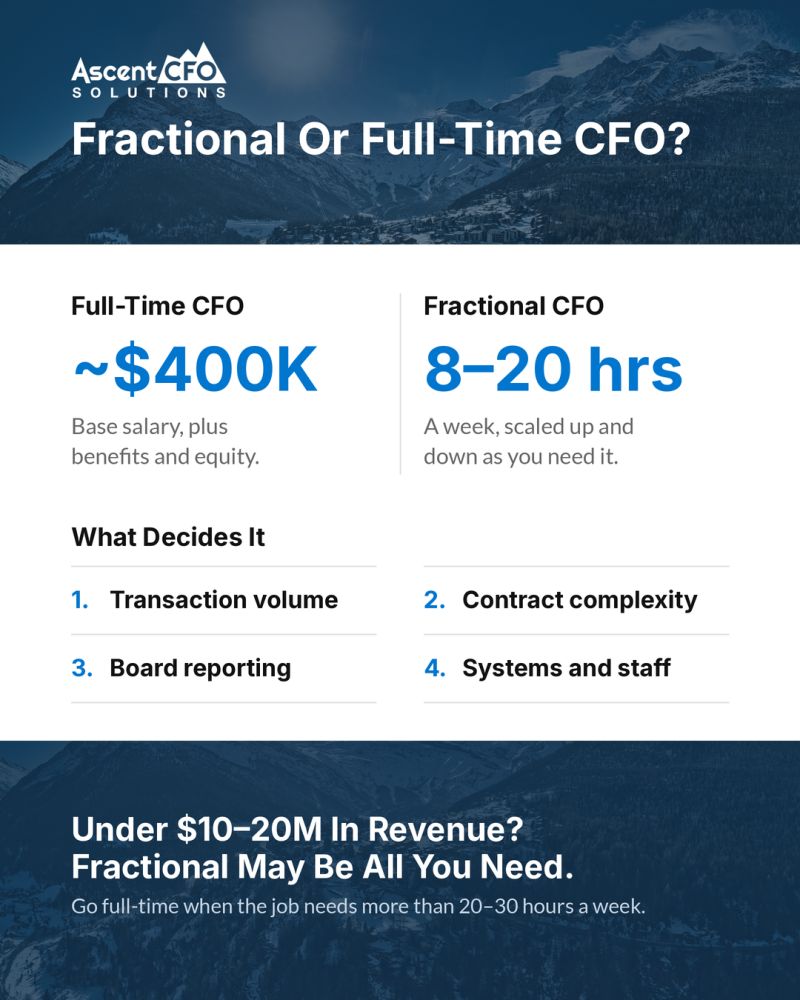
When should you hire fractional, interim, or full-time for the job?
Option A: fractional CFO
Fractional is the right fit for most growing companies that need strategy more than daily oversight. That usually means a business with a capable bookkeeper or controller handling the close, and a leadership team that needs someone to build the forecast, manage cash, set KPIs, and prepare for lenders or investors. It is also the most efficient way to get a company ready for a raise or a sale, because the work that matters most in those processes (a credible model, clean reporting, defensible metrics) is project-heavy rather than hours-heavy.
The limit is availability. A fractional CFO isn’t in the building every day. If your business needs someone managing a sizable finance team or making real-time decisions across complex operations, part-time coverage will start to show its edges.
Option B: interim CFO
Interim is the right fit when something specific needs full-time attention now. Common cases: a CFO or finance leader leaves unexpectedly, a transaction is underway, cash is tight and lenders are asking questions, or the books need to be rebuilt before an audit. An interim CFO stabilizes the function and carries the company through the event.
A good interim engagement also leaves the company better prepared for what comes next. The interim CFO is often the best person to define the permanent role, because they have spent months inside it.
Option C: hire a full-time CFO
A full-time hire is the right fit when financial complexity is high and constant. Multiple entities, significant debt or outside capital, an institutional board, a finance team that needs a dedicated leader, or a company preparing for a major liquidity event all point that way. So does a simple test: if the decisions the CFO will influence each year are worth many times their compensation, the full-time cost is easy to justify.
| Fractional | Interim | Full-Time | |
|---|---|---|---|
| Time commitment | Part-time, ongoing | Full-time, temporary | Full-time, permanent |
| Typical length | Months to years | A few months to a year | Long-term |
| Best for | Growing companies that need strategy without a full-time cost | Transitions, transactions, and turnarounds | Companies with high, constant financial complexity |
| Relative cost | Lowest | Highest per month, for a limited time | Highest annual commitment, including bonus, equity, and benefits |
| Watch out for | Limited day-to-day availability | It ends; plan the handoff | Costly if it’s the wrong person or the wrong time |
Four mistakes companies make when choosing a CFO model
When a new client comes to us, the question of which CFO model to use has often already been answered, sometimes the wrong way. These are the patterns behind most of those missteps.
1. Hiring full-time before the role is defined
A company decides it needs a CFO, writes a job description from a template, and hires. Six months later, it becomes clear that the business needed a strong controller and two days a month of strategy, not a full-time executive. The role is defined by what the business needs, and that is hard to see from the outside. A fractional or interim engagement first makes the full-time job description far more accurate.
2. Waiting until the event is already underway
The raise has started, the lender wants a forecast by Friday, or a buyer has sent a diligence list. At that point every option is more expensive, and the numbers are being built under pressure. The time to bring in CFO-level leadership is two or three quarters before the event, which for many companies means now.
3. Promoting the controller into a CFO title
Controllers are essential, and some grow into excellent CFOs. But closing the books accurately and building the capital strategy are different jobs. Giving a controller the title without the support often leaves the company with neither function done well. A fractional CFO working alongside the controller can cover the strategic gap and develop the controller at the same time.
4. Treating the choice as permanent
The right model in 2027 may not be the right model in 2029. Companies that revisit the question as they grow end up with the right amount of leadership at each stage, instead of too little early and too much later.
If it’s time to hire, how do you get the hire right?
A full-time CFO is one of the most consequential hires a growing company makes, and one of the hardest to evaluate. Most CEOs aren’t finance specialists, so it’s difficult to tell a candidate who interviews well from one who will build a reliable forecast, manage a lender relationship, and hold up in diligence. A wrong hire at this level costs more than the search: it costs a year of decisions made on weaker information.
Four practices make the hire more reliable:
- Define the role from the work, not a template. List the specific outcomes the CFO must deliver in the first 12 to 18 months: a refinancing, a raise, a system migration, a team build-out. Hire for those.
- Match industry and stage experience. A CFO who has taken a company from $20M to $100M has solved different problems than one who has run finance at a $1B enterprise. Both are valuable, and only one may fit.
- Test technical judgment directly. Ask candidates to walk through a model, critique a board package, or explain how they would handle a specific cash or covenant scenario.
- Plan the handoff. If a fractional or interim CFO is in place, use them to help evaluate finalists and to transition the work.
This is where Ascent can now help on the hiring side, too. Ascent CFO Solutions offers direct hire recruitment services to find, vet, and place full-time CFOs, controllers, and finance leaders. Because our team works as CFOs every day, we know what the role requires at your stage, we know what to ask, and we can evaluate candidates on the work rather than the résumé. For companies already working with one of our fractional or interim CFOs, the search is informed by someone who knows the business from the inside.
Frequently asked questions
What is the difference between a fractional CFO and an interim CFO?
A fractional CFO works part-time on an ongoing basis, usually a set number of days or hours each month. An interim CFO works full-time, or close to it, for a defined period tied to a specific need, such as a leadership gap, a transaction, or a turnaround. Fractional is built to continue; interim is built to end.
At what revenue should a company hire a full-time CFO?
There is no single threshold. Revenue matters less than complexity: multiple entities, outside investors, significant debt, a large finance team, or an upcoming liquidity event. Many companies under roughly $50M in revenue are well served by a fractional CFO, and some well above that still are.
Can a fractional CFO help us prepare to hire a full-time CFO?
Yes, and it is one of the most effective ways to hire well. A fractional CFO learns what the business actually needs, builds the systems and reporting a full-time CFO will inherit, and can help define the role and evaluate candidates.
How long does an interim CFO engagement usually last?
Most run from a few months to a year, depending on the reason for the engagement. A search for a permanent CFO, a transaction, or a turnaround each has its own natural endpoint.
Is a controller the same as a CFO?
No. A controller owns accounting accuracy: the close, reconciliations, and financial statements. A CFO owns financial strategy: forecasting, capital, pricing, and the decisions those numbers drive. Growing companies usually need both, and a fractional CFO often works alongside an in-house controller.
Does Ascent CFO Solutions help with full-time CFO hiring?
Yes. In addition to fractional and interim CFO services, Ascent now offers direct hire recruitment for CFOs, controllers, and other finance leaders.
Decide how finance will be led before the plan depends on it
We help founders and CEOs across the country put the right financial leadership in place at the right stage. Our fractional CFOs build the forecast, the cash plan, and the board reporting. Our interim CFOs step in when a transition or transaction calls for full-time leadership. So, whether you need a temporary full-time CFO or an ongoing part-time team, financial leaders at Ascent CFO are ready to step in.

Contact Us
Questions or business inquiries regarding our part-time CFO, finance and accounting services are welcome at: info@ascentcfo.com

