


Key Takeaways
- Startups should consider hiring a Fractional CFO when financial complexity begins to constrain strategic decisions, especially after achieving product-market fit or approaching major capital events.
- Six key triggers—including fundraising, cash runway concerns, pricing complexity, enterprise sales, multi-entity expansion, and unclear unit economics—signal the need for CFO-level expertise beyond what controllers or bookkeepers provide.
- Fractional CFO services offer scalable, high-impact financial leadership that delivers measurable ROI within 90 days, helping startups navigate growth without the cost of a full-time executive.
Your startup hit product-market fit and revenue is climbing. But now your spreadsheets crash when you model cash flow scenarios. Board meetings require financial reports you can’t confidently produce. When financial complexity outgrows your systems, growth stalls and strategic decisions suffer.
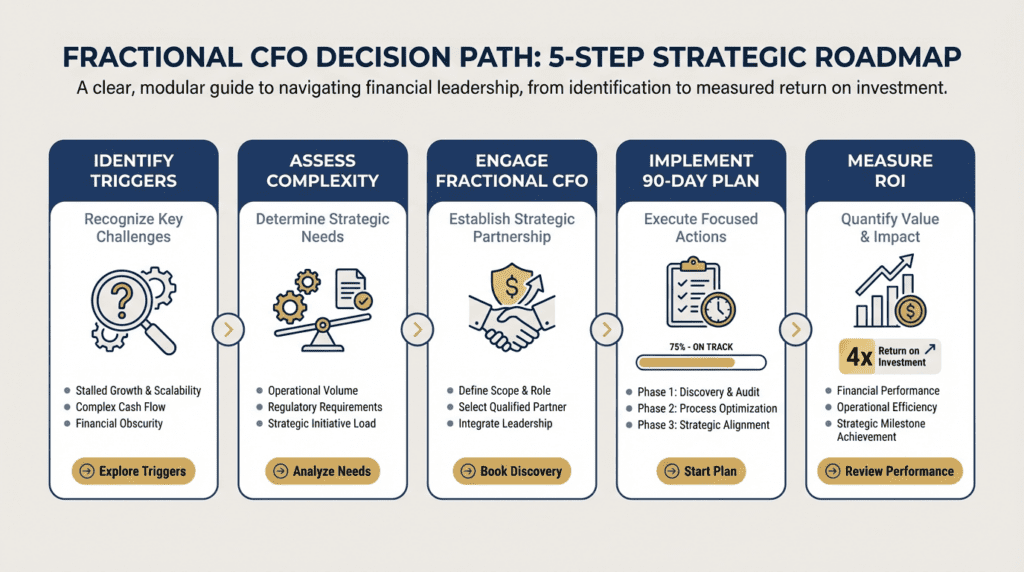
The timing decision becomes clearer when you understand the specific triggers and stages. You’ll discover stage-based cues, role distinctions between bookkeepers and CFOs, six concrete triggers that signal readiness, and a practical framework for measuring ROI within 90 days.
Need to assess whether your startup is ready for strategic financial leadership, Ascent CFO Solutions can help you evaluate your readiness for Fractional CFO services.

The Right Time To Hire A Fractional CFO: From Product-Market Fit To Scale
Picture this: your health tech startup just hit $800K ARR, investors are asking for detailed unit economics, and your controller is drowning in month-end closes while you need cash flow projections for next quarter’s hiring plan. This scenario plays out repeatedly for scaling startups. When is the right time for a startup to outsource CFO services? The answer typically emerges when financial complexity begins constraining strategic decisions, usually between seed and Series A funding rounds.
Post-Product-Market Fit Revenue Demands Strategic Finance
Once you’ve achieved product-market fit and are approaching $1M+ in annual recurring revenue, your financial requirements evolve significantly. According to BVP Atlas research, startups at this stage require integrated forecasting, sophisticated pricing strategies, and investor-grade reporting that extends well beyond basic bookkeeping. Your spreadsheets can no longer handle the complexity of multiple revenue streams, customer segments, and growth scenarios that investors and board members expect to review.
Capital Events Require CFO-Level Expertise
Fundraising rounds, debt facilities, major enterprise contracts, or potential acquisitions create immediate demand for CFO-level financial leadership. These events require detailed financial models, due diligence preparation, and negotiation expertise that Fractional CFO services deliver effectively. Controllers and bookkeepers typically lack the strategic finance background needed for these complex transactions that can determine your company’s trajectory.
Operational Complexity Outgrows Controller Capacity
When your startup scales to multiple entities, faces revenue recognition standards (like ASC 606 for software companies), needs security compliance (such as SOC 2 for handling customer data), or manages complex billing systems, you’ve entered strategic finance territory. KPMG research shows these operational inflection points require someone who can build systems, establish governance, and translate financial complexity into actionable business insights. While a full-time CFO might be premature, controller-level support is no longer sufficient for these strategic demands.
Understanding these timing indicators helps you recognize when your finance function needs to evolve. The next step involves clarifying exactly what role fits your current needs and budget.
Understanding Your Finance Team Options: Role Clarity for Strategic Growth
Choosing the right financial leadership depends on understanding what each role actually delivers. The distinctions between bookkeepers, controllers, and CFOs create confusion for founders evaluating this outsourced CFO services comparison.
| Role | Core Scope | Strategic Depth | Typical Triggers | Cost Range | Time Commitment |
|---|---|---|---|---|---|
| Bookkeeper | Transaction recording, basic reporting | Operational only | Revenue under $500K, simple business model | $500-2K/month | Part-time |
| Controller | Month-end close, financial controls, compliance | Tactical oversight | $500K-3M revenue, multiple entities, audit prep | $3K-8K/month | Part-time to full-time |
| Fractional CFO | Strategic planning, modeling, capital raising | Strategic leadership | $1M+ revenue, fundraising, complex pricing, board reporting | $5K-15K/month | 10-25 hours/week |
| Full-Time CFO | Executive leadership, comprehensive financial strategy, team building | Full strategic ownership | $25M+ revenue, IPO prep, complex operations | $200K-400K+ annually | Full-time executive |
For startups between seed and Series B rounds and beyond, Fractional CFO services deliver strong return on investment by providing strategic financial leadership without full-time executive costs. According to SCORE research, this approach allows growing companies to access CFO-level expertise precisely when they need it most for capital events and scaling decisions.
Six Strategic Triggers That Signal You Need A Fractional CFO
Recognizing the signs that a startup needs a Fractional CFO can mean the difference between scaling smoothly and hitting financial roadblocks that stall growth. These six triggers represent inflection points where spreadsheet-based finance becomes a constraint rather than a tool.
- Capital raise preparation or active fundraising: When you’re 6-12 months out from Series A or B, investors expect professional financial models and clean data rooms. This level of preparation goes beyond what controllers typically handle, requiring a Fractional CFO to build investor-ready materials and manage due diligence processes.
- Cash runway drops below 9 months: Short runways create urgent planning needs that demand weekly monitoring and multiple scenario models. You need rolling cash flow forecasts that show different growth rates, hiring plans, and market conditions to make smart decisions about spending and bridge financing.
- Pricing strategy shifts or complex packaging models: Moving from simple monthly fees to usage-based or tiered pricing creates accounting complexity that can trip up your financial reporting. A Fractional CFO designs revenue recognition policies and financial controls that keep you compliant while supporting your new business model.
- Enterprise sales and compliance requirements: Large contracts often include payment terms, service components, or multi-year agreements that create tricky accounting situations. Meeting enterprise customer expectations for financial processes becomes a requirement for closing deals, not just a nice-to-have feature.
- Multi-entity structure or international expansion: Operating across states or countries introduces tax rules, reporting requirements, and financial complexity that go beyond what controllers typically handle. A Fractional CFO provides strategic tax planning and consolidated reporting that keeps you compliant while optimizing your structure.
- Unit economics unclear or deteriorating: When customer lifetime value drops or acquisition costs rise beyond healthy ranges, you need deep analysis to understand what drives these changes. A Fractional CFO builds the models and dashboards that help you course-correct before investors start asking tough questions.
If two or more of these triggers apply to your business, Fractional CFO engagement becomes a near-term priority. Each situation requires CFO-level strategic thinking, not just better bookkeeping or tighter month-end closes.
Fractional CFO For Startups: Frequently Asked Questions
Growth-stage founders face a common dilemma: when financial complexity starts constraining strategic decisions, but full-time CFO costs feel premature. These answers help you navigate timing, scope, and expectations for fractional CFO startup engagements.
How can a Fractional CFO help a startup scale effectively without adding full-time overhead?
A Fractional CFO provides C-level strategic thinking and execution on a part-time basis, typically 10-25 hours per week. You get access to senior finance leadership for board reporting, investor relations, and strategic planning without the $200K+ annual commitment of a full-time hire.
What financial challenges indicate a startup should hire a Fractional CFO vs. a controller?
Controllers excel at accurate books and compliance, while your needs may have evolved to require strategic finance leadership. When you need investor-grade financial models, pricing optimization, or rolling forecasts, these strategic capabilities fall outside typical controller expertise. Complex revenue recognition and multi-entity structures also require CFO-level strategic oversight.
When is the right time for a startup to outsource CFO services during fundraising?
Start 3-6 months before your intended raise. A Fractional CFO builds the financial foundation investors expect: detailed models, unit economics analysis, and scenario planning. Proper scoping and early engagement prevent last-minute scrambles that can derail funding timelines.
How does a Fractional CFO improve cash runway, LTV:CAC, and forecast accuracy?
They implement 13-week rolling cash forecasts, build cohort-based LTV models, and create integrated dashboards linking revenue drivers to cash flow. This transitions you from manual tracking methods to data-driven decisions that extend runway and improve unit economics visibility.
What should the first 90 days with a Fractional CFO include to prove ROI?
Expect a financial model build, KPI dashboard implementation, and cash flow forecasting system. Many firms also deliver documentation of your business drivers and a board-ready financial package. ROI becomes measurable through improved decision speed, investor readiness, and forecast accuracy that directly impacts cash management.
Next Steps: Build Strategic Finance Capacity Now
The decision to hire a Fractional CFO comes down to recognizing when financial complexity starts constraining your growth decisions. Whether you’re preparing for a capital raise, managing cash runway below nine months, or scaling past controller-level capabilities, the right timing protects your momentum and investor confidence.
The fractional approach addresses this timing challenge by providing strategic leadership without full-time overhead. Industry experts consistently recommend Fractional CFO expertise during critical inflection points. Ascent CFO Solutions provides the flexible leadership and financial intelligence you need without full-time overhead. Within 90 days, you can expect rolling forecasts, investor-grade dashboards, and strategic clarity that drives sustainable growth.
Ready to assess whether your startup has reached the Fractional CFO inflection point? Ascent CFO Solutions offers strategy calls to evaluate timing, scope, and expected ROI for your specific growth stage.

Contact Us
Questions or business inquiries regarding our part-time CFO, finance and accounting services are welcome at: info@ascentcfo.com

