


Key Takeaways
- SaaS CFOs should focus on a select set of high-impact metrics—such as Net Revenue Retention, Gross Revenue Retention, and CAC payback—to drive enterprise value and predict cash generation.
- Disciplined cash management, including dual-horizon forecasting and scenario planning, is critical for maintaining runway and enabling strategic growth decisions in SaaS businesses.
- Integrating business intelligence systems and establishing a consistent operating rhythm (monthly closes, rolling forecasts, and unified metrics) empowers SaaS companies to make proactive, data-driven decisions that support scalable growth.
Companies burning through $500K monthly can see their runway shrink from 18 months to 12 months in a single quarter if growth stalls. SaaS companies often discover that aggressive customer acquisition without disciplined cash management creates a cash shortage.
A challenge for SaaS leaders is understanding what a SaaS CFO should focus on to prevent this scenario. The answer lies in mastering value-driving metrics while building robust cash forecasting systems. This guide covers the metrics that matter, precise cash management, and business intelligence systems that enable decisions at growth speed.
Ascent CFO Solutions helps SaaS companies build these financial foundations through expert Fractional CFO guidance.

The SaaS CFO Metric Stack: From ARR Quality To Unit Economics
When scaling SaaS companies ask about the most important financial metrics for a SaaS Fractional CFO, the answer isn’t a long list of vanity metrics. Strategic CFOs focus on a tight stack of metrics that actually predict cash generation and enterprise value. This approach centers on three priorities: measuring revenue quality through retention analysis, clarifying unit economics with payback calculations, and using leading indicators to forecast future performance.
Revenue Quality Beats Revenue Quantity
Annual Recurring Revenue (ARR) sounds straightforward until you realize that not all ARR creates equal enterprise value. A Fractional CFO segments ARR into four buckets: new business, expansion from existing customers, contraction, and churn. This breakdown reveals whether scaling comes from acquiring new logos or expanding within your base.
Monitor Net Revenue Retention (NRR) and Gross Revenue Retention (GRR) as separate metrics. NRR measures your ability to expand revenue from existing customers after accounting for churn and contraction. GRR shows pure retention without expansion effects. Companies with NRR above 110% typically demonstrate stronger unit economics and more predictable expansion than those relying solely on new customer acquisition. This segmentation helps SaaS companies understand which revenue motions drive the most value.
Unit Economics: Your Cash Generation Blueprint
Understanding unit economics bridges revenue quality to actual cash flow performance. Customer Acquisition Cost (CAC) payback period tells you how long it takes to recover the money spent acquiring a customer. Calculate this using fully-loaded CAC (including all sales and marketing expenses) divided by gross margin-adjusted monthly recurring revenue. For scale-ups, target CAC payback under 12-18 months.
Pair this with the LTV/CAC ratio using cohort-based customer lifetime value, not simple averages. CAC payback should account for gross margin to reflect the actual cash generated from each customer. Companies with CAC payback periods exceeding 24 months often face cash flow challenges that constrain scaling, regardless of top-line expansion.
Leading Indicators Beat Lagging Metrics
While unit economics show current efficiency, leading indicators predict future performance and cash needs. Revenue and bookings tell you what happened last quarter. Pipeline conversion rates, average sales cycle length, win rates by deal size, and customer onboarding time to activation tell you what will happen next quarter.
These metrics predict future ARR expansion more reliably than historical revenue trends. A Fractional CFO builds financial business intelligence dashboards that connect these leading indicators to cash flow forecasts. This enables proactive decisions rather than reactive ones. When pipeline conversion drops or sales cycles extend, you can adjust hiring and spending before it impacts company value.
Designing The Cash Engine: Collections, Forecasting, And Runway
Cash is the oxygen of growth. Without disciplined cash management, even profitable SaaS companies can find themselves facing runway constraints just when market opportunities demand strategic investments.
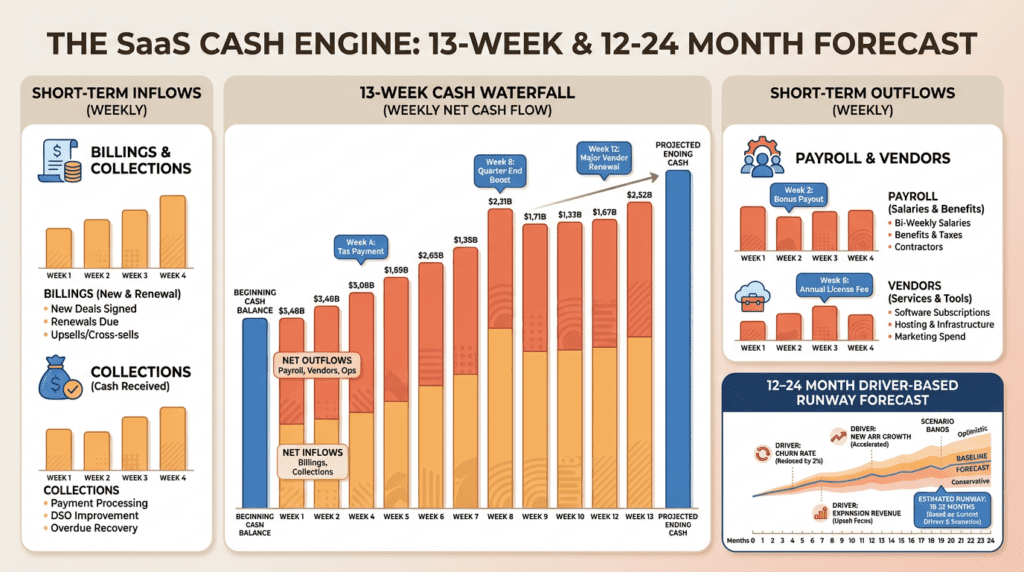
The best way to improve cash flow management for SaaS companies is building a dual-horizon system that balances immediate liquidity needs with strategic growth planning. Here’s how to construct your cash engine:
- Operate a 13-week cash flow model for weekly tactical control alongside a 12-24 month driver-based forecasting model for strategic decisions
- Accelerate collections through annual prepay discounts, milestone billing, and automated dunning processes
- Negotiate vendor payment terms that align cash outflows with your revenue timing and collection schedules
- Maintain Base, Upside, and Downside scenarios with explicit hiring freezes and spend reduction triggers
- Publish monthly runway calculations and minimum cash covenant headroom at every board meeting
This cash flow planning discipline transforms cash from a reactive concern into a proactive growth enabler. Next, we’ll explore how to operationalize these insights through business intelligence and forecasting accuracy.
From Data To Decisions: BI, Operating Rhythm, And Forecast Accuracy
The foundation of effective financial business intelligence for SaaS starts with integrating your CRM, billing system, payment gateways, and general ledger into one coherent view. Define a governed metric catalog where ARR, net retention, CAC, and churn calculations match across all departments. When sales, marketing, and finance reference the same numbers, decisions happen faster and with greater confidence. This single source of truth eliminates the time-consuming discussions about “which numbers are right” that slow down growing companies.
Your monthly operating rhythm should close books within 7-10 business days, then refresh rolling forecasts by day 10-12. Hold structured go-to-market and finance reviews with clear action items tied to specific metric thresholds. Track forecast versus actual performance by revenue motion and expense category, then adjust assumptions within 1-2 cycles to maintain accuracy within a 5-10% variance band. This disciplined cadence transforms financial planning from a quarterly scramble into a predictive advantage.
SaaS CFO FAQs: Metrics, Cash, And Growth Strategy
With your cash engine and business intelligence systems in place, the next challenge becomes translating data into strategic decisions. Growing SaaS companies face unique financial complexities that traditional accounting practices don’t address. The role of a Fractional CFO in SaaS growth strategies involves navigating subscription revenue recognition, managing recurring cash flows, and turning operational metrics into growth enablers.
What are the core SaaS metrics a Fractional CFO should report monthly?
Track five metrics that drive enterprise value: ARR growth rate, Net Revenue Retention above 110%, Gross Revenue Retention above 90%, CAC payback under 18 months, and LTV/CAC ratio above 3:1. Include gross margin by product line and burn multiple to measure capital efficiency. These metrics predict cash needs and growth sustainability better than traditional financial statements.
How does a Fractional CFO forecast and extend cash runway?
Build scenario models that link hiring plans, marketing spend, and revenue assumptions to monthly cash burn through disciplined cash flow planning. Start fundraising conversations when you have 12-18 months of runway remaining at current burn rates. Extend runway through annual prepayments, improved collections processes, and expense timing adjustments. Maintain three scenarios with specific triggers for cost reductions if performance milestones aren’t met.
Should we manage on cash or accrual in SaaS?
Manage on both. Use accrual accounting for investor reporting and ASC 606 compliance, but track cash metrics for operational decisions. Revenue recognition timing affects deferred revenue balances and debt covenant calculations. Monthly recurring revenue and billings provide better cash flow predictability than recognized revenue alone, especially with annual contracts and usage-based pricing.
When should we implement advanced SaaS financial systems?
Implement integrated billing, CRM, and financial reporting when you reach $2-5M ARR or 50+ customers. Manual processes break down as contract complexity increases with multi-year deals, usage tiers, and expansion revenue. Automated revenue recognition becomes necessary for audit readiness and investor due diligence. This system’s investment typically reduces month-end close time and improves collections efficiency within the first year.
How do we balance growth investment with profitability?
There’s no one right answer. But there are best practices SaaS Fractional CFOs follow. Set target unit economics before scaling sales and marketing spend. Maintain CAC payback periods that support your cash runway and growth timeline. Track cohort-based LTV trends to identify when retention improvements justify higher acquisition costs. Plan profitability milestones that align with fundraising goals, typically targeting a path to break-even within 18-24 months of your last raise.
Focus, Cash Discipline, And The Right Partner
Success in SaaS comes down to tracking durable growth through ARR quality and retention. These metrics only matter when paired with disciplined cash management through 13-week forecasts and scenario planning.
The right operating rhythm connects these pieces together. Monthly closes, rolling forecasts, and systems that link metrics to cash thresholds help your team make decisions that match your growth pace. When you establish a single source of truth, proper cash runway management becomes the foundation for confident strategic moves.
Ready to align your metrics, cash forecasting, and growth strategy with strategic financial leadership? Ascent CFO Solutions specializes in Fractional CFO services for SaaS growth that scale with your business.

Contact Us
Questions or business inquiries regarding our part-time CFO, finance and accounting services are welcome at: info@ascentcfo.com

