


Key Takeaways
- Venture debt can extend your runway with significantly less dilution than equity, making it a strategic option for companies with predictable revenue, recent investor support, and clear short-term milestones.
- Choosing between venture debt and equity impacts not just ownership and control, but also operational flexibility and risk—requiring founders to weigh dilution against covenant constraints and repayment obligations.
- Detailed financial modeling and expert CFO guidance are essential to evaluate both options, negotiate favorable terms, and create a capital strategy that aligns with your business’s growth trajectory and risk tolerance.
Adding six to twelve months of runway might cost you just 2-4% of your company instead of 15-25%. The difference comes down to choosing venture debt over equity when you have predictable revenue, existing investor support, and clear near-term milestones. Most founders default to equity because it feels familiar, but strategic capital planning means matching your financing instrument to your specific growth stage and risk profile.
Should we pursue venture debt or equity? This decision impacts everything from your ownership structure to your operational flexibility. We’ll compare when each option delivers better outcomes, how they affect dilution and control, and provide a decision framework that considers your financial model assumptions and fundraising readiness.
Ready to model both scenarios and determine which path maximizes your runway while preserving the right balance of ownership and growth capital? Ascent CFO Solutions will walk you through the dilution math, covenant risks, and timing considerations specific to your business.

Venture Debt vs. Equity: Key Differences That Drive Your Decision
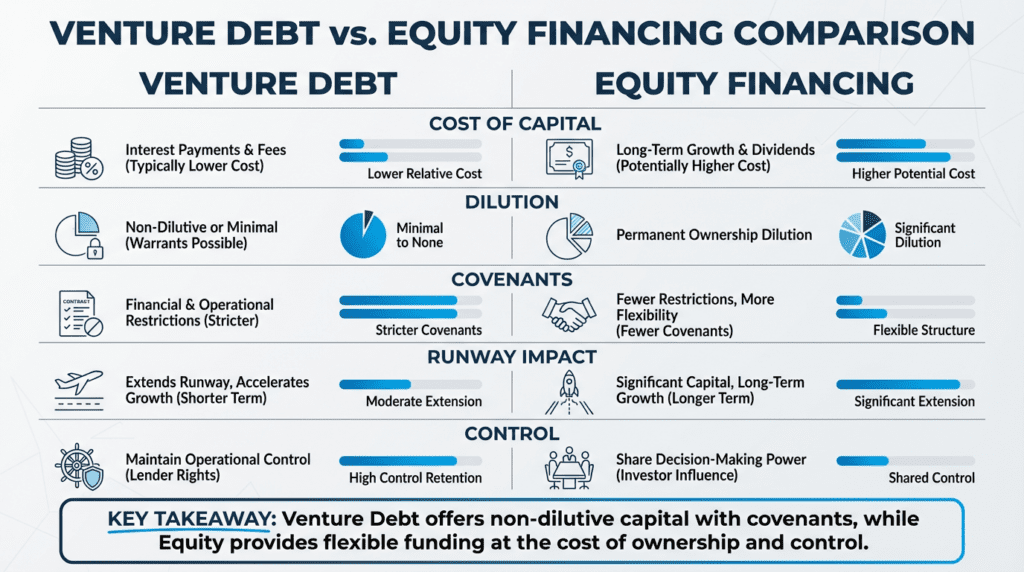
The key differences between venture debt and equity financing for startups come down to three fundamental areas: cost of capital, ownership impact, and evaluation criteria. Each operates on fundamentally different principles around cost, control, and risk assessment. Understanding these differences helps you pick the right tool for your specific situation and growth stage.
Cost of Capital: Comparing True Financing Costs
Venture debt typically costs 8-15% annually in interest and fees, while equity financing can cost 20-40% when you factor in dilution and investor return expectations. The cost difference becomes significant over time, especially for companies with predictable revenue streams. Venture debt proves most effective when you have recent investor backing that signals market confidence and can service debt payments without straining operations. Equity makes more sense when your path forward involves high uncertainty or when you need patient capital that doesn’t require regular cash outflows.
Ownership and Control: Preserving Equity vs. Accepting Constraints
Equity financing typically dilutes existing ownership by 10-25% per round and often brings new board members who influence major decisions. Venture debt preserves your ownership percentage but introduces operational covenants like minimum cash balances and financial reporting requirements. You maintain control of your board composition, but lenders can accelerate repayment if you breach covenant terms. Each approach involves different compromises: ownership stakes versus operational constraints.
Underwriting Focus: Risk Assessment Through Different Lenses
Lenders and VCs evaluate your company through completely different frameworks. Debt providers focus on your ability to repay, examining cash flow predictability, burn rates, and downside scenarios. They want to see sustainable metrics and typically size deals at 20-30% of your last equity round. VCs bet on exponential growth potential and market capture. They prioritize growth potential over predictable returns, accepting higher risk for transformational outcomes. This fundamental difference in perspective determines which option aligns better with your current business stage and risk profile.
When Venture Debt Is the Better Tool for Scaling
Understanding when venture debt is a better option than equity for scaling a business comes down to timing and company readiness. Venture debt works best as a strategic bridge, not a band-aid. The sweet spot comes when you’ve recently closed an equity round and need extra runway to hit specific milestones that will unlock your next valuation step-up. Think of it as buying time to execute your plan rather than fixing a broken business model.
- Extend runway post-equity round: Use debt to add 6-9 months of operating capital after raising equity, giving you breathing room to hit revenue targets or product launches without immediate dilution. Venture debt typically ranges from 20-35% of your last equity raise.
- Meet the lender profile: Companies with $2-3M+ in ARR, net revenue retention above 100%, and controlled churn rates make ideal candidates. Lenders want to see credible VC participation in your recent rounds as validation.
- Bridge to clear catalysts: Use debt when you have specific, measurable goals ahead like launching a new product line, expanding into enterprise sales, or reaching profitability. Avoid using it to address underlying burn rate challenges or undefined growth experiments.
- Consider timing advantages: Most venture debt facilities close in 8-12 weeks, making them faster than equity rounds. This speed advantage matters when you need capital to capture a market opportunity or weather an unexpected downturn.
- Preserve equity for bigger moves: When you’re confident in your near-term execution but want to save dilution for a larger strategic round later, debt lets you maintain ownership while scaling operations.
Ownership, Control, and Risk: Dilution Math vs. Covenants
Understanding how choosing venture debt versus equity impacts company ownership and control starts with the numbers. Equity financing typically dilutes founder ownership by 10-25% in growth rounds, which can shift board composition and decision-making power. Each equity round brings new investors who may have different priorities or timelines than founders. Venture debt preserves your cap table but introduces operational covenants that can restrict spending, hiring, or strategic decisions. The choice between giving up ownership versus accepting operational constraints often comes down to your confidence in hitting near-term milestones and your tolerance for external oversight.
Cash planning becomes more complex with debt because even interest-only periods require careful forecasting. You need to model downside scenarios with a 21-23% cash buffer beyond your base case to handle unexpected market shifts or slower growth. Lender terms like material adverse change clauses, minimum cash covenants, and warrant coverage can dramatically alter your risk profile. Partnering with a Fractional CFO for financial modeling and cash flow forecasting helps you negotiate better terms and avoid covenant violations that could trigger acceleration or additional dilution.
FAQ: Practical Questions Founders Ask About Venture Debt vs. Equity
CEOs facing funding decisions need clear answers about capital efficiency, risk trade-offs, and timing. These questions address the specific concerns that drive smart capital choices.
What are the main risks and benefits of venture debt compared to equity?
Venture debt preserves ownership but requires cash payments and agreement requirements, while equity dilutes but provides flexible funding that doesn’t require immediate returns. Venture debt typically costs 10-15% annually with 12-48 month terms, making it cheaper than equity for companies with predictable revenue. The trade-off: debt must be repaid regardless of performance, while equity investors absorb losses alongside you.
How much venture debt can we typically raise relative to our last equity round?
Most venture debt facilities range from 20-40% of your last equity round size, depending on revenue predictability and investor backing. Companies with $3M+ ARR and strong profit per customer can often access $1-3M in venture debt. Lenders focus on recurring revenue models with low operational expenses and clear paths to profitability.
When should we combine a small equity top-up with venture debt?
This hybrid approach works when you need 12-18 months of runway but want to minimize dilution before hitting major milestones. For example, if you need $2M runway, raise $1M in equity and $1M in venture debt. This strategy requires strong cash flow forecasting to model repayment scenarios and agreement requirements.
What financial metrics do venture debt lenders prioritize?
Lenders evaluate monthly recurring revenue growth, net revenue retention above 100%, and controlled customer churn rates. They also require 12-18 months of post-funding cash runway and prefer companies backed by reputable VCs. IMF research shows venture debt works best for later-stage, revenue-generating companies rather than early-stage startups.
How do we know if our company is ready for venture debt?
You’re ready when you have predictable monthly revenue, existing VC backing, and clear milestones to hit within 12-18 months. Avoid venture debt if you’re pre-revenue, burning cash without clear profit per customer, or facing major market uncertainty. Consider working with Virtual CFO services to test different repayment scenarios and model various funding combinations before approaching lenders.
Choose the Right Capital—With a CFO-Grade Decision Framework
The choice between venture debt and equity comes down to risk and timing. When you have strong investor backing, predictable revenue metrics, and clear milestones within 12 months, debt preserves ownership while extending runway. When your path forward involves high uncertainty or major pivots, equity provides the flexibility and patient capital you need.
Making this decision requires detailed financial modeling and covenant analysis, not intuition. You need robust cash flow forecasting to stress-test debt scenarios and experienced CFO guidance to navigate complex term sheets. Y Combinator’s venture debt guide emphasizes involving financial counsel early because the wrong choice can cost months of runway or unnecessary dilution.
The complexity of this analysis is exactly why many growth-stage CEOs turn to fractional finance leadership. Ascent CFO Solutions helps you model both debt and equity scenarios, negotiate favorable terms, and build a capital strategy that scales with your business.


Contact Us
Questions or business inquiries regarding our part-time CFO, finance and accounting services are welcome at: info@ascentcfo.com

