


Key Takeaways
- Rolling forecasts provide greater agility and real-time financial visibility than static annual budgets, enabling high-growth companies to respond quickly to market changes.
- A hybrid approach—maintaining annual budgets for board alignment while using rolling forecasts for operational decisions—offers both stability and flexibility.
- Successful implementation of rolling forecasts relies on focusing on key business drivers, integrating financial systems, and starting with pilot programs to build organizational buy-in.
Your health tech company just landed three enterprise clients early. A competitor raised $50M and changed pricing overnight. If these shifts happened after your annual budget was locked, you’re operating without current visibility. Research shows that leading organizations use rolling forecasts to maintain accuracy in fast-changing markets.
The question “Should we move to rolling forecasts instead of annual budgets?” becomes urgent when growth accelerates. Rolling forecasts updated monthly give you agility to pivot resources, manage cash flow, and build stronger financial foundations without waiting for next year’s planning cycle.
Ascent CFO Solutions helps scale-ups implement rolling forecasts that turn market volatility into competitive advantage.

Rolling Forecasts vs. Annual Budgets: What Growing Businesses Need Most
When your company is adding new markets, scaling customer acquisition, or navigating regulatory shifts, static annual budgets become roadblocks to agile decision-making. What are the benefits of rolling forecasts compared to annual budgets? The answer lies in responsiveness, accuracy, and strategic agility that scaling businesses need to maintain growth momentum while managing cash runway effectively.
Real-Time Responsiveness Beats Static Planning
Rolling forecasts update your financial outlook on a monthly or quarterly cadence, extending visibility 12 to 18 months beyond today. Unlike annual budgets that lock you into January assumptions, rolling forecasts adapt to new customer acquisition rates, regulatory changes, or competitive pressures. Deloitte research shows this approach helps organizations identify changes quickly and adjust resource allocation before problems compound.
Driver-Based Models Improve Signal Quality
Driver-based modeling connects your revenue and cost projections directly to operational inputs like sales pipeline, headcount growth, and unit economics. This approach provides clearer signals than static budget line items because it reflects how your business actually operates. When your customer acquisition cost changes or your sales cycle lengthens, driver-based forecasts automatically adjust downstream projections, giving you more accurate cash flow visibility.
How Annual Budgets and Rolling Forecasts Complement Each Other
Annual budgets still serve important purposes for board alignment and target setting, but rolling forecasts inform day-to-day decisions about hiring, spending, and strategic pivots. The combination gives you both accountability frameworks and operational flexibility that experienced CFO guidance can help you implement effectively.
When to Switch: Triggers for High-Growth Teams
Knowing when to make the switch isn’t always obvious, but certain indicators signal your annual budget has become an obstacle rather than an asset.
When should a company switch from annual budgets to rolling forecasts? Here are the key indicators that it’s time to make the switch:
- Revenue swings exceed 20% quarterly – Your bookings or usage patterns shift faster than annual plans can capture
- New markets or products launch frequently – You need to model 2-3 scenarios per cycle without rebuilding entire budgets
- Cash runway decisions happen monthly – Board meetings and hiring choices require near-real-time data visibility
- Monthly variance reporting takes weeks – Your finance team spends more time explaining budget misses than planning ahead
- Investor updates feel outdated – Your board presentations show projections that were stale before the meeting started
These triggers often appear together during the rapid scaling phases. Companies experiencing high volatility benefit from the continuous planning approach that rolling forecasts provide, allowing them to adapt quickly to changing market conditions.
If multiple triggers resonate with your current situation, you’re ready to implement a more agile forecasting model that matches your growth trajectory.

How to Implement Rolling Forecasts Without Chaos
Rolling forecasts can improve financial planning for growing businesses when implemented systematically. The key is starting simple and building the right foundation from day one.
- Focus on key drivers first – Model 2-3 revenue drivers and 3-5 cost drivers that explain 80% of variance
- Connect your systems early – Link CRM, billing, and payroll data to automate actuals into your forecast model
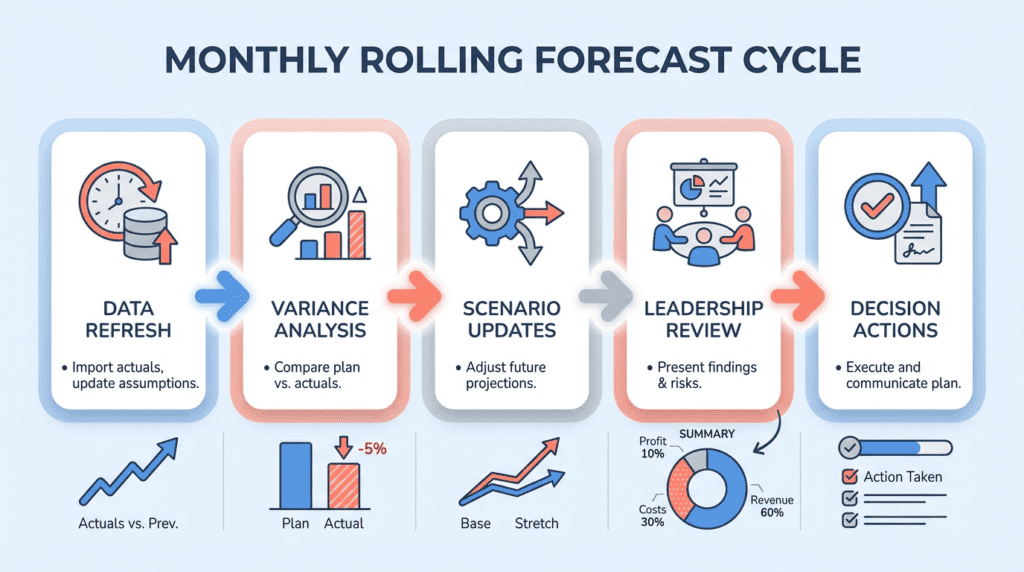
- Establish monthly cadence – Block out 3-5 days each month for data refresh, variance review, and forecast updates
- Assign clear ownership – Finance owns the process and timeline; department leaders own their input assumptions
- Start with 12-18 month horizon – Extend visibility beyond the current year while keeping projections realistic.
This driver-based approach avoids the complexity that often derails rolling forecast implementations. Rather than modeling every line item, you’re focusing on the factors that create the biggest impact on your business. Many growing companies find that tracking pipeline conversion rates, customer acquisition costs, and headcount plans gives them most of the insight they need.
The combination of automated data feeds and consistent timing transforms your monthly forecast update from a tedious exercise into strategic planning. Best practices show that when your Fractional CFO can pull fresh actuals directly from integrated systems, the team spends time analyzing trends rather than gathering numbers. For companies managing tight cash flow, pairing this approach with a 13-week cash flow model provides both strategic visibility and operational control.
Start with these five steps in one business unit for your first two cycles, then expand company-wide with the same disciplined approach.
FAQ: Rolling Forecasts and Annual Budgets—Practical Answers
Scaling companies often wrestle with practical questions about implementing rolling forecasts while maintaining board alignment and operational discipline. These answers address the most common concerns we hear from growing businesses ready to upgrade their financial planning.
Do we still create an annual budget if we adopt rolling forecasts?
Yes, keep both. Your annual budget sets targets for board commitments and compensation plans. Rolling forecasts guide operational decisions and resource allocation throughout the year. Annual budgets provide stability for governance while rolling forecasts deliver agility for management.
What horizon and cadence work best for scale-ups?
Most scale-ups benefit from a 12-18 month rolling forecast horizon updated monthly or quarterly. All companies, especially companies with tight cash runway or volatile revenue, should consider a 13-week cash flow model updated weekly. Match your cadence to decision speed and cash runway needs.
How do we avoid forecast churn and maintain accountability?
Focus on 3-5 key drivers that explain 80% of your variance instead of modeling every detail. This reduces the urge to constantly tweak minor line items. Separate forecasts from incentive targets to encourage honest projections. Establish regular variance analysis and lock forecast windows to prevent endless revisions.
How do we get leadership buy-in for rolling forecasts?
Start with a pilot in one business unit for two cycles to demonstrate improved decision-making. Show specific examples like early detection of pipeline slowdowns or cash flow blind spots that annual budgets missed. Present measurable results that show the return on your planning investment.
Should we use Excel or invest in forecasting software?
Excel works well for straightforward models but struggles with complex scenarios and multiple driver relationships. Scale-ups handling rapid growth typically need dedicated forecasting platforms that integrate with CRM and financial systems. Fractional CFO services can help evaluate the right technology fit for your growth stage.

Build Agility Now—And Keep Your Board Aligned
The best approach combines both tools: maintain your annual budget for board targets and compensation planning, but manage operational decisions with a rolling forecast updated monthly or quarterly. This hybrid model gives you the strategic anchor boards expect while providing agility to pivot when market conditions shift.
To implement this approach effectively, start with a pilot program in one business unit for two forecast cycles, then expand company-wide with standardized drivers and governance. Focus on rolling forecasts best practices like driver-based modeling and integrated dashboards to avoid constant forecast revisions. Research shows that companies using agile budgeting approaches respond 40% faster to market changes than those relying solely on annual budgets.
Ready to implement a rolling forecast that scales with your growth? Ascent CFO Solutions can design and implement your forecasting system in 30-60 days.

Contact Us
Questions or business inquiries regarding our part-time CFO, finance and accounting services are welcome at: info@ascentcfo.com

