


Key Takeaways
- Board-ready financial projections must tie every financial line item to measurable operational drivers, ensuring clarity and accountability for board members.
- Integrated three-statement models with scenario planning provide a comprehensive, actionable view of a company’s financial health, enabling boards to evaluate strategic options and trade-offs.
- A disciplined workflow—including rolling updates, consistent governance, and focused presentation—transforms financial forecasts from static reports into dynamic tools for strategic board discussions and confident decision-making.
Industry research reveals a concerning trend: most board members receive financial projections they can’t use for strategic decision-making. Entrepreneurs typically present dense spreadsheets filled with assumptions that lack operational context. Boards don’t want more numbers: they want clear, defensible projections that connect your business drivers to strategic choices and trade-offs.
Building board-ready financial projections requires connecting operational metrics to GAAP financials, incorporating multiple scenarios, and framing decisions with clear runway visibility. This guide covers the components, step-by-step workflow, presentation tactics, and common questions that help growing businesses transform their forecasting from reactive reporting to strategic advantage.
Ascent CFO Solutions specializes in building board-ready forecasting systems that transform how growing businesses present to their boards.

Key Components Of Board-Ready Financial Projections
Board-ready financial projections require three foundational components that separate professional forecasting from ad hoc approaches. What are the key components of board-ready financial projections that drive strategic decisions? Your board needs to see the operational story behind the numbers, complete financial integration across all statements, and robust governance that builds confidence in your forecasting process.
Connect Every Dollar To Operational Drivers
Revenue projections must be grounded in measurable business drivers, not assumptions. Tie every line item to specific operational metrics that your team actually tracks and controls. Revenue flows from units sold, conversion rates, and pricing decisions. COGS connects to material costs, labor productivity, and vendor terms. Hiring plans link directly to headcount growth, compensation bands, and productivity ramps. Driver-based planning eliminates black-box assumptions and gives your board confidence that projections reflect real business levers under management control.
Build Integrated Three-Statement Models With Scenarios
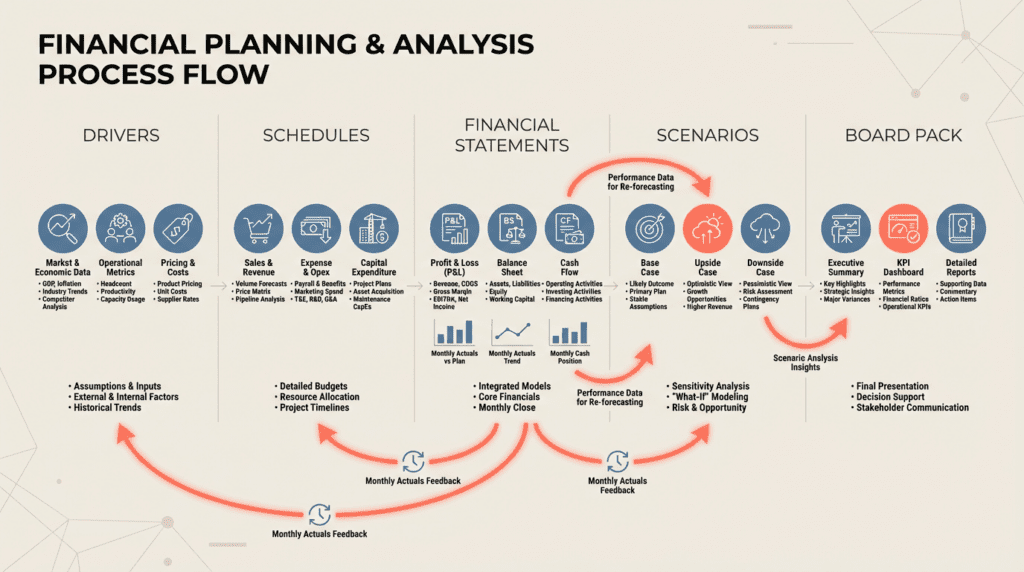
Board-ready projections require complete integration across your P&L, balance sheet, and cash flow statements. Revenue timing shifts directly impact working capital requirements. Hiring decisions affect both operating expenses and cash flow timing. Equipment purchases flow through depreciation and financing needs. Your model should include scenario toggles for base, upside, and downside cases, with clear visibility into covenant compliance and runway calculations. This integrated approach paired with comprehensive cash flow forecasting ensures your board sees the complete financial picture, not isolated metrics. Consider following an investor-ready financial model framework to maintain professional standards.
Establish Single Source Of Truth With Rolling Updates
Robust governance separates professional projections from inconsistent forecasting practices. Maintain one master model with clear version control and designated ownership. Implement a 12 to 24-month rolling horizon that updates monthly with actual results. Your board should receive consistent formatting with a 30/60/90-day update cadence that shows variance explanations and revised assumptions. This disciplined approach, similar to what we outline in our financial forecasting methodology, builds credibility and enables informed decision-making when market conditions change.
Step-By-Step Workflow To Build Board-Ready Projections
How can startups ensure accuracy and credibility in financial forecasts for board presentations? The answer lies in building a systematic workflow that connects operational reality to financial outcomes. Rather than starting with spreadsheet templates, successful companies begin with the business drivers that actually move the numbers.
Map Your Business Drivers First
Start by identifying the 7-10 metrics that directly impact your revenue, margins, operating expenses, and working capital. These might include customer acquisition cost, monthly recurring revenue per user, gross margin by product line, or sales team productivity ratios. Driver-based forecasting creates transparency and accountability. Assign clear ownership for each metric and validate your data sources. When board members ask tough questions, you’ll have specific owners and reliable data backing every assumption.
Build Integrated Financial Statements
With your drivers mapped, assemble detailed schedules for revenue, cost of goods sold, headcount planning, capital expenditures, and funding requirements. These schedules should roll seamlessly into your profit and loss statement, balance sheet, and 13-week cash flow statements. Cash flow forecasting becomes the foundation for runway visibility and covenant compliance. This integrated approach prevents the disconnected spreadsheets that often plague growing companies and confuse board discussions.
Execute An 11-Week Implementation Sprint
Break your model-building into three focused phases with experienced Fractional CFO guidance. Phase 1 involves data hygiene and driver validation over four weeks. Phase 2 covers model construction and testing over the next four weeks. Phase 3 focuses on scenario design with Base, Downside, and Upside cases, plus decision gates for capital allocation over three weeks. Scenario planning helps boards understand trade-offs and timing for strategic decisions. This structured timeline prevents endless revisions and delivers a working model that scales with your business.
From Numbers To Narrative: Tailoring Projections For Board Discussions
Raw numbers alone won’t drive board decisions. Your projections need to tell a clear story that connects financial data to strategic choices and business outcomes.
- Structure presentations with a 3-slide arc: Where We Are (current KPIs), What Changed (variance drivers), What’s Next (scenarios with runway impact)
- Present 2-3 quantified levers per scenario: Show specific outcomes for pricing changes, CAC efficiency improvements, or hiring pace adjustments
- Lead with cash runway in months: Board members need immediate visibility into funding timeline and cash burn
- Limit board packs to 10-12 pages maximum: Include executive summary, key metrics dashboard, and top 3 risks with mitigation plans
- Show choices, not predictions: Frame scenarios as strategic options with clear trade-offs rather than single-point forecasts
- Maintain monthly update rhythm: Consistent cadence builds board confidence and enables faster course corrections
According to Bessemer Venture Partners, effective board presentations combine quantitative scenarios with qualitative context that helps directors understand the business implications behind the numbers. Your financial forecasts should guide decision-making rather than simply report projections.
The goal is transforming your projections into a strategic tool that accelerates board discussions and enables faster, more informed decisions about your company’s future.
FAQs: Financial Projections For Board Meetings
Board members ask pointed questions about resource allocation, growth investments, and risk management. These answers address the most common concerns about turning financial projections into actionable board decisions that drive sustainable growth.
How do financial projections directly support board decisions on capital allocation and hiring?
Projections translate strategic choices into financial outcomes. When boards see hiring plans tied to revenue per employee metrics, or CapEx requests linked to capacity constraints, they can approve resources confidently. Harvard Business Review emphasizes connecting forecasts to resource needs for effective board governance.
How do we operationalize a 30/60/90 update rhythm effectively?
Day 30: Close the books and update actuals. Day 60: Refresh drivers and scenarios. Day 90: Present full board package with variance analysis. BVP Atlas recommends this cadence to balance accuracy with operational efficiency while keeping boards informed.
What cadence should we maintain for updating board-ready projections?
Refresh your rolling 12-month forecast each month, present scenarios quarterly, and maintain a 13-week cash flow updated weekly. Fractional CFO services help establish this rhythm without overwhelming your team.
How can we improve forecast accuracy without slowing business operations?
Focus on the 7-10 drivers that move 80% of your business—like customer acquisition cost, monthly recurring revenue, and gross margin for SaaS companies. Automate data collection where possible and track forecast variance by driver each month. Accuracy improves through consistent measurement, not complex models.
What time horizon should board projections cover?
Maintain a rolling 12-24 month outlook with quarterly detail for the first year. Include 3-5 year strategic milestones for context. This horizon supports both operational decisions and strategic planning while remaining credible and actionable for board discussions.
How should we handle significant forecast misses in board presentations?
Address variances head-on with root cause analysis and corrective actions. Present the miss, explain the driver that changed, and show your updated assumptions going forward. Boards respect transparency and decisive responses more than perfect predictions.

Conclusion: Turn Your Projections Into A Strategic Advantage
Board-ready financial projections transform raw data into business decision-making tools. When you connect operational drivers to integrated financial statements and present scenarios with clear trade-offs, you move from reactive reporting to proactive leadership. Effective board interactions require executives to deliver concise, data-driven insights that support tactical discussions and drive confident decision-making.
However, building this capability requires more than good intentions. Consistent execution with governance controls, scenario planning, and reliable cash flow forecasting positions your company for confident capital allocation and growth decisions. Success demands expertise in both financial modeling standards and board-level presentation frameworks.
Ready to build projections that drive board confidence and operational clarity? Ascent CFO Solutions can help you implement a board-ready projection process within 90 days.

Contact Us
Questions or business inquiries regarding our part-time CFO, finance and accounting services are welcome at: info@ascentcfo.com

