


Key Takeaways
- A Virtual CFO helps e-commerce brands scale profitably by implementing rolling forecasts, optimizing cash flow, and providing actionable insights into channel-level profitability.
- Integrated financial systems and predictive forecasting enable better inventory management, working capital optimization, and data-driven decision-making for sustainable growth.
- Partnering with a specialized fractional CFO provides executive-level financial expertise and technology integration at a fraction of the cost of a full-time hire, supporting confident, strategic scaling.
E-commerce brands often scale revenue faster than their financial controls can keep pace. McKinsey research shows that growth without cost discipline frequently destroys value in online retail. This creates cash flow blind spots, inventory inefficiencies, and channel profitability gaps that threaten sustainable growth.
A Virtual CFO solution bridges this gap by implementing rolling forecasts, tightening cash conversion cycles, and aligning channel-level profitability to strategy. Specialized e-commerce financial services deliver CFO-level leadership with data-driven KPI tracking without the full-time cost. We’ll explore how cash flow management, inventory forecasting, channel profitability analysis, and integrated data infrastructure transform e-commerce operations.
Ready to scale with financial discipline? Ascent CFO Solutions provides the strategic financial leadership your e-commerce brand needs to grow profitably.

Virtual CFO Services for E-commerce: From Cash Flow To Growth Strategy
When your e-commerce brand hits $10M in revenue, spreadsheet-based financial management becomes a growth bottleneck. A virtual CFO for ecommerce shows you which marketing dollars actually generate profitable sales after accounting for inventory costs and fulfillment expenses. Your fractional financial partner converts disconnected data into actionable growth decisions.
Strategic Financial Alignment Across Operations
Your financial partner analyzes the relationship between customer acquisition costs, lifetime value, and channel-specific margins. Instead of looking at revenue in isolation, they examine how marketing efficiency impacts inventory turns and working capital. This means understanding which products and channels actually drive profitable growth, not just top-line numbers. Fractional CFO services provide this strategic oversight without the full-time executive cost.
Operational Cadence Built on Predictive Forecasting
Expect a structured monthly rhythm centered on 13-week cash flow models and SKU-level contribution analysis. Your fractional CFO establishes forward-looking financial projections that connect demand planning with marketing spend and seasonal trends. According to Shopify’s cash flow guide, short-term predictive models help businesses anticipate cash needs and avoid working capital crunches during growth phases.
Systems Integration for Single Source of Truth
The right financial partner integrates your commerce platforms, fulfillment systems, and marketing tools into one comprehensive dashboard. Your fractional CFO connects Shopify or marketplace data with your ERP, 3PL systems, and advertising platforms. Shopify’s ERP integration research shows that disconnected systems create blind spots in inventory costs and margin analysis. When fulfillment data flows seamlessly into financial reporting, you gain real-time visibility into unit economics across all channels. Celigo’s integration research demonstrates how proper 3PL connectivity eliminates the manual data reconciliation that slows down financial decision-making. Your Virtual CFO builds data infrastructure that eliminates spreadsheet errors and provides accurate, timely financial insights.
Cash Flow Management And Inventory Forecasting For Online Retail
E-commerce brands often struggle with timing mismatches that tie up cash. You buy inventory upfront, spend on marketing before sales happen, and wait for customer payments to come in. A Virtual CFO helps solve these working capital challenges by implementing proven systems that predict and smooth these cash needs, turning reactive scrambling into proactive planning.
- Build a rolling 13-week cash flow model that tracks weekly money coming in and going out, connecting inventory purchases to sales patterns and marketing spend schedules. This 13-week approach provides detailed weekly reviews where teams can spot problems early before they get worse.
- Target a 46-day cash conversion cycle by measuring how long money stays tied up from buying inventory to collecting customer payments. The cash conversion cycle shows whether to focus on faster inventory turns, quicker customer collections, or extended supplier payment terms to free up working capital. Tracking the right ecommerce KPIs helps monitor these metrics consistently.
- Use demand planning with ABC inventory segmentation to right-size purchase orders by blending past sales data with upcoming promotions and supplier lead times. ABC segmentation on your highest-volume SKUs helps prioritize working capital toward fast-moving products while reducing safety stock on slower items.
- Align payment schedules strategically by negotiating supplier terms that match your inventory turn rates and adjusting marketing spend schedules to smooth monthly cash dips. For example, if you pay suppliers on the 15th, schedule major ad campaigns to start generating revenue by the 10th, creating natural cash buffers.
- Connect forecasting systems that link your cash flow planning to inventory decisions, making sure purchase choices reflect both demand signals and available liquidity. This prevents buying inventory you can’t afford to carry or missing sales because money was tied up elsewhere.
These operational improvements become the foundation for scaling confidently. When you can predict and manage working capital needs 13 weeks ahead, growth becomes a strategic choice rather than a financial stress test.
Financial Forecasting, Channel Profitability, And Data Infrastructure
Rolling forecasts improve how e-commerce brands plan for growth by connecting revenue scenarios directly to operational realities. A Virtual CFO implements monthly rolling forecasts spanning 12-18 months that link traffic projections to cost fluctuations and operational capacity. These models adjust marketing spend efficiency and fixed cost absorption as market conditions shift. This approach replaces static annual budgets with dynamic planning tools that anticipate working capital needs. Research shows that companies using driver-based forecasting can achieve 20% better forecast accuracy compared to traditional methods. The result is a cash flow forecasting system that identifies growth constraints before they impact operations.
Beyond forecasting accuracy, true profitability visibility requires measuring contribution margins at the channel and customer cohort level, not relying on blended averages that mask unprofitable channels.
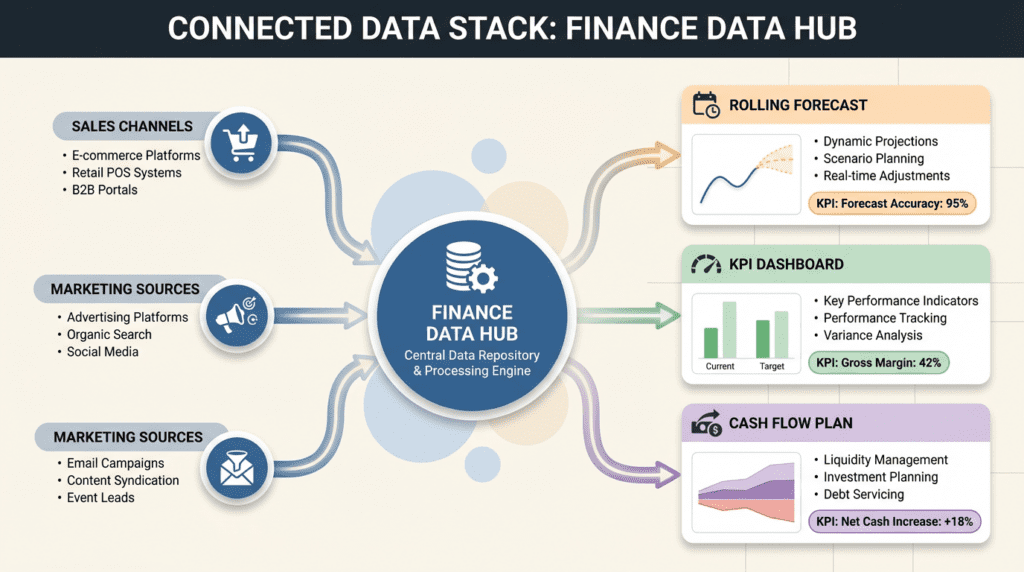
A Virtual CFO builds unit economics models that track customer acquisition costs, lifetime value, return rates, and discount impacts across Amazon, Shopify, wholesale, and other channels separately. This granular view reveals which channels actually drive profitable growth and which drain resources. The foundation for this analysis is an integrated finance data hub that connects commerce platforms, 3PL systems, ERP software, and marketing tools into a single dashboard. By eliminating spreadsheet drift and manual data reconciliation, brands gain the financial discipline needed to make faster, more accurate decisions about inventory, marketing spend, and channel strategy.
Virtual CFO FAQs For E-commerce Brands
E-commerce founders often wonder whether a Virtual CFO can address their specific financial challenges without the full-time executive cost. The questions below address the most pressing concerns around cash flow control, growth strategy, and implementation timelines that online retail businesses face.
What financial challenges do e-commerce brands face that a virtual CFO can solve?
E-commerce brands struggle with inventory cash management timing, channel profitability blind spots, and disconnected data systems. Virtual CFOs solve these by implementing rolling forecasts, margin analysis by SKU and channel, and integrated reporting. They transform scattered spreadsheets into actionable financial insights that support strategic decision-making.
Which e-commerce finance pain points does a Virtual CFO solve first?
A Virtual CFO immediately addresses cash flow visibility, SKU and channel profitability analysis, and forecasting discipline. They implement cash flow planning models that prevent stockouts and overbuying. The focus starts with working capital optimization and margin transparency across your sales channels.
How does a Virtual CFO drive strategic growth for online retail businesses?
Virtual CFOs align capital allocation with ROI data, enforce inventory buying discipline based on demand signals, and build scalable financial processes. They create KPI dashboards that connect marketing spend to lifetime value by channel. This analytics-based approach supports confident scaling decisions rather than assumption-driven growth.
What should be included in the first 90 days with a Virtual CFO?
The initial phase includes weekly cash review meetings, building a 13-week cash flow model, and cleaning up your chart of accounts. You’ll also get a comprehensive KPI dashboard and established monthly forecasting rhythm. This foundation creates the financial infrastructure needed for sustainable growth.
How does a Virtual CFO differ from hiring a full-time CFO for e-commerce?
Virtual CFOs bring specialized e-commerce experience at 60-70% cost savings compared to full-time executive salaries. They integrate your Shopify, Amazon, inventory systems, and marketing tools into unified financial insights. You get executive-level financial expertise without the overhead, plus flexibility to scale services as your business grows.
Choosing The Right Fractional CFO Partner
When evaluating Fractional CFO services for e-commerce, prioritize partners with proven experience improving cash conversion cycles and channel-level contribution margins. Look for demonstrated capability in data integration across commerce platforms, 3PLs, and marketing tools. According to McKinsey research, finance leaders now prioritize longer-term planning and technology-enabled insights.
This shift makes it even more important that your discovery conversation should assess current forecast maturity, existing KPI measurement capabilities, and the roadmap to a single source of truth. The right partner will outline specific deliverables for the first 90 days, including rolling cash flow models and channel profitability analysis. Shopify’s integration framework provides a useful benchmark for evaluating technical capabilities.
Ready to explore how strategic financial leadership can accelerate your e-commerce growth? Ascent CFO Solutions specializes in helping brands like yours build the financial infrastructure needed for sustainable scaling.

Contact Us
Questions or business inquiries regarding our part-time CFO, finance and accounting services are welcome at: info@ascentcfo.com

