


Key Takeaways
- Investors at Seed and Series A prioritize both momentum and capital efficiency—founders must present a focused set of growth, retention, efficiency, and runway metrics to demonstrate sustainable business fundamentals.
- Consistent, context-rich metric reporting and benchmarking against industry standards are essential to stand out in due diligence and prove investment readiness.
- Building integrated, investor-grade dashboards and financial models that tie KPIs to cash runway and strategic forecasts transforms data into compelling fundraising narratives and accelerates the path to funding.
Most Series A pitches fail not because of weak revenue growth, but because founders can’t prove their growth is capital efficient. Investors at Seed and Series A stages fund momentum and efficiency together. Your metric stack must demonstrate both sustainable traction and efficient spending.
The difference? The companies that raise successfully focus on a focused set of traction and unit economics metrics, measured consistently with clear context. They build investor-grade dashboards that connect growth rates, retention curves, and burn multiples to a disciplined 12-18 month capital plan.
When your fundraising data room tells this complete story, investor confidence follows. Ascent CFO Solutions helps founders build these metric frameworks that turn data into funding momentum.

The Core Metrics Investors Expect at Seed and Series A
When investors evaluate the most important financial metrics for Seed and Series A startups, they’re looking for proof of momentum and efficiency, not just growth. The difference between companies that secure funding and those that don’t often comes down to presenting a focused set of metrics that tell a compelling story about sustainable business fundamentals.
The Four Pillars of Early-Stage Metrics
Successful fundraising hinges on four metric categories: growth, retention, efficiency, and runway. Growth metrics like MRR or ARR show market demand, while retention metrics prove you’re solving a real problem customers want to keep paying for. Efficiency metrics including CAC payback and burn multiple demonstrate you can scale profitably. Runway metrics give investors confidence you’ll reach meaningful milestones before needing more capital. As outlined in investor-ready financial models, these four pillars create the foundation for compelling fundraising narratives.
Quality Over Quantity in Metric Reporting
Building on these foundational metrics, context provides the depth investors need to make confident decisions. Month-over-month growth rates reveal momentum better than absolute numbers, while cohort retention curves show whether your product creates lasting value. Pipeline coverage becomes meaningful when it reaches 3-5x your next quarter’s targets. This level of coverage demonstrates predictable revenue generation that investors can count on. Andreessen Horowitz emphasizes that segmented analysis and trend data matter more than vanity metrics that look impressive but lack substance.
Industry Benchmarks That Matter
To complete the picture, successful founders benchmark their performance against industry standards to demonstrate competitive positioning. SaaS companies should target gross margins between 70-85%, CAC payback periods under 12 months by Series A, and burn multiples below 2.0 as they approach product-market fit. Companies that track SaaS metrics systematically and present structured pitch deck financials with these benchmarks help investors quickly assess business health against portfolio standards.
Proving Product–Market Fit With Traction KPIs
Product-market fit requires measurable evidence through specific traction patterns that Series A backers recognize. The essential metrics for demonstrating traction in early-stage fundraising go beyond vanity numbers to show sustainable, repeatable momentum that validates your business model.
- Track sustained month-over-month expansion patterns spanning 3-5 consecutive months. Backers want to see consistent momentum, with 9-15% monthly increases being particularly compelling for funding readiness. Pair this with cohort retention above 80% at six months to prove your expansion isn’t just acquisition-driven but retention-powered.
- Measure activation quality through time-to-value and onboarding completion rates. When customers reach their first meaningful outcome within 28 days and over 70% complete your onboarding process, you’re demonstrating that your product delivers on its promise quickly and effectively—two strong predictors of long-term retention and expansion.
- Demonstrate revenue expansion potential with net dollar retention above 100-110%. According to SaaS Capital’s 2025 benchmarks, median net revenue retention sits at 104%, making anything above 110% a strong signal of pricing power and expand-led momentum that Series A teams love to see.
- Include monthly cohort retention summaries and reconciled KPI workbooks in your fundraising data room. Document not just what happened, but why—giving potential backers confidence in your ability to predict and manage future performance through detailed variance reporting.
- Connect traction metrics to your financial model and cash runway projections. Investor-ready models tie your KPIs directly to revenue forecasts and burn rate planning, while strategic SaaS metrics show how your product-market fit translates into sustainable unit economics and predictable scaling.
Industry-Specific Metrics for Seed and Series A Success
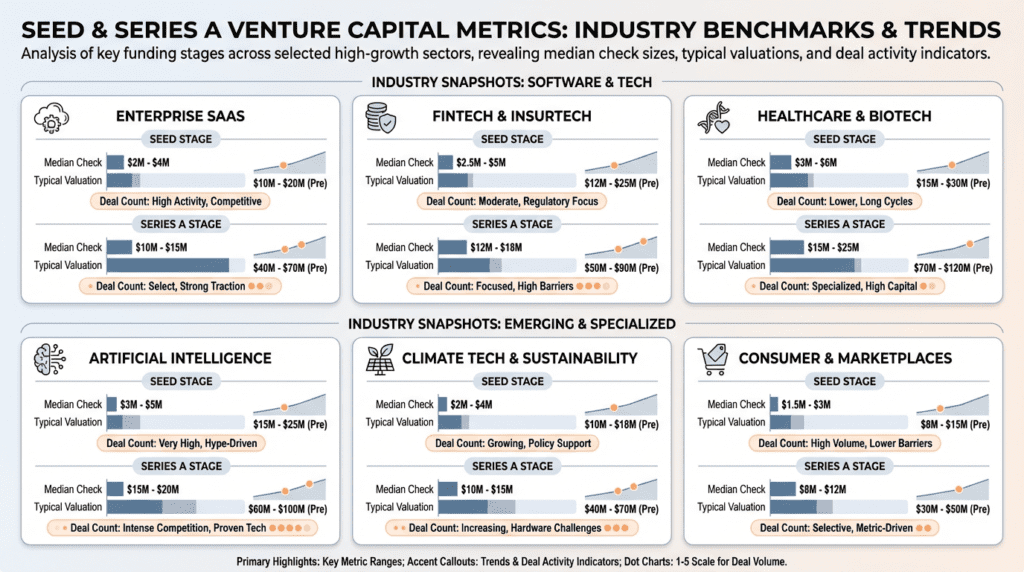
Building on the core growth, retention, and efficiency metrics that all investors expect, different industries require specific measurement methods to demonstrate true investment readiness. Each sector has unique business models and cash flow patterns that shape how investors evaluate performance and potential.
| Industry | Primary Metrics | Series A Benchmarks |
|---|---|---|
| SaaS | Monthly Recurring Revenue (MRR/ARR), Net Dollar Retention, Customer Acquisition Cost Payback | NDR 110-120%, CAC payback <12 months |
| Professional Services | Utilization Rate, Billable Hours per FTE, Gross Margin | Utilization >75%, gross margin >40% |
| Construction & Real Estate | Project Margin, Backlog Coverage, Days Sales Outstanding | DSO <45 days, backlog 6-12 months |
| Manufacturing | Inventory Turnover, Gross Margin, Order Lead Time | Inventory turns >6/year, gross margin >25% |
| Retail & Ecommerce | Gross Merchandise Value (GMV), Conversion Rate, Average Order Value | Conversion >2%, repeat purchase rate >30% |
| Healthcare | Patient Retention, Revenue per Encounter, Claims Denial Rate | Denial rate <5%, retention >80% |
| Financial Services | Assets Under Management, Net Interest Margin, Client Acquisition Cost | NIM >3%, CAC efficiency improving quarterly |
Key abbreviations: Net Dollar Retention (NDR) measures revenue expansion from existing customers, while Days Sales Outstanding (DSO) tracks how quickly you collect payments. Healthcare companies face unique challenges with revenue cycle management, making claims denial rates a critical efficiency indicator that directly impacts cash flow.
Companies that track the right industry-specific metrics alongside universal growth indicators create compelling investment narratives. Investor-ready models that combine sector-relevant KPIs with standardized financial projections demonstrate both operational sophistication and market understanding.
Seed and Series A Metrics FAQ
Founders preparing for their next funding round often have specific questions about which metrics investors prioritize and what benchmarks signal readiness. These answers provide practical guidance based on investor expectations and industry standards.
What specific KPIs do Series A investors prioritize during due diligence?
Investors focus on revenue quality (MRR/ARR growth), unit economics (CAC payback, LTV:CAC ratio), and capital efficiency (burn rate, runway). Your fundraising data room should include detailed reconciliations and cohort analyses supporting these core metrics.
What growth and retention thresholds signal readiness for Series A?
Investors typically look for 3-5 consecutive months of month-over-month growth between 9-15%, paired with customer cohort retention above 80% at six months. SaaS companies should demonstrate net dollar retention above 110% to show expansion potential beyond initial sales.
How do investors assess CAC payback and burn multiple at early stage?
CAC payback under 12 months, by Series A, demonstrates efficient customer acquisition, while a burn multiple under 2.0 shows capital efficiency as you scale. Investors evaluate these metrics quarterly to assess your path to profitability and future funding needs.
Which dashboards and BI integrations help maintain a single source of truth?
Business intelligence platforms such as Power BI integrate with your existing systems to create unified reporting dashboards. Success depends on connecting your CRM, accounting software, and operational tools into one platform that automatically updates your investor metrics and board reporting.
How long does it take to improve metrics before fundraising?
Most metric improvements require 3-6 months of consistent execution to show meaningful trends. Start building your investor-ready financial model at least six months before your target raise date to demonstrate sustained performance rather than temporary spikes. A Fractional CFO can help accelerate this timeline through strategic planning and system implementation.

From Metrics to Momentum: Implement, Forecast, and Raise With Confidence
Building investor confidence starts with the right metrics, but success comes from consistent implementation. Your core stack of growth, retention, efficiency, and runway metrics needs rolling forecasts and integrated systems that create a single source of truth. When you align these KPIs to a disciplined 12-18 month cash runway, you transform data into compelling investor narratives.
The path from metrics to momentum requires board-ready reporting that tells your growth story with clarity and context. Focus on key startup metrics that demonstrate both traction and efficiency, then build forecasting models that support strategic decision-making. When founders use financial metrics to drive strategic growth at Seed and Series A, they create the foundation for sustainable scaling and funding readiness.
Ready to build an investor-grade metric stack that accelerates your fundraising timeline? Ascent CFO Solutions can help you implement the forecasting systems and KPI frameworks that turn your growth story into fundraising success.

Contact Us
Questions or business inquiries regarding our part-time CFO, finance and accounting services are welcome at: info@ascentcfo.com

